
旧药新用:驱虫药尼氯硝唑对刚地弓形虫 RH 株的体外和体内作用。
New life for an old drug: In vitro and in vivo effects of the anthelmintic drug niclosamide against Toxoplasma gondii RH strain.
机构信息
Key Laboratory of Veterinary Pharmaceutical Development, Ministry of Agriculture, Lanzhou, Gansu Province, 730050, PR China; Lanzhou Institute of Husbandry and Pharmaceutical Sciences, Chinese Academy of Agricultural Sciences, Lanzhou, Gansu Province, 730050, PR China.
College of Pharmacy, Jinan University, Guangzhou, Guangdong Province, 510632, PR China.
出版信息
Int J Parasitol Drugs Drug Resist. 2019 Apr;9:27-34. doi: 10.1016/j.ijpddr.2018.12.004. Epub 2018 Dec 21.
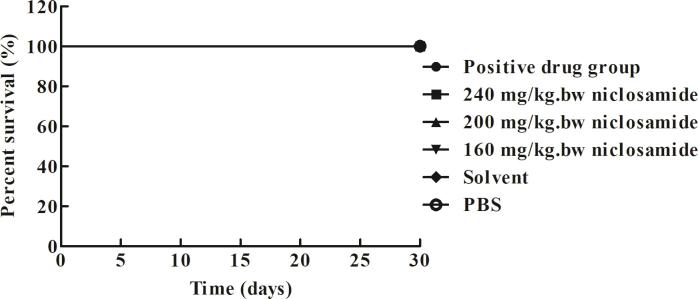
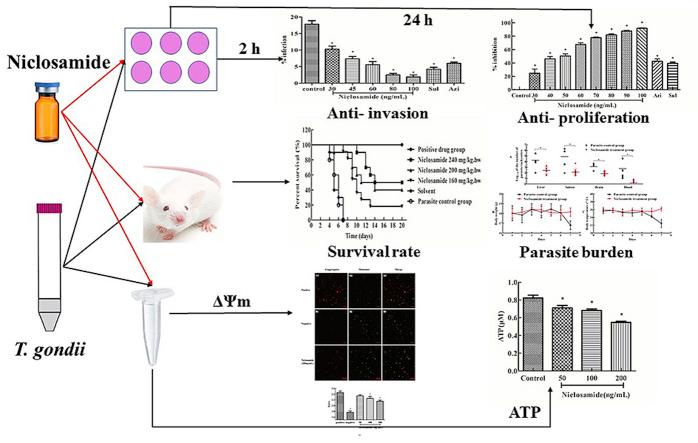
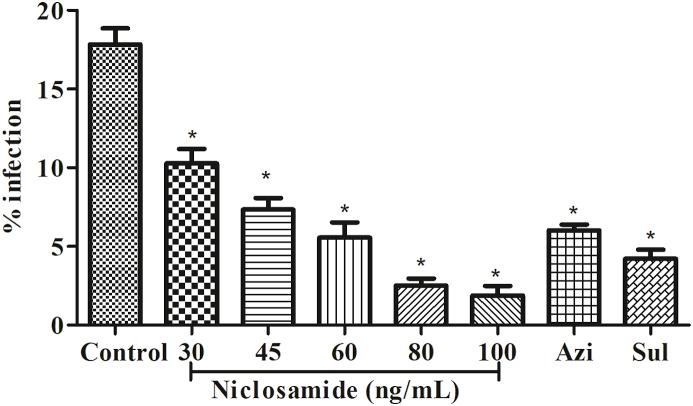
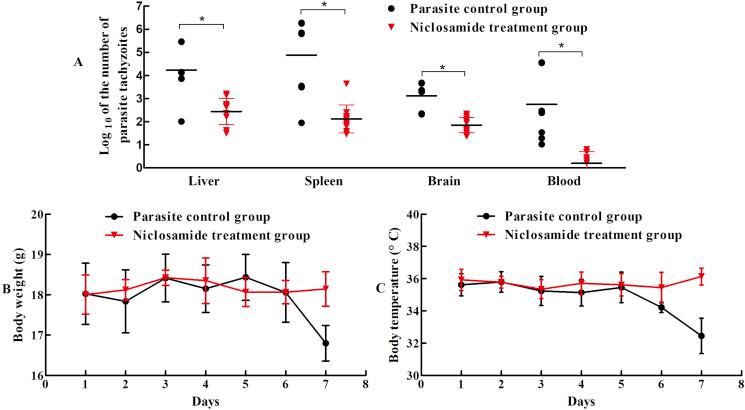
Toxoplasma gondii is the causative agent of toxoplasmosis and causes serious public health problems. However, the current treatment drugs have many limitations, such as serious side effects. Niclosamide is a salicylanilide drug commonly used to treat worm infections. Herein, the effectiveness of niclosamide for the treatment of T. gondii infection was demonstrated. This study was to evaluate the in vitro and in vivo activities of niclosamide against T. gondii and to explore its mechanism of action. The in vitro cytotoxicity of niclosamide on human foreskin fibroblast cells was evaluated by MTT test. Niclosamide displayed low host toxicity and its 50% inhibitory concentration was 8.3 μg/mL. The in vitro anti-proliferation and anti-invasion effects of niclosamide on T. gondii were determined by quantitative PCR and Giemsa staining. Niclosamide also inhibited T. gondii tachyzoite proliferation, with a 50% effective concentration of 45.3 ng/mL, and reduced the invasion of cells by tachyzoites (17.8% for the parasite control versus 1.9% for the niclosamide group treated with 100 ng/mL). A model was established by infecting BALB/c mice with the virulent RH strain of T. gondii and used to determine the in vivo effects of niclosamide on acute infection. The mice infected with tachyzoites and treated with 160, 200 or 240 mg/kg·bw niclosamide for 7 days exhibited 20%, 40% and 50% survival, respectively. In addition, niclosamide reduced the parasite burden in the blood and tissues of acutely infected mice, and niclosamide induced decreases in the mitochondrial membrane potential (ΔΨm) and adenosine triphosphate (ATP) levels in extracellular tachyzoites, as assessed by laser confocal microscopy and a multilabel reader. These findings indicated that the mechanism of action of niclosamide might be associated with T. gondii mitochondria oxidative phosphorylation. In conclusion, our results support the efficacy of niclosamide as a potential compound for the treatment of T. gondii infection.
刚地弓形虫是弓形体病的病原体,引起严重的公共卫生问题。然而,目前的治疗药物有许多局限性,如严重的副作用。氯硝柳胺是一种常用于治疗蠕虫感染的水杨酰苯胺药物。本文证明了氯硝柳胺治疗弓形虫感染的有效性。本研究旨在评估氯硝柳胺对弓形虫的体外和体内活性,并探讨其作用机制。通过 MTT 试验评估氯硝柳胺对人包皮成纤维细胞的体外细胞毒性。氯硝柳胺对宿主的毒性较低,其 50%抑制浓度为 8.3μg/mL。通过定量 PCR 和吉姆萨染色法测定氯硝柳胺对弓形虫的体外增殖和侵袭抑制作用。氯硝柳胺还抑制速殖子的增殖,其 50%有效浓度为 45.3ng/mL,并减少速殖子对细胞的侵袭(寄生虫对照组为 17.8%,100ng/mL 氯硝柳胺组为 1.9%)。通过用 RH 强毒株感染 BALB/c 小鼠建立急性感染模型,确定氯硝柳胺在体内对急性感染的作用。用 160、200 或 240mg/kg·bw 氯硝柳胺治疗感染速殖子的小鼠 7 天,分别有 20%、40%和 50%的小鼠存活。此外,氯硝柳胺降低了急性感染小鼠血液和组织中的寄生虫负荷,并用激光共聚焦显微镜和多标记阅读器评估,氯硝柳胺诱导细胞外速殖子的线粒体膜电位(ΔΨm)和三磷酸腺苷(ATP)水平降低。这些发现表明,氯硝柳胺的作用机制可能与弓形虫线粒体氧化磷酸化有关。总之,我们的结果支持氯硝柳胺作为一种治疗弓形虫感染的潜在化合物的疗效。





 Zotero 插件