
美国表皮生长因子受体(EGFR)突变阳性非小细胞肺癌患者的真实世界管理。
Real-world management of patients with epidermal growth factor receptor (EGFR) mutation-positive non-small-cell lung cancer in the USA.
机构信息
Pharma Development, F. Hoffmann-La Roche Ltd, Beijing, China.
Pharma Development, F. Hoffmann-La Roche Ltd, Basel, Switzerland.
出版信息
PLoS One. 2019 Jan 4;14(1):e0209709. doi: 10.1371/journal.pone.0209709. eCollection 2019.
BACKGROUND
Randomized phase III trials have established the efficacy of epidermal growth factor receptor (EGFR) tyrosine kinase inhibitors as first-line treatment for EGFR mutation-positive advanced non-small-cell lung cancer (EGFR Mut+ NSCLC). This retrospective cohort study examined the management patterns and outcomes of patients with EGFR Mut+ NSCLC in a real-world setting.
MATERIALS AND METHODS
Data were extracted from the US Flatiron Electronic Health Record-derived database. Adult patients with stage IIIB/IV EGFR Mut+ NSCLC (exon 19 deletion or exon 21 L858R mutation) who had received first-line systemic therapy between 2011 and 2016 were included. Demographic and clinical characteristics were analyzed. Outcomes evaluated were time to next treatment (a surrogate for progression-free survival) and overall survival.
RESULTS
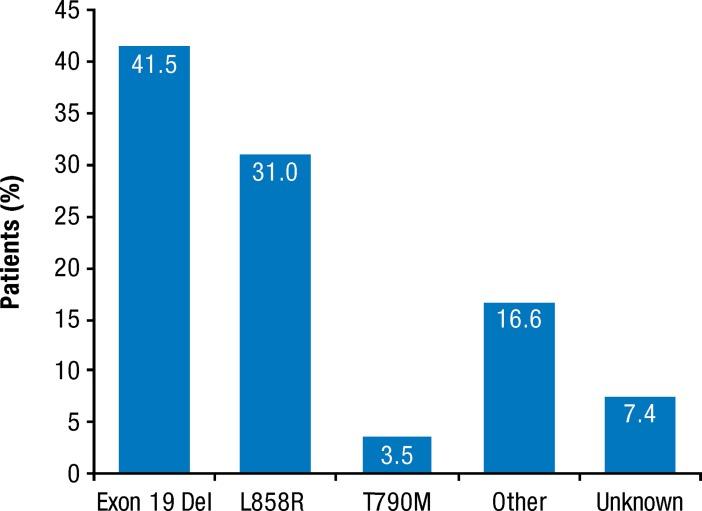
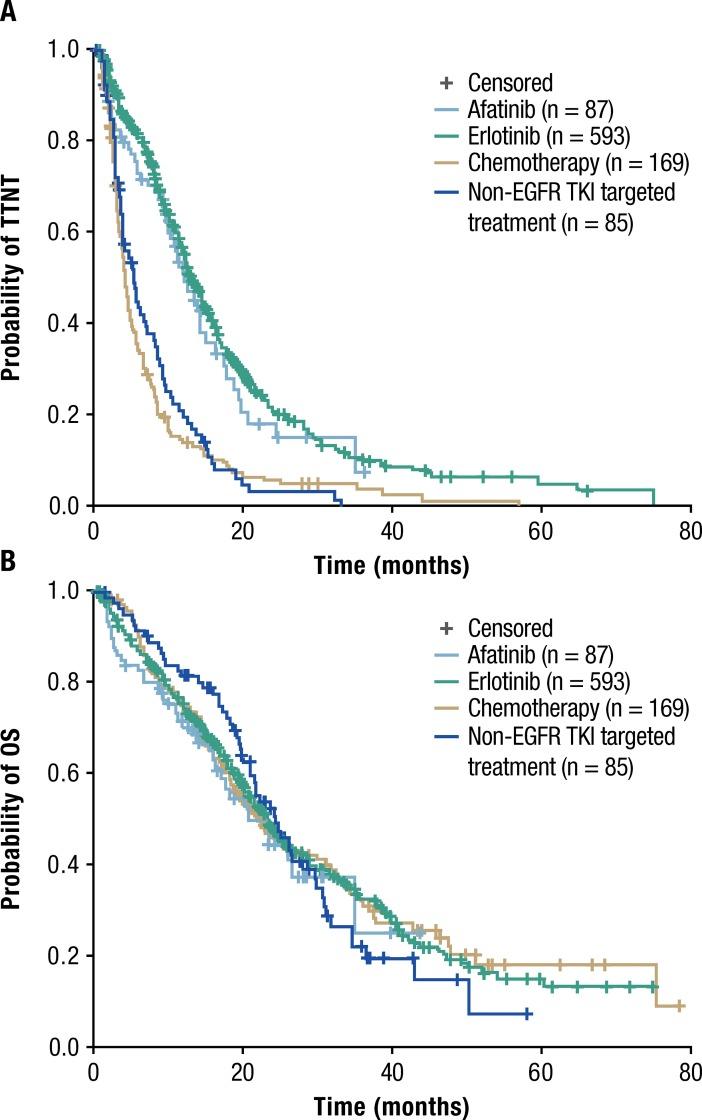
Of the 22,258 patients with advanced NSCLC in the database, 961 met the inclusion criteria. Median age was 69.0 years (range: 61-78) and the majority were female (68.0%), with stage IV (93.9%), non-squamous cell carcinoma (97.4%). EGFR tyrosine kinase inhibitors were the most widely prescribed first-line therapy (72.8%). The likelihood of receiving an EGFR tyrosine kinase inhibitor or chemotherapy was unaffected by the type of medical insurance patients had. Patients treated with an EGFR tyrosine kinase inhibitor had significantly longer time to next treatment than those given other first-line systemic therapies (p < 0.0001). There were no significant differences in overall survival according to treatment type.
CONCLUSION
Results from this large US cohort study reflect those obtained in randomized trials of patients with advanced EGFR Mut+ NSCLC and demonstrate their transferability into a real-world setting.
背景
随机 III 期临床试验已经证实表皮生长因子受体(EGFR)酪氨酸激酶抑制剂作为 EGFR 突变阳性晚期非小细胞肺癌(EGFR Mut+ NSCLC)一线治疗的疗效。本回顾性队列研究考察了 EGFR Mut+ NSCLC 患者在真实世界环境中的治疗模式和结局。
材料与方法
数据从美国 Flatiron 电子健康记录数据库中提取。纳入 2011 年至 2016 年期间接受一线系统治疗的 IIIB/IV 期 EGFR Mut+ NSCLC(外显子 19 缺失或外显子 21 L858R 突变)的成年患者。分析了人口统计学和临床特征。评估的结局包括下一次治疗时间(替代无进展生存期)和总生存期。
结果
数据库中 22258 例晚期 NSCLC 患者中,961 例符合纳入标准。中位年龄为 69.0 岁(范围:61-78),大多数为女性(68.0%),IV 期(93.9%),非鳞状细胞癌(97.4%)。EGFR 酪氨酸激酶抑制剂是最广泛应用的一线治疗药物(72.8%)。患者接受 EGFR 酪氨酸激酶抑制剂或化疗的可能性不受所拥有的医疗保险类型的影响。接受 EGFR 酪氨酸激酶抑制剂治疗的患者与接受其他一线系统治疗的患者相比,下一次治疗时间明显延长(p<0.0001)。根据治疗类型,总生存期无显著差异。
结论
这项来自美国大型队列研究的结果反映了在晚期 EGFR Mut+ NSCLC 患者的随机试验中获得的结果,并证明了它们在真实世界环境中的可转移性。


 Zotero 插件