
神经嗜性冠状病毒脑炎后通过 IFN 和 IL-10 调整细胞因子风暴。
Fine Tuning the Cytokine Storm by IFN and IL-10 Following Neurotropic Coronavirus Encephalomyelitis.
机构信息
Department of Neuroscience, Cleveland Clinic Foundation, Lerner Research Institute, Cleveland, OH, United States.
出版信息
Front Immunol. 2018 Dec 20;9:3022. doi: 10.3389/fimmu.2018.03022. eCollection 2018.
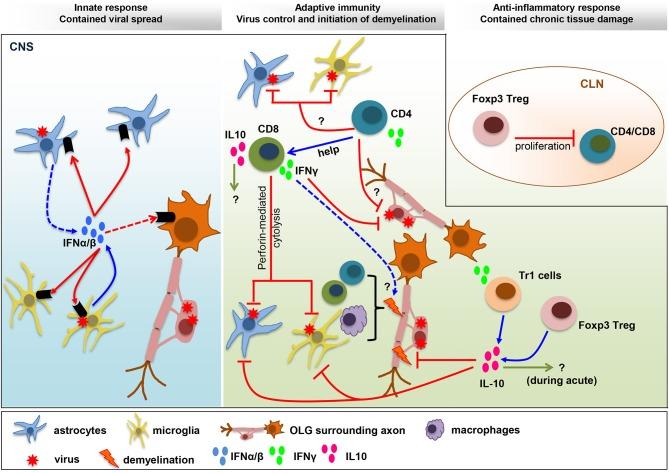
The central nervous system (CNS) is vulnerable to several viral infections including herpes viruses, arboviruses and HIV to name a few. While a rapid and effective immune response is essential to limit viral spread and mortality, this anti-viral response needs to be tightly regulated in order to limit immune mediated tissue damage. This balance between effective virus control with limited pathology is especially important due to the highly specialized functions and limited regenerative capacity of neurons, which can be targets of direct virus cytolysis or bystander damage. CNS infection with the neurotropic strain of mouse hepatitis virus (MHV) induces an acute encephalomyelitis associated with focal areas of demyelination, which is sustained during viral persistence. Both innate and adaptive immune cells work in coordination to control virus replication. While type I interferons are essential to limit virus spread associated with early mortality, perforin, and interferon-γ promote further virus clearance in astrocytes/microglia and oligodendrocytes, respectively. Effective control of virus replication is nonetheless associated with tissue damage, characterized by demyelinating lesions. Interestingly, the anti-inflammatory cytokine IL-10 limits expansion of tissue lesions during chronic infection without affecting viral persistence. Thus, effective coordination of pro- and anti-inflammatory cytokines is essential during MHV induced encephalomyelitis in order to protect the host against viral infection at a limited cost.
中枢神经系统(CNS)易受多种病毒感染,包括疱疹病毒、虫媒病毒和 HIV 等。虽然快速有效的免疫反应对于限制病毒传播和死亡率至关重要,但这种抗病毒反应需要严格调节,以限制免疫介导的组织损伤。这种有效控制病毒与有限的病理之间的平衡非常重要,因为神经元的功能高度专业化且再生能力有限,它们可能是病毒直接细胞溶解或旁观者损伤的靶标。神经嗜性鼠肝炎病毒(MHV)感染中枢神经系统会引起急性脑脊髓炎,伴有局灶性脱髓鞘,在病毒持续存在期间持续存在。先天和适应性免疫细胞协同工作以控制病毒复制。虽然 I 型干扰素对于限制与早期死亡率相关的病毒传播至关重要,但穿孔素和干扰素-γ分别在星形胶质细胞/小胶质细胞和少突胶质细胞中促进进一步的病毒清除。然而,有效的病毒复制控制与组织损伤有关,其特征是脱髓鞘病变。有趣的是,抗炎细胞因子 IL-10 在慢性感染期间限制组织病变的扩大,而不影响病毒持续存在。因此,在 MHV 诱导的脑脊髓炎中,有效地协调促炎和抗炎细胞因子对于保护宿主免受病毒感染至关重要,而不会产生过高的代价。
 Zotero 插件