
激素替代疗法的使用与静脉血栓栓塞风险:使用 QResearch 和 CPRD 数据库的巢式病例对照研究。
Use of hormone replacement therapy and risk of venous thromboembolism: nested case-control studies using the QResearch and CPRD databases.
机构信息
Division of Primary Care, University of Nottingham, Nottingham NG2 7RD, UK
Division of Primary Care, University of Nottingham, Nottingham NG2 7RD, UK.
出版信息
BMJ. 2019 Jan 9;364:k4810. doi: 10.1136/bmj.k4810.
OBJECTIVE
To assess the association between risk of venous thromboembolism and use of different types of hormone replacement therapy.
DESIGN
Two nested case-control studies.
SETTING
UK general practices contributing to the QResearch or Clinical Practice Research Datalink (CPRD) databases, and linked to hospital, mortality, and social deprivation data.
PARTICIPANTS
80 396 women aged 40-79 with a primary diagnosis of venous thromboembolism between 1998 and 2017, matched by age, general practice, and index date to 391 494 female controls.
MAIN OUTCOME MEASURES
Venous thromboembolism recorded on general practice, mortality, or hospital records. Odds ratios were adjusted for demographics, smoking status, alcohol consumption, comorbidities, recent medical events, and other prescribed drugs.
RESULTS
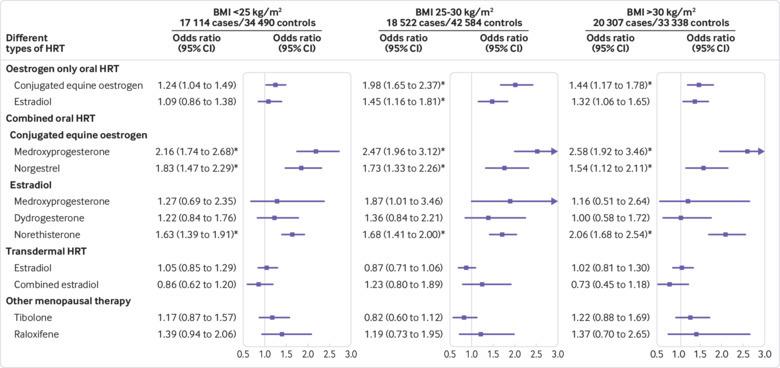
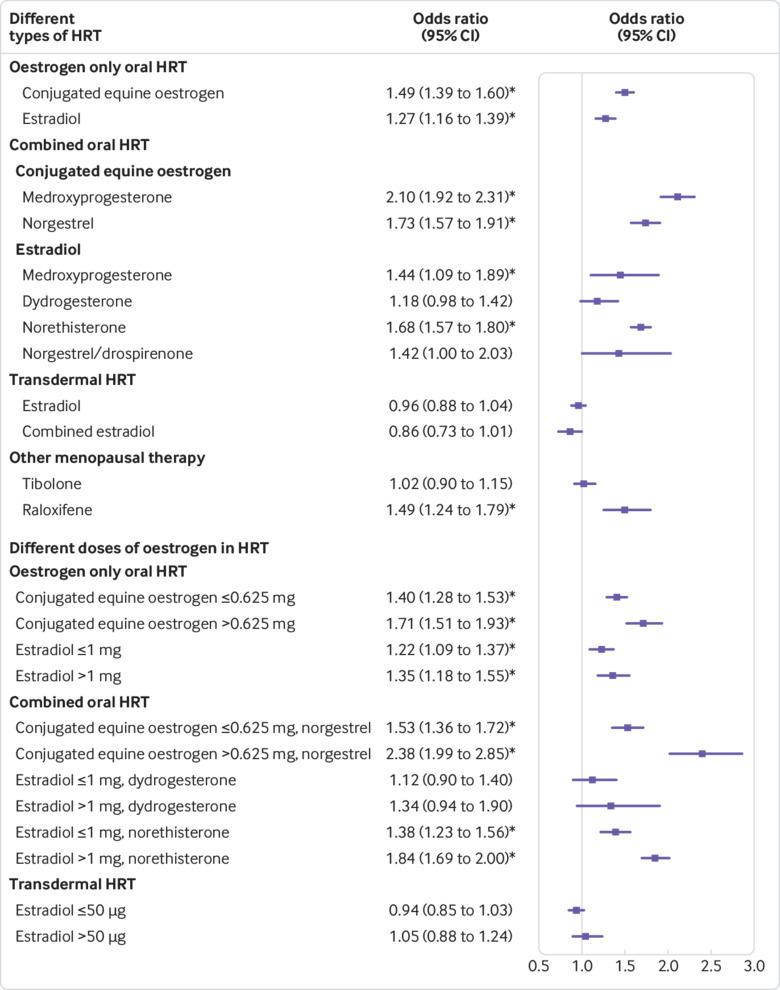
Overall, 5795 (7.2%) women who had venous thromboembolism and 21 670 (5.5%) controls had been exposed to hormone replacement therapy within 90 days before the index date. Of these two groups, 4915 (85%)and 16 938 (78%) women used oral therapy, respectively, which was associated with a significantly increased risk of venous thromboembolism compared with no exposure (adjusted odds ratio 1.58, 95% confidence interval 1.52 to 1.64), for both oestrogen only preparations (1.40, 1.32 to 1.48) and combined preparations (1.73, 1.65 to 1.81). Estradiol had a lower risk than conjugated equine oestrogen for oestrogen only preparations (0.85, 0.76 to 0.95) and combined preparations (0.83, 0.76 to 0.91). Compared with no exposure, conjugated equine oestrogen with medroxyprogesterone acetate had the highest risk (2.10, 1.92 to 2.31), and estradiol with dydrogesterone had the lowest risk (1.18, 0.98 to 1.42). Transdermal preparations were not associated with risk of venous thromboembolism, which was consistent for different regimens (overall adjusted odds ratio 0.93, 95% confidence interval 0.87 to 1.01).
CONCLUSIONS
In the present study, transdermal treatment was the safest type of hormone replacement therapy when risk of venous thromboembolism was assessed. Transdermal treatment appears to be underused, with the overwhelming preference still for oral preparations.
目的
评估静脉血栓栓塞风险与不同类型激素替代疗法使用之间的关联。
设计
两项巢式病例对照研究。
设置
参与 QResearch 或临床实践研究数据链接(CPRD)数据库的英国普通实践,并与医院、死亡率和社会贫困数据相关联。
参与者
1998 年至 2017 年间,80396 名年龄在 40-79 岁之间的女性患有静脉血栓栓塞症,按年龄、普通实践和索引日期与 391494 名女性对照组相匹配。
主要观察指标
普通实践、死亡率或住院记录中记录的静脉血栓栓塞症。比值比根据人口统计学、吸烟状况、饮酒、合并症、近期医疗事件和其他规定药物进行了调整。
结果
总体而言,5795 名(7.2%)患有静脉血栓栓塞症的女性和 21670 名(5.5%)对照组女性在索引日期前 90 天内接受了激素替代疗法。在这两组中,分别有 4915 名(85%)和 16938 名(78%)女性使用了口服治疗,与无暴露相比,这与静脉血栓栓塞症的风险显著增加相关(调整后的比值比 1.58,95%置信区间 1.52 至 1.64),对于雌激素仅制剂(1.40,1.32 至 1.48)和联合制剂(1.73,1.65 至 1.81)均如此。雌二醇与结合马雌激素相比,用于雌激素仅制剂(0.85,0.76 至 0.95)和联合制剂(0.83,0.76 至 0.91)的风险较低。与无暴露相比,结合马雌激素与甲羟孕酮具有最高的风险(2.10,1.92 至 2.31),而雌二醇与地屈孕酮的风险最低(1.18,0.98 至 1.42)。透皮制剂与静脉血栓栓塞风险无关,不同方案的结果一致(总体调整后的比值比 0.93,95%置信区间 0.87 至 1.01)。
结论
在本研究中,当评估静脉血栓栓塞风险时,透皮治疗是最安全的激素替代疗法类型。透皮治疗的使用似乎仍然不足,口服制剂仍然占据主导地位。




 Zotero 插件