
肿瘤抑制基因在各种人类癌症和非肿瘤性疾病中的重要作用。
The essential role of tumor suppressor gene in various human cancers and non-neoplastic disorders.
机构信息
Department of Ophthalmology, The Second Hospital of Jilin University, 218 Ziqiang Street, Changchun, Jilin 130041, China.
Department of Ophthalmology, The Second Hospital of Jilin University, 218 Ziqiang Street, Changchun, Jilin 130041, China
出版信息
Biosci Rep. 2019 Jan 30;39(1). doi: 10.1042/BSR20180773. Print 2019 Jan 31.
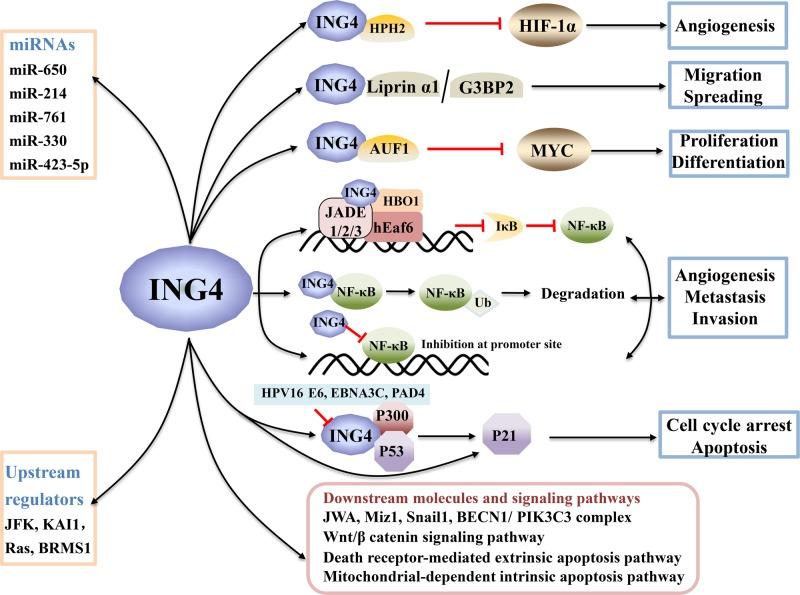
Inhibitor of growth 4 (ING4), a member of the ING family discovered in 2003, has been shown to act as a tumor suppressor and is frequently down-regulated in various human cancers. Numerous published and studies have shown that ING4 is responsible for important cancer hallmarks such as pathologic cell cycle arrest, apoptosis, autophagy, contact inhibition, and hypoxic adaptation, and also affects tumor angiogenesis, invasion, and metastasis. These characteristics are typically associated with regulation through chromatin acetylation by binding histone H3 trimethylated at lysine 4 (H3K4me3) and through transcriptional activity of transcription factor P53 and NF-κB. In addition, emerging evidence has indicated that abnormalities in ING4 expression and function play key roles in non-neoplastic disorders. Here, we provide an overview of ING4-modulated chromosome remodeling and transcriptional function, as well as the functional consequences of different genetic variants. We also present the current understanding concerning the role of ING4 in the development of neoplastic and non-neoplastic diseases. These studies offer inspiration for pursuing novel therapeutics for various cancers.
抑生长因子 4(ING4)是 2003 年发现的 ING 家族的成员之一,已被证明具有肿瘤抑制作用,并且在各种人类癌症中经常下调。大量已发表的研究表明,ING4 负责重要的癌症特征,如病理性细胞周期停滞、细胞凋亡、自噬、接触抑制和缺氧适应,并且还影响肿瘤血管生成、侵袭和转移。这些特征通常与通过与组蛋白 H3 赖氨酸 4 三甲基化(H3K4me3)结合来调节染色质乙酰化以及通过转录因子 P53 和 NF-κB 的转录活性相关联。此外,新出现的证据表明,ING4 表达和功能的异常在非肿瘤性疾病中发挥关键作用。在这里,我们提供了 ING4 调节的染色质重塑和转录功能的概述,以及不同遗传变异的功能后果。我们还介绍了目前对 ING4 在肿瘤性和非肿瘤性疾病发展中的作用的理解。这些研究为各种癌症的新型治疗方法提供了启示。
 Zotero 插件