
利用CRISPR/dCas9系统激活PTEN肿瘤抑制因子表达
Activating PTEN Tumor Suppressor Expression with the CRISPR/dCas9 System.
作者信息
Moses Colette, Nugent Fiona, Waryah Charlene Babra, Garcia-Bloj Benjamin, Harvey Alan R, Blancafort Pilar
机构信息
Cancer Epigenetics Laboratory, The Harry Perkins Institute of Medical Research, 6 Verdun Street, Nedlands, WA 6009, Australia; School of Human Sciences, Faculty of Science, The University of Western Australia, 35 Stirling Highway, Perth, WA 6009, Australia.
Cancer Epigenetics Laboratory, The Harry Perkins Institute of Medical Research, 6 Verdun Street, Nedlands, WA 6009, Australia; School of Molecular Sciences, Faculty of Science, The University of Western Australia, 35 Stirling Highway, Perth, WA 6009, Australia.
出版信息
Mol Ther Nucleic Acids. 2019 Mar 1;14:287-300. doi: 10.1016/j.omtn.2018.12.003. Epub 2018 Dec 14.
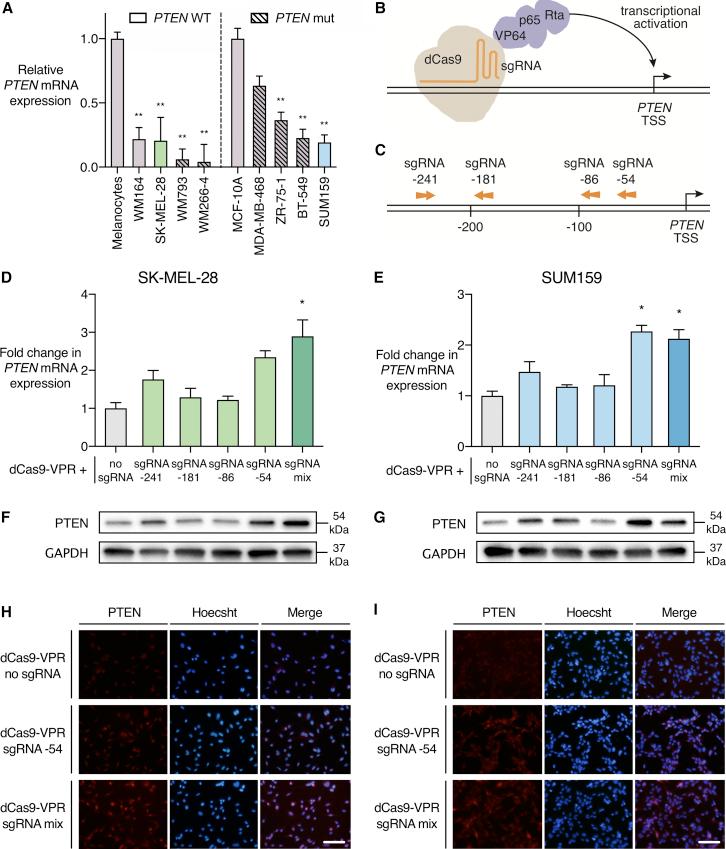
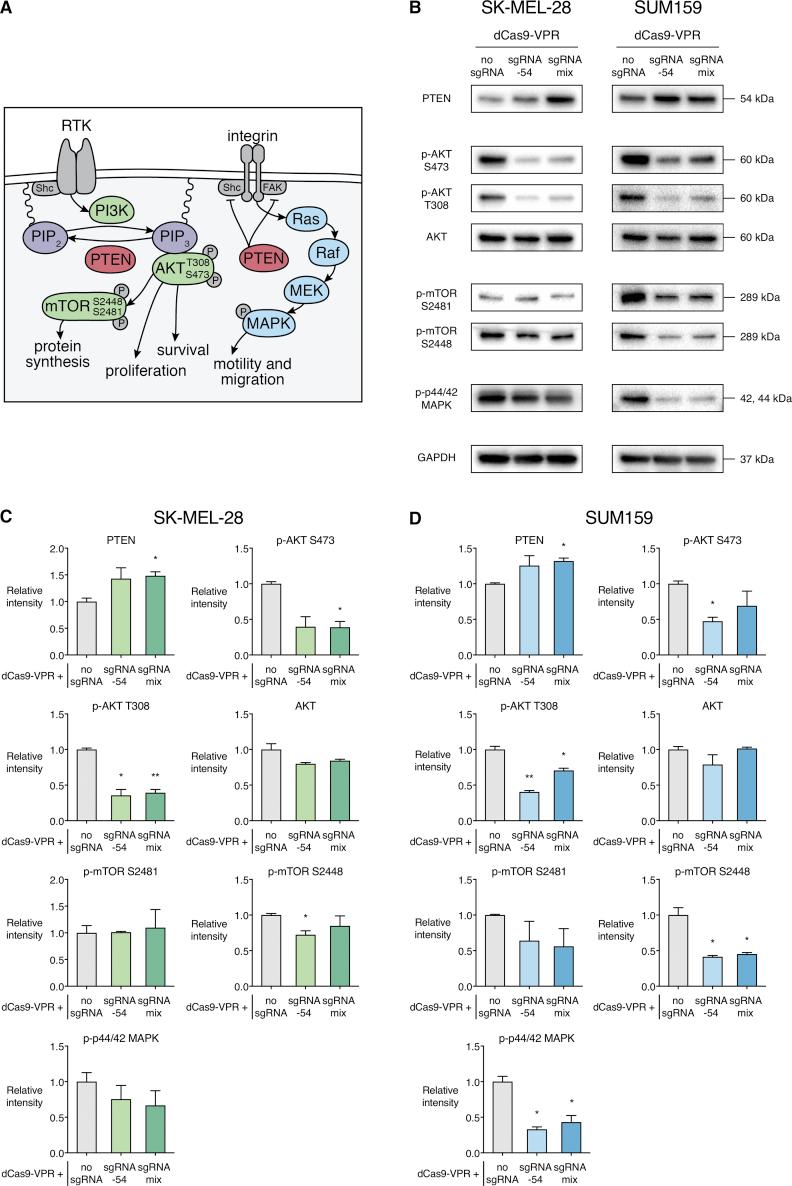
PTEN expression is lost in many cancers, and even small changes in PTEN activity affect susceptibility and prognosis in a range of highly aggressive malignancies, such as melanoma and triple-negative breast cancer (TNBC). Loss of PTEN expression occurs via multiple mechanisms, including mutation, transcriptional repression and epigenetic silencing. Transcriptional repression of PTEN contributes to resistance to inhibitors used in the clinic, such as B-Raf inhibitors in BRAF mutant melanoma. We aimed to activate PTEN expression using the CRISPR system, specifically dead (d) Cas9 fused to the transactivator VP64-p65-Rta (VPR). dCas9-VPR was directed to the PTEN proximal promoter by single-guide RNAs (sgRNAs), in cancer cells that exhibited low levels of PTEN expression. The dCas9-VPR system increased PTEN expression in melanoma and TNBC cell lines, without transcriptional regulation at predicted off-target sgRNA binding sites. PTEN activation significantly repressed downstream oncogenic pathways, including AKT, mTOR, and MAPK signaling. BRAF V600E mutant melanoma cells transduced with dCas9-VPR displayed reduced migration, as well as diminished colony formation in the presence of B-Raf inhibitors, PI3K/mTOR inhibitors, and with combined PI3K/mTOR and B-Raf inhibition. CRISPR-mediated targeted activation of PTEN may provide an alternative therapeutic approach for highly aggressive cancers that are refractory to current treatments.
PTEN表达在许多癌症中缺失,甚至PTEN活性的微小变化也会影响一系列高侵袭性恶性肿瘤(如黑色素瘤和三阴性乳腺癌(TNBC))的易感性和预后。PTEN表达缺失通过多种机制发生,包括突变、转录抑制和表观遗传沉默。PTEN的转录抑制导致对临床使用的抑制剂产生抗性,例如BRAF突变型黑色素瘤中的B-Raf抑制剂。我们旨在使用CRISPR系统激活PTEN表达,特别是与反式激活因子VP64-p65-Rta(VPR)融合的无核酸酶活性(d)Cas9。在PTEN表达水平较低的癌细胞中,通过单向导RNA(sgRNA)将dCas9-VPR靶向PTEN近端启动子。dCas9-VPR系统增加了黑色素瘤和TNBC细胞系中PTEN的表达,而在预测的脱靶sgRNA结合位点没有转录调控。PTEN激活显著抑制了下游致癌途径,包括AKT、mTOR和MAPK信号传导。用dCas9-VPR转导的BRAF V600E突变型黑色素瘤细胞在存在B-Raf抑制剂、PI3K/mTOR抑制剂以及联合PI3K/mTOR和B-Raf抑制的情况下,迁移能力降低,集落形成减少。CRISPR介导的PTEN靶向激活可能为对当前治疗难治的高侵袭性癌症提供一种替代治疗方法。


 Zotero 插件