
基因组拷贝数变异与儿童肉瘤化疗反应生物标志物的整合。
Integration of genomic copy number variations and chemotherapy-response biomarkers in pediatric sarcoma.
机构信息
Department of Biomedical Informatics, College of Medicine, Ohio State University, Columbus, OH, 43210, USA.
Herman B Wells Center for Pediatric Research, Department of Pediatrics, School of Medicine, Indiana University, Indianapolis, IN, 46202, USA.
出版信息
BMC Med Genomics. 2019 Jan 31;12(Suppl 1):23. doi: 10.1186/s12920-018-0456-5.
BACKGROUND
While most pediatric sarcomas respond to front-line therapy, some bone sarcomas do not show radiographic response like soft-tissue sarcomas (rhabdomyosarccomas) but do show 90% necrosis. Though, new therapies are urgently needed to improve survival and quality of life in pediatric patients with sarcomas. Complex chromosomal aberrations such as amplifications and deletions of DNA sequences are frequently observed in pediatric sarcomas. Evaluation of copy number variations (CNVs) associated with pediatric sarcoma patients at the time of diagnosis or following therapy offers an opportunity to assess dysregulated molecular targets and signaling pathways that may drive sarcoma development, progression, or relapse. The objective of this study was to utilize publicly available data sets to identify potential predictive biomarkers of chemotherapeutic response in pediatric Osteosarcoma (OS), Rhabdomyosarcoma (RMS) and Ewing's Sarcoma Family of Tumors (ESFTs) based on CNVs following chemotherapy (OS n = 117, RMS n = 64, ESFTs n = 25 tumor biopsies).
METHODS
There were 206 CNV profiles derived from pediatric sarcoma biopsies collected from the public databases TARGET and NCBI-Gene Expression Omnibus (GEO). Through our comparative genomic analyses of OS, RMS, and ESFTs and 22,255 healthy individuals called from the Database of Genomic Variants (DGV), we identified CNVs (amplifications and deletions) pattern of genomic instability in these pediatric sarcomas. By integrating CNVs of Cancer Cell Line Encyclopedia (CCLE) identified in the pool of genes with drug-response data from sarcoma cell lines (n = 27) from Cancer Therapeutics Response Portal (CTRP) Version 2, potential predictive biomarkers of therapeutic response were identified.
RESULTS
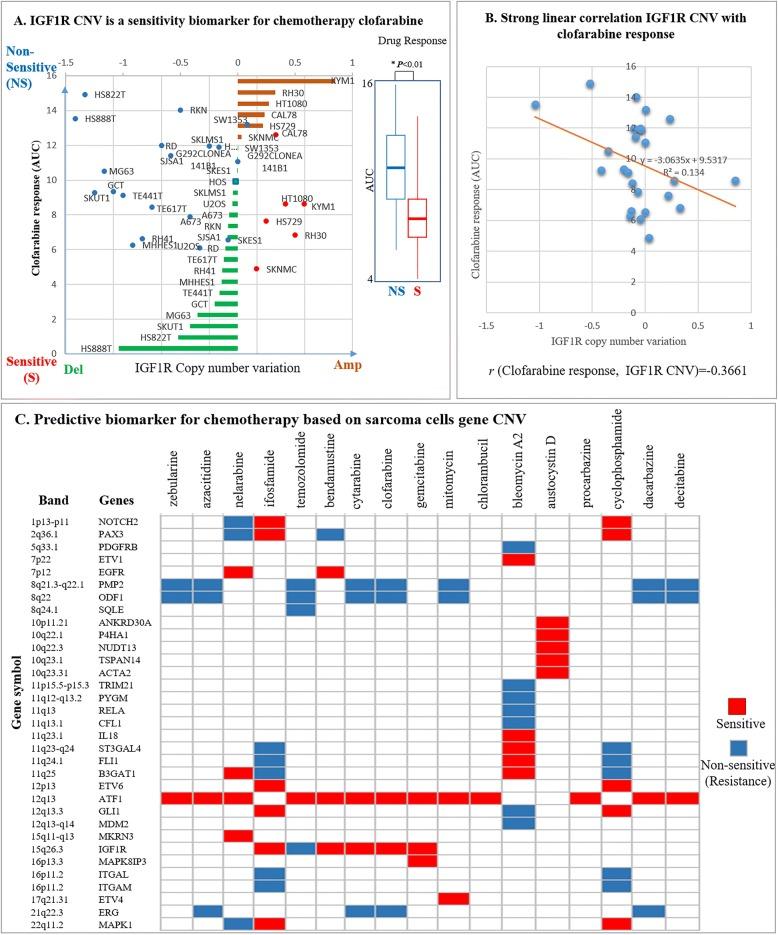
Genes associated with survival and/recurrence of these sarcomas with statistical significance were found on long arm of chromosome 8 and smaller aberrations were also identified at chromosomes 1q, 12q and x in OS, RMS, and ESFTs. A pool of 63 genes that harbored amplifications and/or deletions were frequently associated with recurrence across OS, RMS, and ESFTs. Correlation analysis of CNVs from CCLE with drug-response data of CTRP in 27 sarcoma cell lines, 33 CNVs out of 63 genes correlated with either sensitivity or resistance to 17 chemotherapies from which actionable CNV signatures such as IGF1R, MYC, MAPK1, ATF1, and MDM2 were identified. These CNV signatures could potentially be used to delineate patient populations that will respond versus those that will not respond to a particular chemotherapy.
CONCLUSIONS
The large-scale analyses of CNV-drug screening provides a platform to evaluate genetic alterations across aggressive pediatric sarcomas. Additionally, this study provides novel insights into the potential utilization of CNVs as not only prognostic but also as predictive biomarkers of therapeutic response. Information obtained in this study may help guide and prioritize patient-specific therapeutic options in pediatric bone and soft-tissue sarcomas.
背景
虽然大多数儿科肉瘤对一线治疗有反应,但有些骨肉瘤不像软组织肉瘤(横纹肌肉瘤)那样显示放射学反应,但确实显示 90%的坏死。尽管如此,仍迫切需要新的疗法来提高儿科肉瘤患者的生存率和生活质量。在儿科肉瘤中,经常观察到复杂的染色体异常,如 DNA 序列的扩增和缺失。在诊断时或治疗后评估与儿科肉瘤患者相关的拷贝数变异(CNVs),为评估可能驱动肉瘤发生、进展或复发的失调分子靶点和信号通路提供了机会。本研究的目的是利用公共数据集,根据化疗后的 CNV,鉴定骨肉瘤(OS)、横纹肌肉瘤(RMS)和尤文氏肉瘤家族肿瘤(ESFT)的潜在化疗反应预测生物标志物(OS n=117,RMS n=64,ESFTs n=25 肿瘤活检)。
方法
从公共数据库 TARGET 和 NCBI-Gene Expression Omnibus(GEO)中收集了 206 个来自儿科肉瘤活检的 CNV 图谱。通过对 OS、RMS 和 ESFT 以及来自基因组变异数据库(DGV)的 22255 个健康个体的比较基因组分析,我们鉴定了这些儿科肉瘤中基因组不稳定性的 CNV(扩增和缺失)模式。通过整合癌症细胞系百科全书(CCLE)中鉴定的 CNV,这些基因与肉瘤细胞系的药物反应数据(n=27)来自癌症治疗反应门户(CTRP)版本 2,确定了潜在的治疗反应预测生物标志物。
结果
在 OS、RMS 和 ESFT 中发现了与这些肉瘤的生存和/或复发相关的具有统计学意义的基因,在染色体 8 的长臂上也发现了较小的异常,在 OS、RMS 和 ESFT 中还发现了染色体 1q、12q 和 x 上的较小异常。在 OS、RMS 和 ESFT 中,一组含有扩增和/或缺失的 63 个基因经常与复发相关。在 27 个肉瘤细胞系中,对 CCLE 的 CNV 与 CTRP 的药物反应数据进行了相关性分析,在 63 个基因中有 33 个 CNV 与 17 种化疗药物的敏感性或耐药性相关,从中确定了 IGF1R、MYC、MAPK1、ATF1 和 MDM2 等可操作的 CNV 特征。这些 CNV 特征可潜在地用于描绘将对特定化疗有反应的患者群体与不会有反应的患者群体区分开来。
结论
对 CNV-药物筛选的大规模分析为评估侵袭性儿科肉瘤中的遗传改变提供了一个平台。此外,这项研究为 CNV 不仅作为预后标志物,而且作为治疗反应的预测生物标志物提供了新的见解。本研究获得的信息可能有助于指导和确定儿科骨和软组织肉瘤患者的特定治疗选择。


 Zotero 插件