
热休克蛋白 90 结合免疫亲和素 FKBP51 和 FKBP52 的生物学作用。
Biological Actions of the Hsp90-binding Immunophilins FKBP51 and FKBP52.
机构信息
Instituto de Biología y Medicina Experimental/CONICET, Buenos Aires 1428, Argentina.
Departamento de Química Biológica, Facultad de Ciencias Exactas y Naturales, Universidad de Buenos Aires-CONICET, Buenos Aires 1428, Argentina.
出版信息
Biomolecules. 2019 Feb 1;9(2):52. doi: 10.3390/biom9020052.
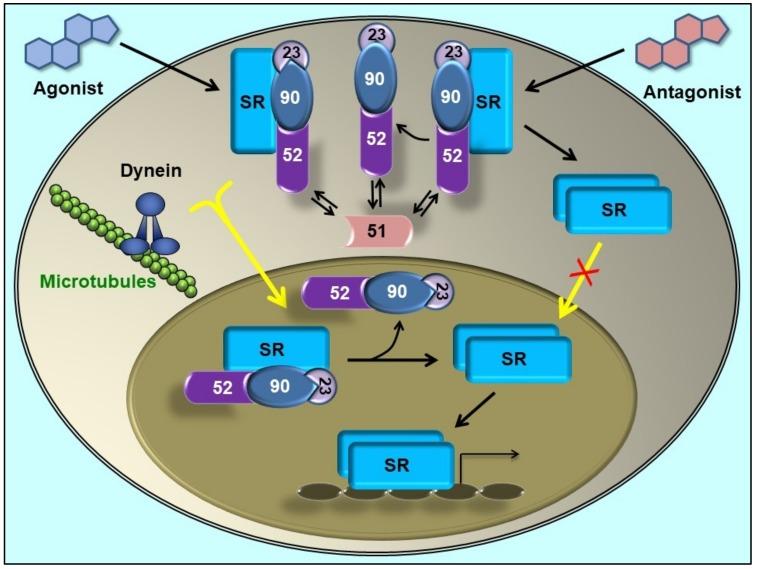
Immunophilins are a family of proteins whose signature domain is the peptidylprolyl-isomerase domain. High molecular weight immunophilins are characterized by the additional presence of tetratricopeptide-repeats (TPR) through which they bind to the 90-kDa heat-shock protein (Hsp90), and via this chaperone, immunophilins contribute to the regulation of the biological functions of several client-proteins. Among these Hsp90-binding immunophilins, there are two highly homologous members named FKBP51 and FKBP52 (FK506-binding protein of 51-kDa and 52-kDa, respectively) that were first characterized as components of the Hsp90-based heterocomplex associated to steroid receptors. Afterwards, they emerged as likely contributors to a variety of other hormone-dependent diseases, stress-related pathologies, psychiatric disorders, cancer, and other syndromes characterized by misfolded proteins. The differential biological actions of these immunophilins have been assigned to the structurally similar, but functionally divergent enzymatic domain. Nonetheless, they also require the complementary input of the TPR domain, most likely due to their dependence with the association to Hsp90 as a functional unit. FKBP51 and FKBP52 regulate a variety of biological processes such as steroid receptor action, transcriptional activity, protein conformation, protein trafficking, cell differentiation, apoptosis, cancer progression, telomerase activity, cytoskeleton architecture, etc. In this article we discuss the biology of these events and some mechanistic aspects.
免疫亲和素是一组蛋白质,其特征结构域是肽基脯氨酰顺反异构酶结构域。高分子量免疫亲和素的特征是通过四肽重复(TPR)结构域额外存在,通过该结构域与 90kDa 热休克蛋白(Hsp90)结合,并且通过这种伴侣蛋白,免疫亲和素有助于调节几个客户蛋白的生物学功能。在这些与 Hsp90 结合的免疫亲和素中,有两个高度同源的成员,分别命名为 FKBP51 和 FKBP52(FK506 结合蛋白 51kDa 和 52kDa),它们最初被表征为与甾体受体相关的 Hsp90 为基础的异源复合物的组成部分。之后,它们被认为是多种其他激素依赖性疾病、应激相关病理、精神障碍、癌症和其他以错误折叠蛋白为特征的综合征的可能贡献者。这些免疫亲和素的不同生物学作用归因于结构相似但功能不同的酶结构域。尽管如此,它们还需要 TPR 结构域的互补输入,这很可能是由于它们依赖于与 Hsp90 作为功能单位的结合。FKBP51 和 FKBP52 调节多种生物学过程,如甾体受体作用、转录活性、蛋白质构象、蛋白质运输、细胞分化、细胞凋亡、癌症进展、端粒酶活性、细胞骨架结构等。在本文中,我们讨论了这些事件的生物学和一些机制方面。

 Zotero 插件