
增加化疗剂量强度:通过更频繁的给药或序贯方案在 26 项随机试验中 37 298 例早期乳腺癌患者的个体水平荟萃分析。
Increasing the dose intensity of chemotherapy by more frequent administration or sequential scheduling: a patient-level meta-analysis of 37 298 women with early breast cancer in 26 randomised trials.
出版信息
Lancet. 2019 Apr 6;393(10179):1440-1452. doi: 10.1016/S0140-6736(18)33137-4. Epub 2019 Feb 8.
BACKGROUND
Increasing the dose intensity of cytotoxic therapy by shortening the intervals between cycles, or by giving individual drugs sequentially at full dose rather than in lower-dose concurrent treatment schedules, might enhance efficacy.
METHODS
To clarify the relative benefits and risks of dose-intense and standard-schedule chemotherapy in early breast cancer, we did an individual patient-level meta-analysis of trials comparing 2-weekly versus standard 3-weekly schedules, and of trials comparing sequential versus concurrent administration of anthracycline and taxane chemotherapy. The primary outcomes were recurrence and breast cancer mortality. Standard intention-to-treat log-rank analyses, stratified by age, nodal status, and trial, yielded dose-intense versus standard-schedule first-event rate ratios (RRs).
FINDINGS
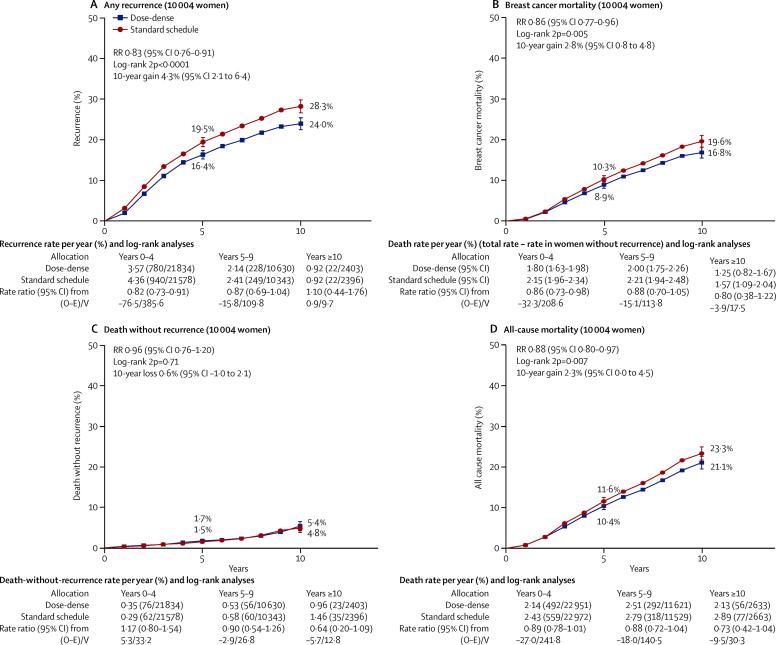
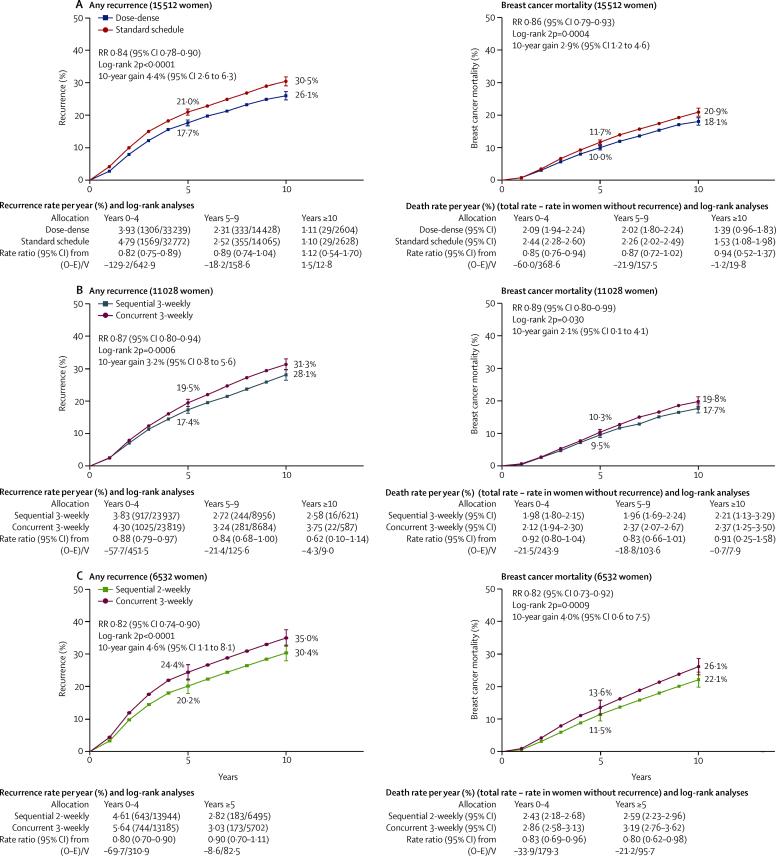
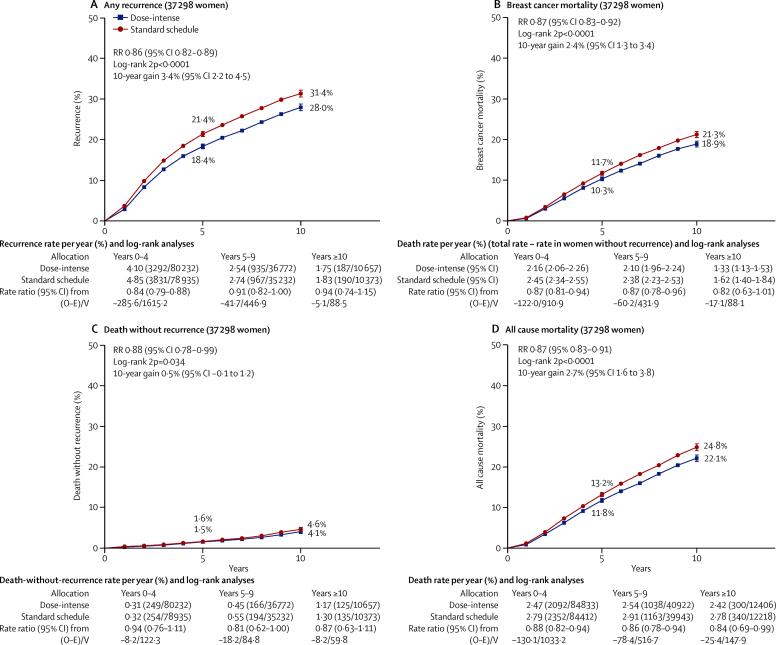
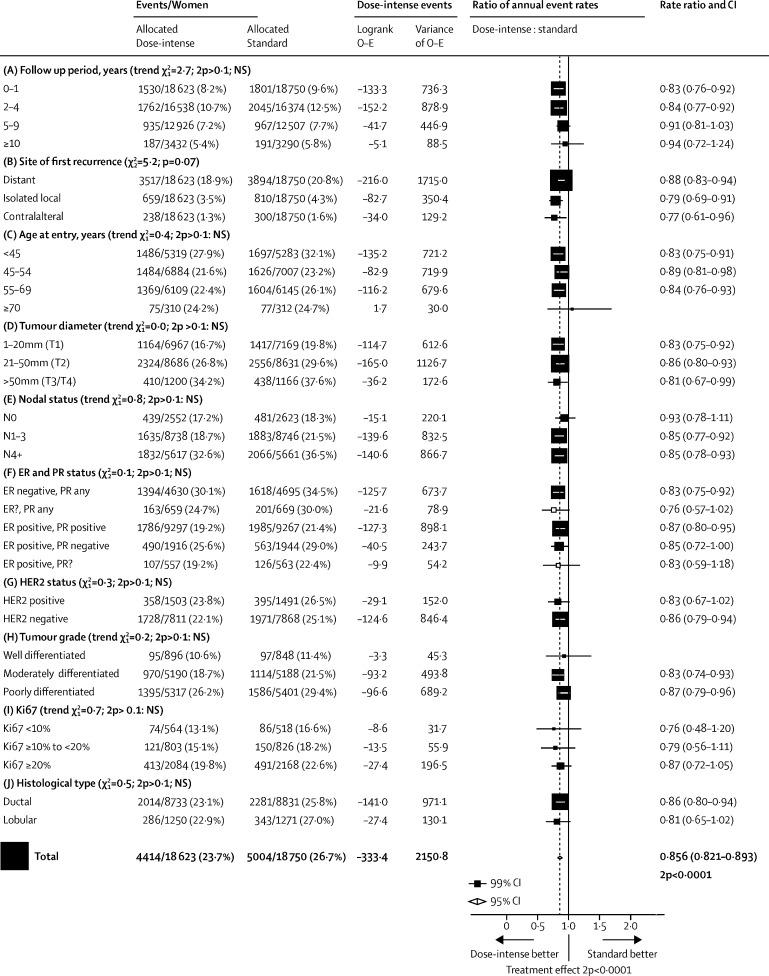
Individual patient data were provided for 26 of 33 relevant trials identified, comprising 37 298 (93%) of 40 070 women randomised. Most women were aged younger than 70 years and had node-positive disease. Total cytotoxic drug usage was broadly comparable in the two treatment arms; colony-stimulating factor was generally used in the more dose-intense arm. Combining data from all 26 trials, fewer breast cancer recurrences were seen with dose-intense than with standard-schedule chemotherapy (10-year recurrence risk 28·0% vs 31·4%; RR 0·86, 95% CI 0·82-0·89; p<0·0001). 10-year breast cancer mortality was similarly reduced (18·9% vs 21·3%; RR 0·87, 95% CI 0·83-0·92; p<0·0001), as was all-cause mortality (22·1% vs 24·8%; RR 0·87, 95% CI 0·83-0·91; p<0·0001). Death without recurrence was, if anything, lower with dose-intense than with standard-schedule chemotherapy (10-year risk 4·1% vs 4·6%; RR 0·88, 95% CI 0·78-0·99; p=0·034). Recurrence reductions were similar in the seven trials (n=10 004) that compared 2-weekly chemotherapy with the same chemotherapy given 3-weekly (10-year risk 24·0% vs 28·3%; RR 0·83, 95% CI 0·76-0·91; p<0·0001), in the six trials (n=11 028) of sequential versus concurrent anthracycline plus taxane chemotherapy (28·1% vs 31·3%; RR 0·87, 95% CI 0·80-0·94; p=0·0006), and in the six trials (n=6532) testing both shorter intervals and sequential administration (30·4% vs 35·0%; RR 0·82, 95% CI 0·74-0·90; p<0·0001). The proportional reductions in recurrence with dose-intense chemotherapy were similar and highly significant (p<0·0001) in oestrogen receptor (ER)-positive and ER-negative disease and did not differ significantly by other patient or tumour characteristics.
INTERPRETATION
Increasing the dose intensity of adjuvant chemotherapy by shortening the interval between treatment cycles, or by giving individual drugs sequentially rather than giving the same drugs concurrently, moderately reduces the 10-year risk of recurrence and death from breast cancer without increasing mortality from other causes.
FUNDING
Cancer Research UK, Medical Research Council.
背景
通过缩短周期之间的间隔或连续给予个体药物而不是同时给予低剂量的联合治疗方案来增加细胞毒性治疗的剂量强度,可能会提高疗效。
方法
为了阐明早期乳腺癌中剂量密集和标准方案化疗的相对益处和风险,我们对比较两周和标准三周方案的试验以及比较蒽环类药物和紫杉烷类药物序贯和同时给药的试验进行了个体患者水平的荟萃分析。主要结局是复发和乳腺癌死亡率。标准意向治疗对数秩分析,按年龄、淋巴结状态和试验分层,得出剂量密集与标准方案的首次事件率比(RR)。
发现
为 33 项相关试验中的 26 项提供了个体患者数据,包括 40070 名随机分配的女性中的 37298 名(93%)。大多数女性年龄小于 70 岁,患有淋巴结阳性疾病。两种治疗方案中总细胞毒性药物的使用大致相当;在剂量更密集的方案中通常使用集落刺激因子。将所有 26 项试验的数据合并,剂量密集化疗的乳腺癌复发率低于标准方案化疗(10 年复发风险 28.0%比 31.4%;RR 0.86,95%CI 0.82-0.89;p<0.0001)。10 年乳腺癌死亡率也相似降低(18.9%比 21.3%;RR 0.87,95%CI 0.83-0.92;p<0.0001),全因死亡率也是如此(22.1%比 24.8%;RR 0.87,95%CI 0.83-0.91;p<0.0001)。如果有的话,剂量密集化疗的无复发死亡率甚至更低(10 年风险 4.1%比 4.6%;RR 0.88,95%CI 0.78-0.99;p=0.034)。在比较两周和相同化疗方案每 3 周给药的 7 项试验(n=10004)中,复发减少相似(10 年风险 24.0%比 28.3%;RR 0.83,95%CI 0.76-0.91;p<0.0001),在 6 项序贯与同时给予蒽环类药物加紫杉烷类药物化疗的试验(n=11028)中,复发减少相似(28.1%比 31.3%;RR 0.87,95%CI 0.80-0.94;p=0.0006),在 6 项测试短时间间隔和序贯给药的试验(n=6532)中,复发减少相似(30.4%比 35.0%;RR 0.82,95%CI 0.74-0.90;p<0.0001)。剂量密集化疗降低复发的比例相似且非常显著(p<0.0001),在雌激素受体(ER)阳性和 ER 阴性疾病中均如此,且不受其他患者或肿瘤特征的显著影响。
解释
通过缩短治疗周期之间的间隔或连续给予个体药物而不是同时给予相同药物来增加辅助化疗的剂量强度,可适度降低乳腺癌 10 年复发和死亡风险,而不会增加其他原因导致的死亡率。
资助
英国癌症研究中心,医学研究委员会。


 Zotero 插件