
美国多发性硬化症的患病率:基于健康索赔数据的人群估计。
The prevalence of MS in the United States: A population-based estimate using health claims data.
机构信息
From the Department of Veterans Affairs Multiple Sclerosis Center of Excellence (M.T.W., W.J.C.); Georgetown University School of Medicine (M.T.W.), Washington, DC; University of Maryland (W.J.C.), Baltimore; University of Colorado (J.D.C., P.D.), Aurora; Stanford University School of Medicine (L.M.N., B.T.), CA; Southern California Permanente Medical Group (A.L.-G., L.H.C.), Pasadena; Departments of Internal Medicine and Community Health Sciences (R.A.M.), Max Rady College of Medicine, Rady Faculty of Health Sciences, University of Manitoba, Winnipeg, Canada; University of Alabama at Birmingham (G.R.C.); McKing Consulting Corp (W.E.K., L.W.), Atlanta, GA; Faculty of Medicine (Neurology) and Centre for Brain Health (H.T.), University of British Columbia, Vancouver, Canada; Brown University (S.L.B.), Providence, RI; and National Multiple Sclerosis Society (N.G.L.), New York, NY.
出版信息
Neurology. 2019 Mar 5;92(10):e1029-e1040. doi: 10.1212/WNL.0000000000007035. Epub 2019 Feb 15.
OBJECTIVE
To generate a national multiple sclerosis (MS) prevalence estimate for the United States by applying a validated algorithm to multiple administrative health claims (AHC) datasets.
METHODS
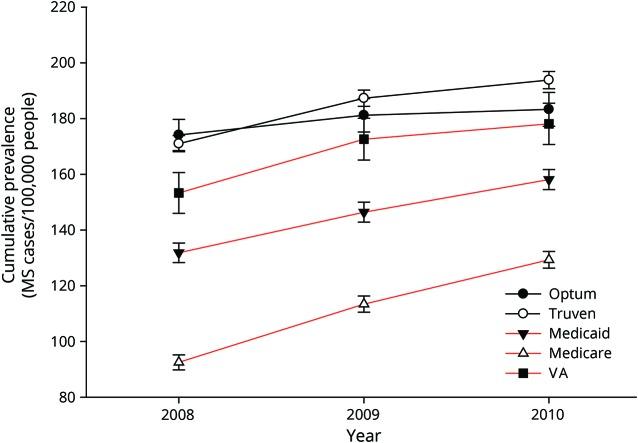
A validated algorithm was applied to private, military, and public AHC datasets to identify adult cases of MS between 2008 and 2010. In each dataset, we determined the 3-year cumulative prevalence overall and stratified by age, sex, and census region. We applied insurance-specific and stratum-specific estimates to the 2010 US Census data and pooled the findings to calculate the 2010 prevalence of MS in the United States cumulated over 3 years. We also estimated the 2010 prevalence cumulated over 10 years using 2 models and extrapolated our estimate to 2017.
RESULTS
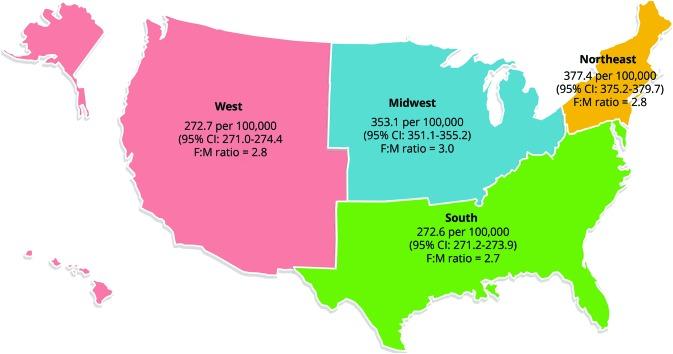
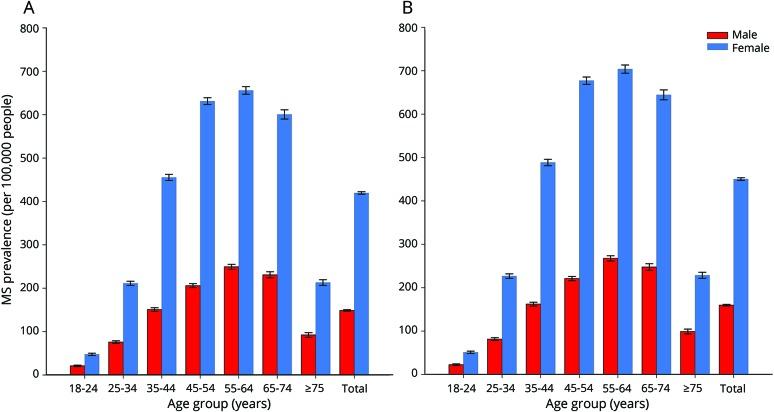
The estimated 2010 prevalence of MS in the US adult population cumulated over 10 years was 309.2 per 100,000 (95% confidence interval [CI] 308.1-310.1), representing 727,344 cases. During the same time period, the MS prevalence was 450.1 per 100,000 (95% CI 448.1-451.6) for women and 159.7 (95% CI 158.7-160.6) for men (female:male ratio 2.8). The estimated 2010 prevalence of MS was highest in the 55- to 64-year age group. A US north-south decreasing prevalence gradient was identified. The estimated MS prevalence is also presented for 2017.
CONCLUSION
The estimated US national MS prevalence for 2010 is the highest reported to date and provides evidence that the north-south gradient persists. Our rigorous algorithm-based approach to estimating prevalence is efficient and has the potential to be used for other chronic neurologic conditions.
目的
通过应用经过验证的算法,对多个行政健康索赔(AHC)数据集进行分析,生成美国多发性硬化症(MS)的全国患病率估计值。
方法
应用经过验证的算法对私人、军事和公共 AHC 数据集进行分析,以确定 2008 年至 2010 年期间成年 MS 病例。在每个数据集,我们确定了总体上的 3 年累计患病率,并按年龄、性别和人口普查区域进行分层。我们将特定保险和特定层的估计值应用于 2010 年美国人口普查数据,并将这些发现进行汇总,以计算美国 2010 年在 3 年内累积的 MS 患病率。我们还使用 2 种模型估算了 2010 年 10 年累积的患病率,并将我们的估计值外推至 2017 年。
结果
估计 2010 年美国成年人口累积 10 年的 MS 患病率为每 100,000 人 309.2 例(95%置信区间[CI] 308.1-310.1),代表 727,344 例病例。在同一时期,女性的 MS 患病率为每 100,000 人 450.1 例(95%CI 448.1-451.6),男性为 159.7 例(95%CI 158.7-160.6)(女性:男性比值 2.8)。估计的 2010 年 MS 患病率在 55-64 岁年龄组最高。确定了美国从北到南的患病率逐渐降低的梯度。还呈现了 2017 年的估计 MS 患病率。
结论
估计的 2010 年美国全国 MS 患病率是迄今为止报告的最高值,并提供了证据表明南北梯度仍然存在。我们基于算法的严格方法来估算患病率效率高,并且有可能用于其他慢性神经疾病。
 Zotero 插件