
2012/2013-2015/2016 年莫斯科因呼吸道疾病住院的孕妇流感流行病学:基于医院的主动监测研究。
Epidemiology of influenza in pregnant women hospitalized with respiratory illness in Moscow, 2012/2013-2015/2016: a hospital-based active surveillance study.
机构信息
Ministry of Health of the Russian Federation, FSBI "N.F. Gamaleya NRCEM", 16, Gamaleya str, Moscow, Russia Moscow, 123098, Russian Federation.
Fundación para el Fomento de la Investigación Sanitaria y Biomédica (FISABIO) de la Comunidad Valenciana, Avda Catalunya 21, 46020, Valencia, Spain.
出版信息
BMC Pregnancy Childbirth. 2019 Feb 15;19(1):72. doi: 10.1186/s12884-019-2192-z.
BACKGROUND
To better understand the impact of seasonal influenza in pregnant women we analyzed data collected during four seasons at a hospital for acute respiratory infection that specializes in treating pregnant women.
METHODS
This was a single-center active surveillance study of women 15-44 years of age hospitalized for acute respiratory diseases between 2012/2013 and 2015/2016 in Moscow, Russian Federation. Women had to have been hospitalized within 7 days of the onset of symptoms. Swabs were taken within 48 h of admission, and influenza was detected by reverse transcription-polymerase chain reaction.
RESULTS
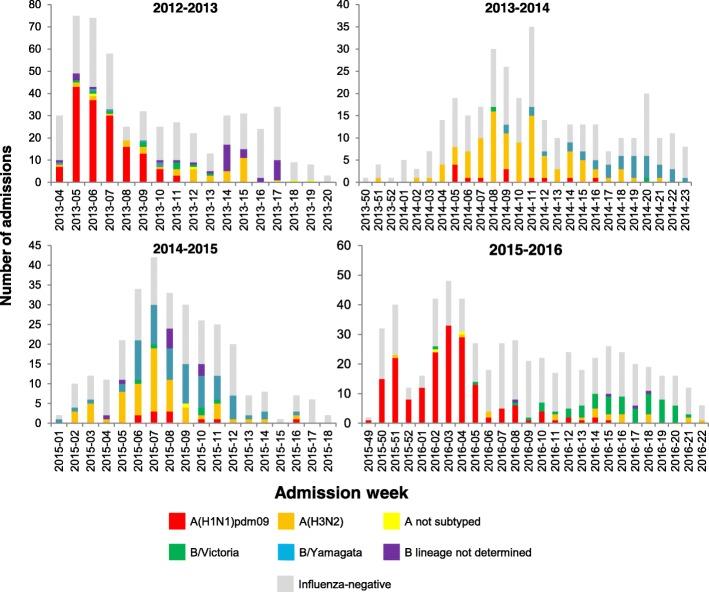
During the four seasons, of the 1992 hospitalized women 1748 were pregnant. Laboratory-confirmed influenza was detected more frequently in pregnant women (825/1748; 47.2%) than non-pregnant women (58/244; 23.8%) (OR for influenza = 2.87 [95% CI, 2.10-3.92]; p < 0.001). This pattern was homogenous across seasons (p = 0.112 by test of homogeneity of equal odds). Influenza A(H1N1)pdm09 was the dominant strain in 2012/2013, A(H3N2) in 2013/2014, B/Yamagata lineage and A(H3N2) in 2014/2015, and A(H1N1)pdm09 in 2015/2016. Influenza-positive pregnant admissions went to the hospital sooner than influenza-negative pregnant admissions (p < 0.001). The risk of influenza increased by 2% with each year of age and was higher in women with underlying conditions (OR = 1.52 [95% CI, 1.16 to 1.99]). Pregnant women positive for influenza were homogeneously distributed by trimester (p = 0.37 for homogeneity; p = 0.49 for trend). Frequencies of stillbirth, delivery, preterm delivery, and caesarean delivery did not significantly differ between influenza-positive and influenza-negative hospitalized pregnant women or between subtypes/lineages.
CONCLUSIONS
Pregnant women are at increased risk for hospitalization due to influenza irrespective of season, circulating viruses, or trimester.
背景
为了更好地了解季节性流感对孕妇的影响,我们分析了一家专门治疗孕妇的急性呼吸道感染医院在四个季节收集的数据。
方法
这是一项在俄罗斯莫斯科的一家专门治疗孕妇的急性呼吸道疾病的医院进行的 15-44 岁女性住院患者的单中心主动监测研究。患者必须在症状出现后 7 天内住院。入院后 48 小时内采集拭子,通过逆转录-聚合酶链反应检测流感。
结果
在四个季节中,1992 名住院患者中有 1748 名孕妇。与非孕妇(58/244;23.8%)相比,孕妇(825/1748;47.2%)中实验室确诊的流感更为常见(流感的 OR=2.87 [95%CI,2.10-3.92];p<0.001)。这种模式在各个季节都是一致的(通过均等优势检验,p=0.112)。2012/2013 年以 A(H1N1)pdm09 为主,2013/2014 年以 A(H3N2)为主,2014/2015 年以 B/Yamagata 谱系和 A(H3N2)为主,2015/2016 年以 A(H1N1)pdm09 为主。流感阳性孕妇的住院时间早于流感阴性孕妇(p<0.001)。年龄每增加 1 岁,患流感的风险就会增加 2%,且有基础疾病的孕妇风险更高(OR=1.52 [95%CI,1.16-1.99])。流感阳性孕妇在各孕期的分布均匀(均等性检验,p=0.37;趋势检验,p=0.49)。流感阳性和阴性住院孕妇之间或各亚型/谱系之间,死胎、分娩、早产和剖宫产的发生率无显著差异。
结论
无论季节、循环病毒或孕期如何,孕妇因流感住院的风险都增加。

 Zotero 插件