
鞭毛 cAMP 信号控制锥虫通过宿主组织的进展。
Flagellar cAMP signaling controls trypanosome progression through host tissues.
机构信息
Institute of Cell Biology, University of Bern, Baltzerstrasse 4, CH-3012, Bern, Switzerland.
Graduate School for Cellular and Biomedical Sciences, University of Bern, CH-3012, Bern, Switzerland.
出版信息
Nat Commun. 2019 Feb 18;10(1):803. doi: 10.1038/s41467-019-08696-y.
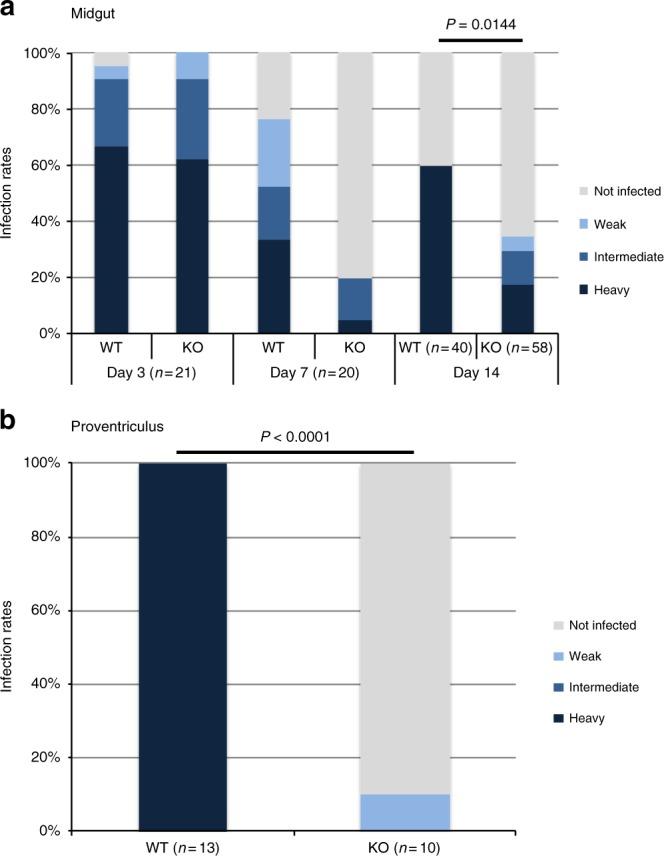
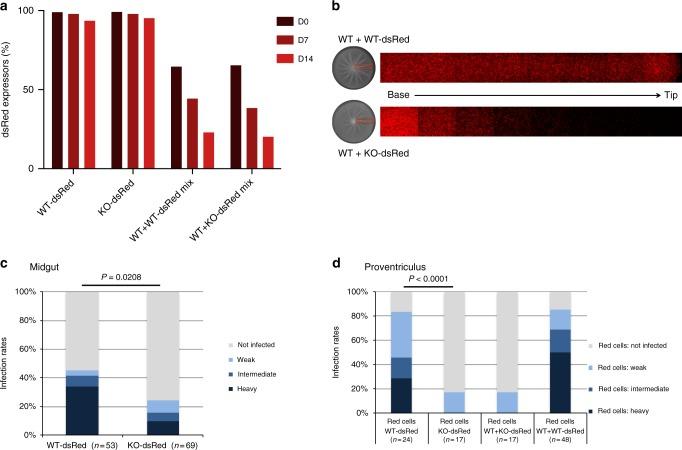
The unicellular parasite Trypanosoma brucei is transmitted between mammals by tsetse flies. Following the discovery that flagellar phosphodiesterase PDEB1 is required for trypanosomes to move in response to signals in vitro (social motility), we investigated its role in tsetse flies. Here we show that PDEB1 knockout parasites exhibit subtle changes in movement, reminiscent of bacterial chemotaxis mutants. Infecting flies with the knockout, followed by live confocal microscopy of fluorescent parasites within dual-labelled insect tissues, shows that PDEB1 is important for traversal of the peritrophic matrix, which separates the midgut lumen from the ectoperitrophic space. Without PDEB1, parasites are trapped in the lumen and cannot progress through the cycle. This demonstrates that the peritrophic matrix is a barrier that must be actively overcome and that the parasite's flagellar cAMP signaling pathway facilitates this. Migration may depend on perception of chemotactic cues, which could stem from co-infecting parasites and/or the insect host.
单细胞寄生虫布氏锥虫通过采采蝇在哺乳动物之间传播。在发现鞭毛磷酸二酯酶 PDEB1 是锥虫对外界信号做出反应(社交运动)所必需的之后,我们研究了它在采采蝇中的作用。在这里,我们表明 PDEB1 敲除寄生虫的运动有细微的变化,类似于细菌趋化性突变体。用敲除寄生虫感染苍蝇,然后用双标记昆虫组织内的荧光寄生虫进行活体共聚焦显微镜观察,表明 PDEB1 对于穿透围食膜很重要,围食膜将中肠腔与外围食膜空间分隔开来。没有 PDEB1,寄生虫就被困在肠腔中,无法通过循环。这表明围食膜是一个必须主动克服的障碍,而寄生虫的鞭毛 cAMP 信号通路促进了这一点。迁移可能依赖于对趋化性线索的感知,这些线索可能来自于共同感染的寄生虫和/或昆虫宿主。





 Zotero 插件