
F-18-氟脱氧葡萄糖正电子发射断层扫描与基因表达数据的放射基因组学分析揭示了结直肠癌格局的流行病学复杂性。
Radiogenomic Analysis of F-18-Fluorodeoxyglucose Positron Emission Tomography and Gene Expression Data Elucidates the Epidemiological Complexity of Colorectal Cancer Landscape.
作者信息
Vlachavas Efstathios-Iason, Pilalis Eleftherios, Papadodima Olga, Koczan Dirk, Willis Stefan, Klippel Sven, Cheng Caixia, Pan Leyun, Sachpekidis Christos, Pintzas Alexandros, Gregoriou Vasilis, Dimitrakopoulou-Strauss Antonia, Chatziioannou Aristotelis
机构信息
Institute of Biology, Medicinal Chemistry & Biotechnology, National Hellenic Research Foundation, Athens, Greece.
Department of Molecular Biology and Genetics, Democritus University of Thrace, 68100 Dragana, Greece.
出版信息
Comput Struct Biotechnol J. 2019 Jan 25;17:177-185. doi: 10.1016/j.csbj.2019.01.007. eCollection 2019.
PURPOSE
Transcriptomic profiling has enabled the neater genomic characterization of several cancers, among them colorectal cancer (CRC), through the derivation of genes with enhanced causal role and informative gene sets. However, the identification of small-sized gene signatures, which can serve as potential biomarkers in CRC, remains challenging, mainly due to the great genetic heterogeneity of the disease.
METHODS
We developed and exploited an analytical framework for the integrative analysis of CRC datasets, encompassing transcriptomic data and positron emission tomography (PET) measurements. Profiling data comprised two microarray datasets, pertaining biopsy specimen from 30 untreated patients with primary CRC, coupled by their F-18-Fluorodeoxyglucose (FDG) PET values, using tracer kinetic analysis measurements. The computational framework incorporates algorithms for semantic processing, multivariate analysis, data mining and dimensionality reduction.
RESULTS
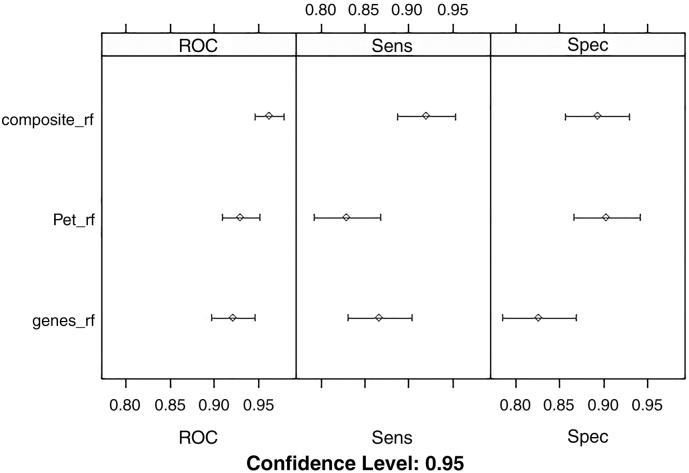
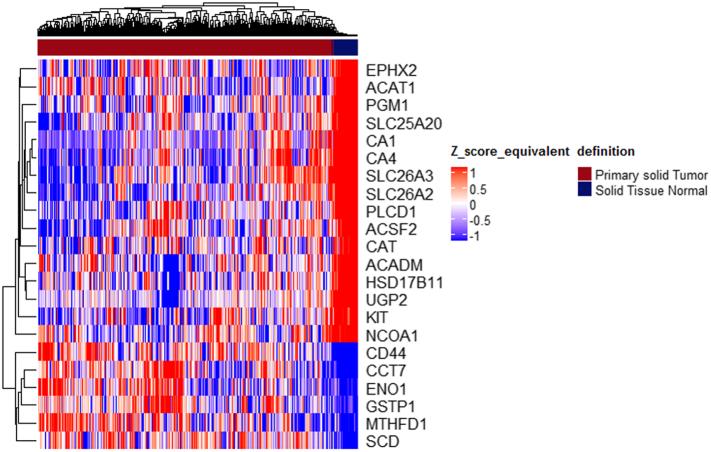
Transcriptomic and PET data feature sets, were evaluated for their discrimination performance between primary colorectal adenocarcinomas and adjacent normal mucosa. A composite signature was derived, pertaining 12 features: 7 genes and 5 PET variables. This compact signature manifests superior performance in classification accuracy, through the integration of gene expression and PET data.
CONCLUSIONS
This work represents an effort for the integrative, multilayered, signature-oriented analysis of CRC, in the context of radio-genomics, inferring a composite signature with promising results for patient stratification.
目的
转录组分析通过推导具有增强因果作用的基因和信息丰富的基因集,实现了对包括结直肠癌(CRC)在内的多种癌症更清晰的基因组特征描述。然而,识别可作为CRC潜在生物标志物的小型基因特征仍然具有挑战性,主要原因是该疾病存在巨大的基因异质性。
方法
我们开发并利用了一个用于CRC数据集综合分析的分析框架,该框架涵盖转录组数据和正电子发射断层扫描(PET)测量。分析数据包括两个微阵列数据集,这些数据集来自30名未经治疗的原发性CRC患者的活检标本,并通过示踪动力学分析测量将其与F-18-氟脱氧葡萄糖(FDG)PET值相结合。该计算框架包含语义处理、多变量分析、数据挖掘和降维算法。
结果
评估了转录组和PET数据特征集对原发性结肠腺癌和相邻正常黏膜的区分性能。得出了一个包含12个特征的复合特征:7个基因和5个PET变量。通过整合基因表达和PET数据,这个紧凑的特征在分类准确性方面表现出卓越的性能。
结论
这项工作是在放射基因组学背景下对CRC进行综合、多层、以特征为导向分析的一次尝试,推断出一个对患者分层有 promising 结果的复合特征。(注:“promising”直译为“有希望的”,在此语境下意译为“有前景的”更合适,但按要求保留原文表述)





 Zotero 插件