
用于癌症治疗中药物递送和诊疗应用的功能性仿生纳米颗粒。
Functional biomimetic nanoparticles for drug delivery and theranostic applications in cancer treatment.
作者信息
Li Lei, Wang Junqing, Kong Hangru, Zeng Yun, Liu Gang
机构信息
State Key Laboratory of Molecular Vaccinology and Molecular Diagnostics & Center for Molecular Imaging and Translational Medicine, School of Public Health, Xiamen University, Xiamen, China.
Department of Pharmacology, Xiamen Medical College, Xiamen, China.
出版信息
Sci Technol Adv Mater. 2018 Oct 26;19(1):771-790. doi: 10.1080/14686996.2018.1528850. eCollection 2018.
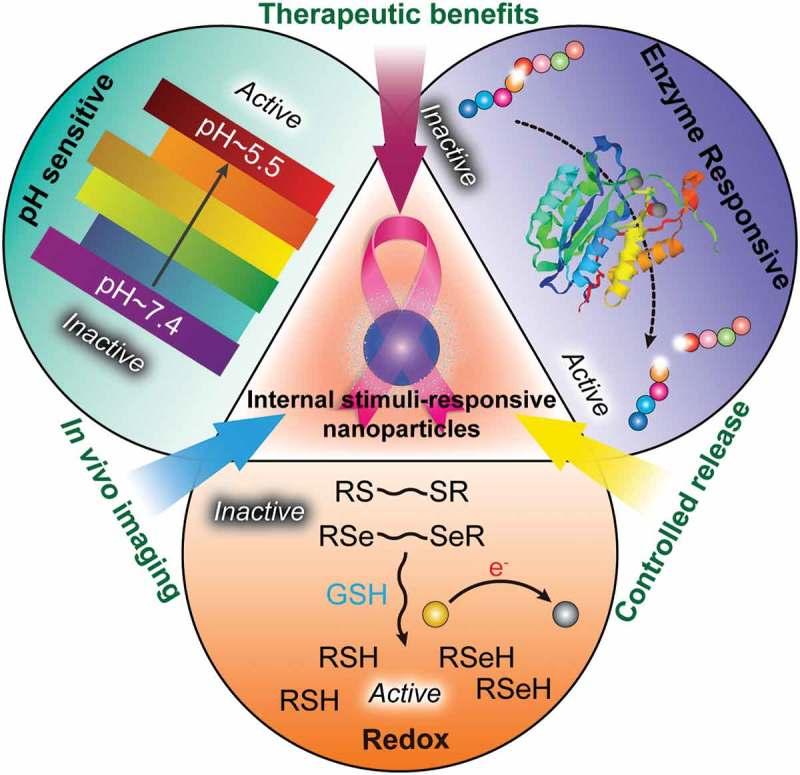
Nanotechnology has been extensively utilized in the design and development of powerful strategies for drug delivery and cancer theranostic. Nanoplatforms as a drug delivery system have many advantages such as imaging, combined drug delivery, extended circulation time, and systemic controlled release. The functional biomimetic drug delivery could be realized by incorporating stimuli-responsive (pH, temperature, redox potential, etc.) properties into the nanocarrier system, allowing them to bypass biological barriers and arrive at the targeted area. In this review, we discuss the role of internal stimuli-responsive nanocarrier system for imaging and drug delivery in cancer therapy. The development of internal stimuli-responsive nanoparticles is highlighted for precision drug delivery applications, with a particular focus on imaging, drug release performance, and therapeutic benefits.
纳米技术已被广泛应用于设计和开发强大的药物递送和癌症诊疗策略。作为药物递送系统的纳米平台具有许多优点,如成像、联合药物递送、延长循环时间和全身控释。通过将刺激响应(pH、温度、氧化还原电位等)特性纳入纳米载体系统,可以实现功能性仿生药物递送,使它们能够绕过生物屏障并到达目标区域。在本综述中,我们讨论了内部刺激响应纳米载体系统在癌症治疗中的成像和药物递送作用。重点介绍了用于精准药物递送应用的内部刺激响应纳米颗粒的开发,特别关注成像、药物释放性能和治疗效果。







 Zotero 插件