
基质辅助激光解吸电离飞行时间质谱法鉴定及快速抗真菌药敏试验
Identification and Rapid Antifungal Susceptibility Testing Against Echinocandins by MALDI-TOF MS.
机构信息
Bruker Daltonik GmbH, Bremen, Germany.
Institute for Biodiversity and Ecosystem Dynamics, University of Amsterdam, Amsterdam, Netherlands.
出版信息
Front Cell Infect Microbiol. 2019 Feb 18;9:20. doi: 10.3389/fcimb.2019.00020. eCollection 2019.
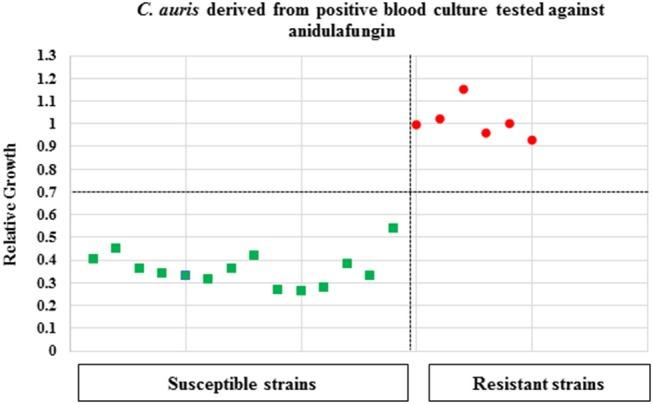
was first reported in an ear swab from Japan in 2009; it then promptly spread over five continents and turned into a global nosocomial problem. The main challenges faced by many researchers are the -identification by conventional methods in clinical laboratories and failure in treatment. About 90% of strains are intrinsically resistant to fluconazole (FLU), and it is developing resistance to multiple classes of available antifungals. Echinocandins are the most potent class of antifungals against ; however, reduced susceptibility to one or many echinocandin drugs has been recently observed. Thus, the main issues addressed in this paper are the fast and accurate identification of derived from Sabouraud dextrose agar and blood culture bottles as well as the rapid antifungal susceptibility test by MALDI-TOF MS. This study successfully identified all isolates of ( = 50) by MALDI-TOF MS, with an average log score of ≥ 2. An accuracy of 100% was found on both agar plate and blood culture bottles. MALDI Biotyper antibiotic susceptibility test-rapid assay (MBT ASTRA) was used for rapid antifungal susceptibility testing (AFST). A comparison between MBT ASTRA and the Clinical and Laboratory Standards Institute guidelines (CLSI) detected a sensitivity and specificity of 100% and 98% for anidulafungin, and 100% and 95.5% for micafungin, respectively. A categorical agreement of 98% and 96% was calculated for the two methods. For caspofungin, sensitivity and specificity of 100 and 73% were found, respectively, with a categorical agreement of 82%. MBT ASTRA has the great potential to detect isolates non-susceptible against echinocandin antifungals within 6 h, which makes it a promising candidate for AFST in clinical laboratories in the future.
该菌于 2009 年首次从日本的耳拭子中报告;随后迅速传播到五大洲,成为全球医院感染问题。许多研究人员面临的主要挑战是-临床实验室常规方法鉴定和治疗失败。大约 90%的 菌株对氟康唑(FLU)具有固有耐药性,并且对现有的多种抗真菌药物产生耐药性。棘白菌素类是抗 最有效的一类抗真菌药物;然而,最近观察到对一种或多种棘白菌素类药物的敏感性降低。因此,本文主要解决的问题是快速准确地鉴定来自沙氏琼脂和血培养瓶的 ,以及通过 MALDI-TOF MS 进行快速抗真菌药敏试验。本研究通过 MALDI-TOF MS 成功鉴定了所有 (=50)分离株,平均对数评分≥2。在琼脂平板和血培养瓶上均发现准确率为 100%。MALDI Biotyper 抗生素药敏试验-快速检测(MBT ASTRA)用于快速抗真菌药敏试验(AFST)。MBT ASTRA 与临床和实验室标准协会指南(CLSI)的比较检测到阿尼达卢芬净的敏感性和特异性分别为 100%和 98%,米卡芬净分别为 100%和 95.5%。两种方法的分类一致性分别为 98%和 96%。对于卡泊芬净,发现敏感性和特异性分别为 100%和 73%,分类一致性为 82%。MBT ASTRA 具有在 6 小时内检测对棘白菌素类抗真菌药物不敏感的 分离株的巨大潜力,这使其成为未来临床实验室 AFST 的有前途的候选者。


 Zotero 插件