
自体富血小板血浆治疗对冻融胚胎移植周期中难治性薄子宫内膜的影响:一项初步研究。
Effect of Autologous Platelet-Rich Plasma Treatment on Refractory Thin Endometrium During the Frozen Embryo Transfer Cycle: A Pilot Study.
作者信息
Kim Hounyoung, Shin Ji Eun, Koo Hwa Seon, Kwon Hwang, Choi Dong Hee, Kim Ji Hyang
机构信息
Department of Obstetrics and Gynecology, Fertility Center of CHA Bundang Medical Center, CHA University School of Medicine, Seongnam, South Korea.
出版信息
Front Endocrinol (Lausanne). 2019 Feb 14;10:61. doi: 10.3389/fendo.2019.00061. eCollection 2019.
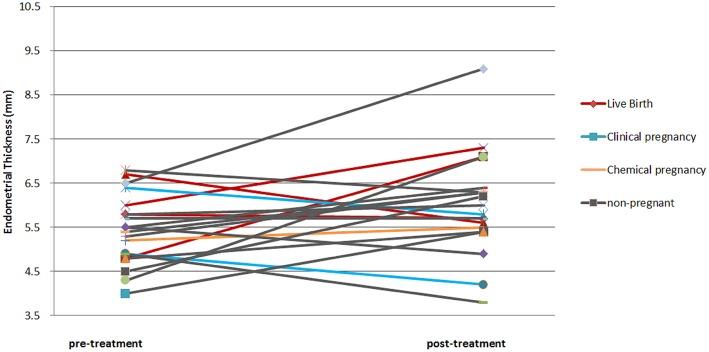
Thin or damaged endometrium remains to be an unsolved problem in the treatment of patients with infertility. The empirical preference for endometrial thickness (EMT) among clinicians is >7 mm, and the refractory thin endometrium, which doesn't respond to standard medical therapies, can be the etiology of recurrent implantation failure (RIF). Autologous platelet-rich plasma (PRP) is known to help tissue regeneration and is widely used in various fields. In the present study, we conducted PRP treatment and investigated its effect on the refractory thin endometrium. Prospective interventional study (https://cris.nih.go.kr/cris, clinical trial registration number: KCT0003375). Women who had a history of two or more failed IVF cycles and refractory thin endometrium were enrolled in this study. The main inclusion criteria were EMT of <7 mm after more than 2 cycles of previous medical therapy for increasing the EMT. Twenty-four women were enrolled in this study. The subjects were treated with intrauterine infusion of autologous PRP 2 or 3 times from menstrual cycle day 10 of their frozen-thawed embryo transfer (FET) cycle, and ET was performed 3 days after the final autologous PRP infusion. 22 patients underwent FET, and 2 patients were lost to follow up. The ongoing pregnancy rate and LBR were both 20%. The implantation and clinical pregnancy rates were 12.7 and 30%, respectively, and the difference was statistically significant. The average increase in the EMT was 0.6 mm compared with the EMT of their previous cycle. However, this difference was not statistically significant. Further, EMT of 12 patients increased (mean difference: 1.3 mm), while that of seven patients decreased (mean difference: 0.7 mm); the EMT of one patient did not change. There were no adverse effects reported by the patients who were treated with autologous PRP. The use of autologous PRP improved the implantation, pregnancy, and live birth rates (LBR) of the patients with refractory thin endometrium. We assume that the ability of autologous PRP to restore the endometrial receptivity of damaged endometrium has some aspects other than increasing the EMT. The molecular basis of the treatment needs to be revealed in future studies.
子宫内膜薄或受损仍是不孕症患者治疗中一个尚未解决的问题。临床医生对子宫内膜厚度(EMT)的经验性偏好是大于7mm,而对标准药物治疗无反应的难治性薄子宫内膜可能是反复种植失败(RIF)的病因。自体富血小板血浆(PRP)已知有助于组织再生,并广泛应用于各个领域。在本研究中,我们进行了PRP治疗,并研究了其对难治性薄子宫内膜的影响。前瞻性干预研究(https://cris.nih.go.kr/cris,临床试验注册号:KCT0003375)。有两次或更多次体外受精周期失败且子宫内膜难治性薄的女性被纳入本研究。主要纳入标准是在先前进行的两个以上增加EMT的药物治疗周期后,EMT小于7mm。本研究共纳入24名女性。受试者在冻融胚胎移植(FET)周期的月经周期第10天接受2或3次宫内输注自体PRP,并在最后一次自体PRP输注后3天进行胚胎移植。22例患者接受了FET,2例失访。持续妊娠率和活产率均为20%。着床率和临床妊娠率分别为12.7%和30%,差异有统计学意义。与前一周期的EMT相比,EMT平均增加了0.6mm。然而,这种差异无统计学意义。此外,12例患者的EMT增加(平均差异:1.3mm),7例患者的EMT减少(平均差异:0.7mm);1例患者的EMT未改变。接受自体PRP治疗的患者未报告不良反应。自体PRP的使用提高了难治性薄子宫内膜患者的着床率、妊娠率和活产率(LBR)。我们假设自体PRP恢复受损子宫内膜容受性的能力除了增加EMT外还有其他方面。该治疗的分子基础有待未来研究揭示。
 Zotero 插件