
年龄独立的生存获益:诊断时无转移的肝细胞癌(HCC)患者的基于人群研究。
Age independent survival benefit for patients with hepatocellular carcinoma (HCC) without metastases at diagnosis: a population-based study.
机构信息
Department of Medicine II, University Hospital, Ludwig-Maximilians-University (LMU), Munich, Germany.
Munich Cancer Registry, Institute for Medical Information Processing, Biometry and Epidemiology, Ludwig-Maximilians-University (LMU), Munich, Germany.
出版信息
Gut. 2020 Jan;69(1):168-176. doi: 10.1136/gutjnl-2018-318193. Epub 2019 Mar 16.
OBJECTIVE
Hepatocellular carcinoma (HCC) is a major cause of death worldwide and its incidence is expected to increase globally. Aim of this study was to assess whether the implementation of screening policies and the improvement of treatment options translated into a real-world survival benefit in HCC patients.
DESIGN
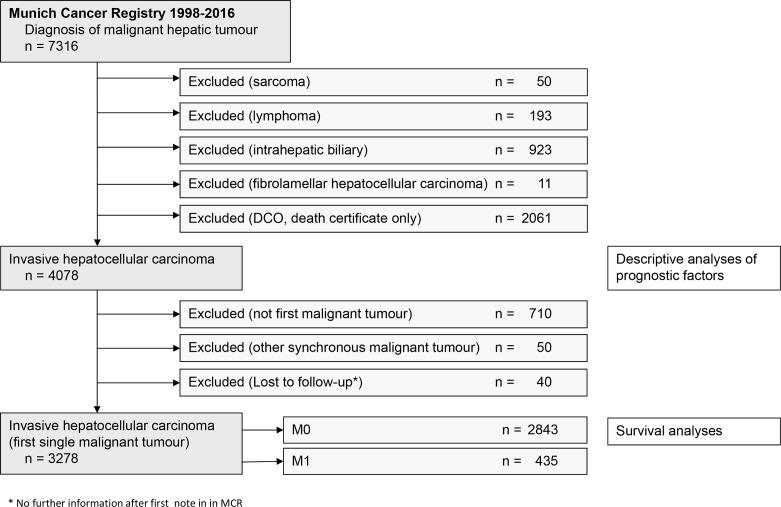
4078 patients diagnosed with HCC between 1998 and 2016 from the Munich Cancer Registry were analysed. Tumour characteristics and outcome were analysed by time period and according to age and presence of metastases at diagnosis. Overall survival (OS) was analysed using Kaplan-Meier method and relative survival (RS) was computed for cancer-specific survival. Cox proportional hazard models were conducted to control for prognostic variables.
RESULTS
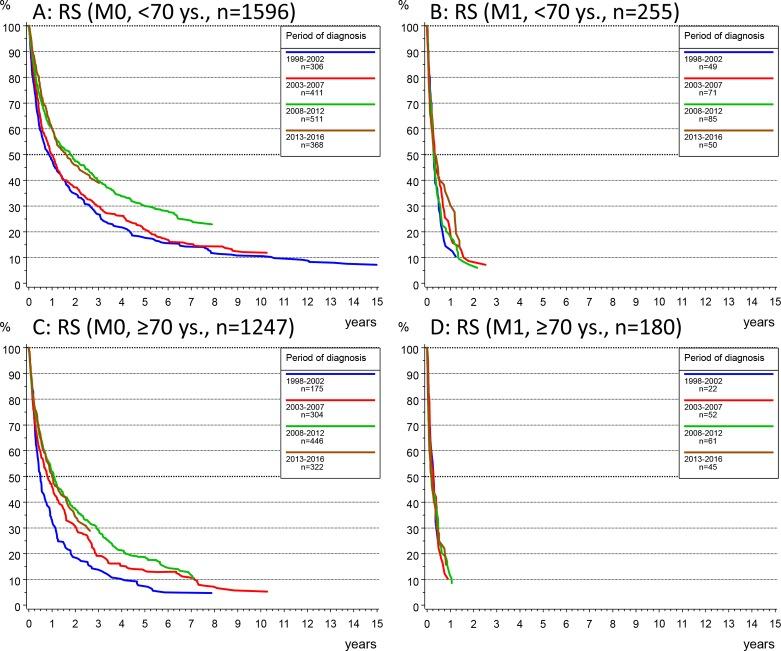
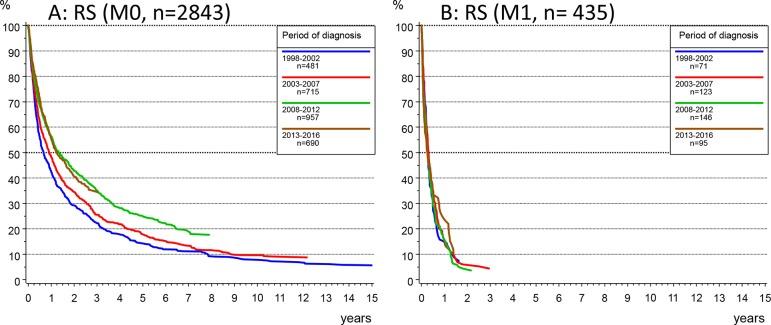
While incidence of HCC remained substantially stable, tumours were diagnosed at increasingly earlier stages, although the median age at diagnosis increased. The 3 years RS in HCC improved from 19.8% in 1998-2002, 22.4% in 2003-2007, 30.6% in 2008-2012 up to 31.0% in 2013-2016. Median OS increased from 6 months in 1998-2002 to 12 months in 2008-2016. However, analysis according to the metastatic status showed that survival improved only in patients without metastases at diagnosis whereas the prognosis of patients with metastatic disease remained unchanged.
CONCLUSION
These real-world data show that, in contrast to the current assumptions, the incidence of HCC did not increase in a representative German region. Earlier diagnosis, likely related to the implementation of screening programmes, translated into an increasing employment of effective therapeutic options and a clear survival benefit in patients without metastases at diagnosis, irrespective of age.
目的
肝细胞癌(HCC)是全球主要的死亡原因,其发病率预计在全球范围内会增加。本研究旨在评估在 HCC 患者中,筛查政策的实施和治疗选择的改善是否转化为实际的生存获益。
设计
分析了慕尼黑癌症登记处 1998 年至 2016 年间诊断为 HCC 的 4078 例患者。根据时间阶段以及诊断时的年龄和转移情况分析肿瘤特征和结果。使用 Kaplan-Meier 方法分析总生存(OS),并计算癌症特异性生存的相对生存(RS)。Cox 比例风险模型用于控制预后变量。
结果
尽管 HCC 的发病率基本保持稳定,但肿瘤的诊断分期越来越早,尽管诊断时的中位年龄增加了。1998-2002 年 HCC 的 3 年 RS 为 19.8%,2003-2007 年为 22.4%,2008-2012 年为 30.6%,2013-2016 年为 31.0%。中位 OS 从 1998-2002 年的 6 个月增加到 2008-2016 年的 12 个月。然而,根据转移状态的分析表明,仅在诊断时无转移的患者中生存得到改善,而患有转移性疾病的患者的预后保持不变。
结论
这些真实世界的数据表明,与当前的假设相反,德国一个代表性地区的 HCC 发病率并未增加。更早的诊断,可能与筛查计划的实施有关,转化为对诊断时无转移的患者更有效地治疗选择,并且在任何年龄都明确具有生存获益。

 Zotero 插件