
早期帕金森病和路易体痴呆与健康对照组纹状体 DAT 和外纹状体 SERT 结合的比较:一项 I-FP-CIT SPECT 研究。
Striatal DAT and extrastriatal SERT binding in early-stage Parkinson's disease and dementia with Lewy bodies, compared with healthy controls: An I-FP-CIT SPECT study.
机构信息
Amsterdam UMC, Vrije Universiteit Amsterdam, Neurology, Amsterdam Neuroscience, De Boelelaan 1117, Amsterdam, Netherlands; Amsterdam UMC, Univ of Amsterdam, Radiology and Nuclear Medicine, Amsterdam Neuroscience, Meibergdreef 9, Amsterdam, Netherlands; Amsterdam UMC, Vrije Universiteit Amsterdam, Anatomy and Neurosciences, Amsterdam Neuroscience, De Boelelaan 1117, Amsterdam, Netherlands.
Amsterdam UMC, Vrije Universiteit Amsterdam, Psychiatry, Amsterdam Neuroscience, De Boelelaan 1117, Amsterdam, Netherlands; Amsterdam UMC, Vrije Universiteit Amsterdam, Anatomy and Neurosciences, Amsterdam Neuroscience, De Boelelaan 1117, Amsterdam, Netherlands.
出版信息
Neuroimage Clin. 2019;22:101755. doi: 10.1016/j.nicl.2019.101755. Epub 2019 Mar 12.
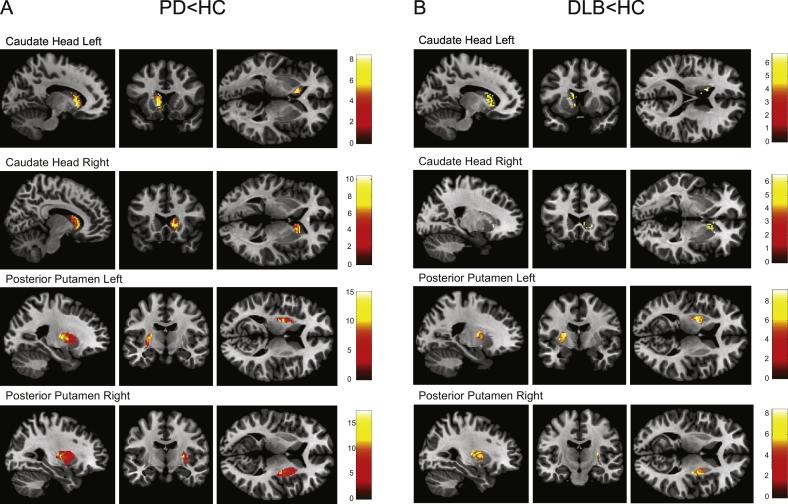
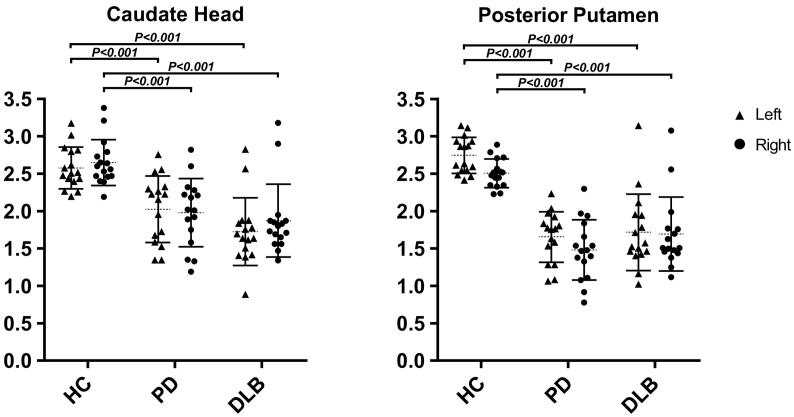
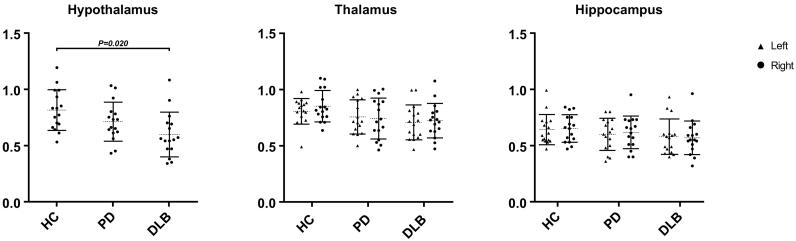
Parkinson's disease (PD) and dementia with Lewy bodies (DLB) are thought to be part of a spectrum: both have a clinical profile including symptoms associated with dopaminergic and serotonergic loss, yet few imaging studies have focused on serotonergic neurodegeneration in both disorders. We aimed to study degeneration of terminals with dopamine and serotonin transporter (DAT and SERT, respectively) in patients with early-stage PD and DLB relative to healthy controls, using I-N-ω-fluoropropyl-2β-carbomethoxy-3β-(4-iodophenyl)nortropane (I-FP-CIT) single photon emission computed tomography (SPECT). We conducted region of interest (ROI) and voxel-based analyses on I-FP-CIT SPECT scans. Using the cerebellum as a reference region, we determined binding ratios (BRs) for bilateral ROIs in the DAT-rich striatum (head of the caudate nucleus and posterior putamen) and SERT-rich extrastriatal brain regions (thalamus, hypothalamus and hippocampus). We compared BRs in PD and DLB patients with BRs in healthy controls (all groups: n = 16). Both PD and DLB patients had lower striatal I-FP-CIT BRs than healthy controls for the bilateral caudate head (PD-left: F(1,29) = 28.778, P < .001, ω = 0.35; right: F(1,29) = 35.338, P < .001, ω = 0.42; DLB-left: F(1,29) = 28.241, P < .001, ω = 0.31; right: F(1,29) = 18.811, P < .001, ω = 0.26) and bilateral posterior putamen (PD-left: F(1,29) = 107.531, P < .001, ω = 0.77; right: F(1,29) = 87.525, P < .001, ω = 0.72; DLB-left: F(1,29) = 39.910, P < .001, ω = 0.48; right: F(1,29) = 26.882, P < .001, ω = 0.38). DLB patients had lower hypothalamic I-FP-CIT BRs than healthy controls (F(1,29) = 6.059, P = .020, ω = 0.12). In the voxel-based analysis, PD and DLB patients had significantly lower striatal binding than healthy controls. Both PD patients in the early disease stages and DLB patients have reduced availability of striatal DAT, and DLB patients lower hypothalamic SERT compared with healthy controls. These observations add to the growing body of evidence that PD and DLB are not merely dopaminergic diseases, thereby providing additional clinicopathological insights.
帕金森病(PD)和路易体痴呆(DLB)被认为是一个谱系的一部分:两者都有包括与多巴胺能和 5-羟色胺能丧失相关的症状的临床特征,但很少有影像学研究集中在这两种疾病中的 5-羟色胺能神经退行性变。我们旨在使用 I-N-ω-氟丙基-2β- 碳甲氧基-3β-(4-碘苯基)去甲托烷(I-FP-CIT)单光子发射计算机断层扫描(SPECT)研究早期 PD 和 DLB 患者相对于健康对照的多巴胺和 5-羟色胺转运体(DAT 和 SERT,分别)终末的变性。我们对 I-FP-CIT SPECT 扫描进行了感兴趣区域(ROI)和体素分析。使用小脑作为参考区域,我们确定了富含 DAT 的纹状体(尾状核头部和壳核后部)和富含 SERT 的纹状体外脑区(丘脑、下丘脑和海马)双侧 ROI 的结合比(BR)。我们将 PD 和 DLB 患者的 BR 与健康对照者的 BR 进行了比较(所有组:n=16)。与健康对照组相比,PD 和 DLB 患者双侧尾状核头部的纹状体 I-FP-CIT BR 均较低(PD-左侧:F(1,29)=28.778,P<.001,ω=0.35;右侧:F(1,29)=35.338,P<.001,ω=0.42;DLB-左侧:F(1,29)=28.241,P<.001,ω=0.31;右侧:F(1,29)=18.811,P<.001,ω=0.26)和双侧壳核后部(PD-左侧:F(1,29)=107.531,P<.001,ω=0.77;右侧:F(1,29)=87.525,P<.001,ω=0.72;DLB-左侧:F(1,29)=39.910,P<.001,ω=0.48;右侧:F(1,29)=26.882,P<.001,ω=0.38)。DLB 患者的下丘脑 I-FP-CIT BR 低于健康对照组(F(1,29)=6.059,P=0.020,ω=0.12)。在体素分析中,PD 和 DLB 患者的纹状体结合明显低于健康对照组。处于疾病早期阶段的 PD 患者和 DLB 患者的纹状体 DAT 可用性降低,与健康对照组相比,DLB 患者的下丘脑 SERT 降低。这些观察结果增加了越来越多的证据表明 PD 和 DLB 不仅仅是多巴胺能疾病,从而提供了额外的临床病理见解。
 Zotero 插件