
大黄素通过 TNF-α/RIP1/RIP3 通路诱导脑胶质瘤 U251 细胞发生坏死性凋亡。
Emodin induced necroptosis in the glioma cell line U251 via the TNF-α/RIP1/RIP3 pathway.
机构信息
Graduate School, Tianjin Medical University, Tianjin, 300070, People's Republic of China.
Department of Neurosurgery, Affiliated Hospital of Jining Medical University, & Shandong Provincial Key Laboratory of Stem Cells and Neuro-oncology, Jining, Shandong, 272029, People's Republic of China.
出版信息
Invest New Drugs. 2020 Feb;38(1):50-59. doi: 10.1007/s10637-019-00764-w. Epub 2019 Mar 28.
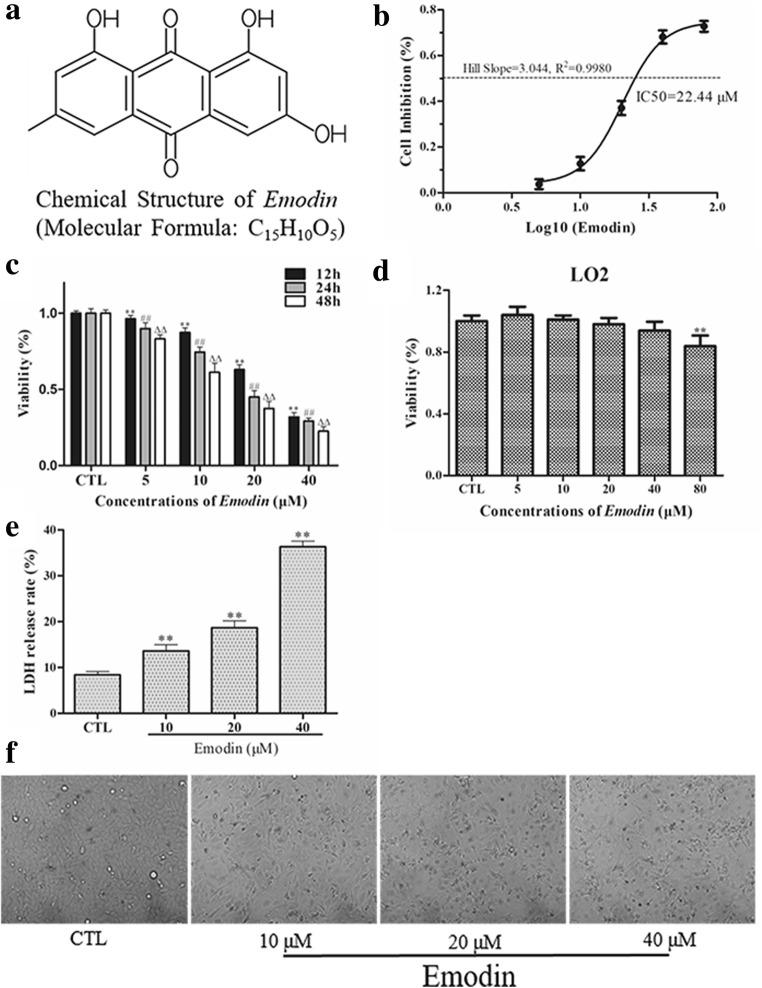
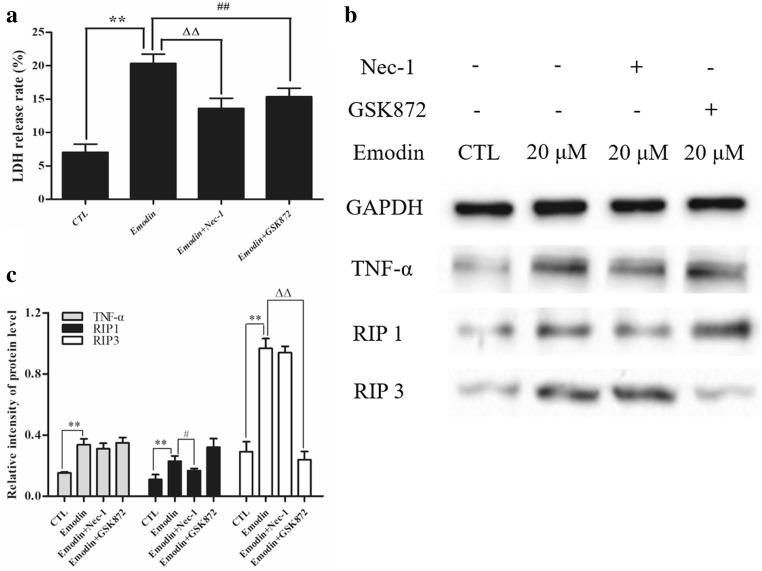
Emodin, an anthraquinone compound extracted from rhubarb and other traditional Chinese medicines, has been proven to have a wide range of pharmacological effects, such as anti-inflammatory, antiviral, and antitumor activities. Previous studies have confirmed that emodin has inhibitory effects on various solid tumors, such as osteosarcoma, liver cancer, prostate cancer and glioma. This study aimed to investigate the effects and mechanisms of emodin-induced necroptosis in the glioma cell line U251 by targeting the TNF-α/RIP1/RIP3 signaling pathway. We found that emodin could significantly inhibit U251 cell proliferation, and the viability of U251 cells treated with emodin was reduced in a dose- and time-dependent manner. Flow cytometry assays and Hoechst-PI staining assays showed that emodin induced apoptosis and necroptosis. Real-time PCR and western blot analysis showed that emodin upregulated the levels of TNF-α, RIP1, RIP3 and MLKL. Furthermore, the RIP1 inhibitor Nec-1 and the RIP3 inhibitor GSK872 attenuated the killing effect of emodin on U251 cells. In addition, emodin could increase the levels of TNF-α, RIP1, RIP3 and MLKL in vivo. The results demonstrate that emodin could induce necroptosis in glioma possibly through the activation of the TNF-α/RIP1/RIP3 axis. These studies provide novel insight into the induction of necroptosis by emodin and indicate that emodin might be a potential candidate for treating glioma through the necroptosis pathway.
大黄素是从大黄和其他中药中提取的一种蒽醌类化合物,已被证明具有广泛的药理作用,如抗炎、抗病毒和抗肿瘤活性。先前的研究已经证实,大黄素对多种实体瘤,如骨肉瘤、肝癌、前列腺癌和神经胶质瘤具有抑制作用。本研究旨在通过靶向 TNF-α/RIP1/RIP3 信号通路,探讨大黄素诱导神经胶质瘤细胞系 U251 发生坏死性凋亡的作用及其机制。我们发现大黄素能显著抑制 U251 细胞的增殖,大黄素处理的 U251 细胞的活力呈剂量和时间依赖性降低。流式细胞术和 Hoechst-PI 染色实验表明,大黄素诱导细胞发生凋亡和坏死性凋亡。实时 PCR 和 Western blot 分析显示,大黄素上调了 TNF-α、RIP1、RIP3 和 MLKL 的水平。此外,RIP1 抑制剂 Nec-1 和 RIP3 抑制剂 GSK872 减弱了大黄素对 U251 细胞的杀伤作用。此外,大黄素能在体内增加 TNF-α、RIP1、RIP3 和 MLKL 的水平。结果表明,大黄素可能通过激活 TNF-α/RIP1/RIP3 轴诱导神经胶质瘤发生坏死性凋亡。这些研究为大黄素诱导坏死性凋亡提供了新的见解,并表明大黄素可能通过坏死性凋亡途径成为治疗神经胶质瘤的潜在候选药物。



 Zotero 插件