
与退伍军人健康管理局中持续较差的糖尿病控制相关的临床因素:一项全国性队列研究。
Clinical factors associated with persistently poor diabetes control in the Veterans Health Administration: A nationwide cohort study.
机构信息
Center of Innovation to Accelerate Discovery and Practice Transformation (ADAPT), Durham Veterans Affairs Health Care System, Durham, NC, United States of America.
Division of Endocrinology, Duke University, Durham, NC, United States of America.
出版信息
PLoS One. 2019 Mar 29;14(3):e0214679. doi: 10.1371/journal.pone.0214679. eCollection 2019.
OBJECTIVE
Patients with persistent poorly-controlled diabetes mellitus (PPDM) despite engagement in clinic-based care are at particularly high risk for diabetes complications and costs. Understanding this population's demographics, comorbidities and care utilization could guide strategies to address PPDM. We characterized factors associated with PPDM in a large sample of Veterans with type 2 diabetes.
METHODS
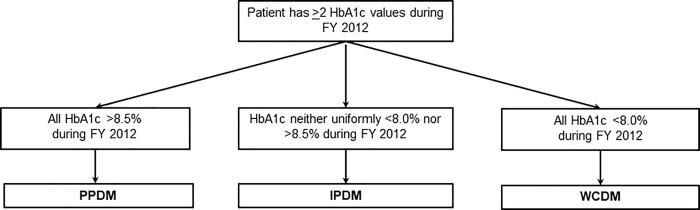
We identified a cohort of Veterans with medically treated type 2 diabetes, who received Veterans Health Administration primary care during fiscal years 2012 and 2013. PPDM was defined by hemoglobin A1c levels uniformly >8.5% during fiscal year (FY) 2012, despite engagement with care during this period. We used FY 2012 demographic, comorbidity and medication data to describe PPDM in relation to better-controlled diabetes patients and created multivariable models to examine associations between clinical factors and PPDM. We also constructed multivariable models to explore the association between PPDM and FY 2013 care utilization.
RESULTS
In our cohort of diabetes patients (n = 435,820), 12% met criteria for PPDM. Patients with PPDM were younger than better-controlled patients, less often married, and more often Black/African-American and Hispanic or Latino/Latina. Of included comorbidities, only retinopathy (OR 1.68, 95% confidence interval (CI): 1.63,1.73) and nephropathy (OR 1.26, 95% CI: 1.19,1.34) demonstrated clinically significant associations with PPDM. Complex insulin regimens such as premixed (OR 10.80, 95% CI: 10.11,11.54) and prandial-containing regimens (OR 18.74, 95% CI: 17.73,19.81) were strongly associated with PPDM. Patients with PPDM had higher care utilization, particularly endocrinology care (RR 3.56, 95% CI: 3.47,3.66); although only 26.4% of patients saw endocrinology overall.
CONCLUSION
PPDM is strongly associated with complex diabetes regimens, although heterogeneity in care utilization exists. While there is evidence of underutilization, inadequacy of available care may also contribute to PPDM. Our findings should inform tailored approaches to meet the needs of PPDM, who are among the highest-risk, highest-cost patients with diabetes.
目的
尽管接受了基于诊所的治疗,但持续性血糖控制不佳的糖尿病(PPDM)患者仍面临着极高的糖尿病并发症和医疗费用风险。了解这一人群的人口统计学、合并症和护理利用情况,可以为解决 PPDM 问题提供指导策略。我们在大量 2 型糖尿病退伍军人中,对与 PPDM 相关的因素进行了特征描述。
方法
我们确定了一个接受医疗治疗的 2 型糖尿病退伍军人队列,他们在 2012 财年和 2013 财年接受了退伍军人健康管理局的初级保健。在 2012 财年,HbA1c 水平均匀>8.5%定义为 PPDM,尽管在此期间接受了治疗。我们使用 2012 财年的人口统计学、合并症和药物数据,描述了 PPDM 与血糖控制较好的糖尿病患者之间的关系,并建立了多变量模型,以检查临床因素与 PPDM 之间的关联。我们还构建了多变量模型,以探索 PPDM 与 2013 财年护理利用之间的关联。
结果
在我们的糖尿病患者队列(n=435820)中,有 12%符合 PPDM 的标准。与血糖控制较好的患者相比,PPDM 患者年龄更小,婚姻状况更差,黑人和西班牙裔/拉丁裔的比例更高。在纳入的合并症中,只有视网膜病变(OR 1.68,95%置信区间[CI]:1.63,1.73)和肾病(OR 1.26,95%CI:1.19,1.34)与 PPDM 具有显著的临床关联。复杂的胰岛素方案,如预混胰岛素(OR 10.80,95%CI:10.11,11.54)和餐时胰岛素方案(OR 18.74,95%CI:17.73,19.81)与 PPDM 密切相关。PPDM 患者的护理利用率较高,特别是内分泌科护理(RR 3.56,95%CI:3.47,3.66);尽管只有 26.4%的患者总体上接受了内分泌科护理。
结论
PPDM 与复杂的糖尿病方案密切相关,尽管护理利用率存在差异。虽然有证据表明利用率不足,但现有护理的不足也可能导致 PPDM。我们的研究结果应能为满足 PPDM 的需求提供信息,因为 PPDM 是糖尿病患者中风险最高、费用最高的人群之一。
 Zotero 插件