
Haplin 功效分析:用于家系三成员和无关对照的遗传关联分析中功效和样本量计算的软件模块。
Haplin power analysis: a software module for power and sample size calculations in genetic association analyses of family triads and unrelated controls.
机构信息
Department of Global Public Health and Primary Care, University of Bergen, Bergen, Norway.
Department of Genetics and Bioinformatics, Norwegian Institute of Public Health, Oslo, Norway.
出版信息
BMC Bioinformatics. 2019 Apr 2;20(1):165. doi: 10.1186/s12859-019-2727-3.
BACKGROUND
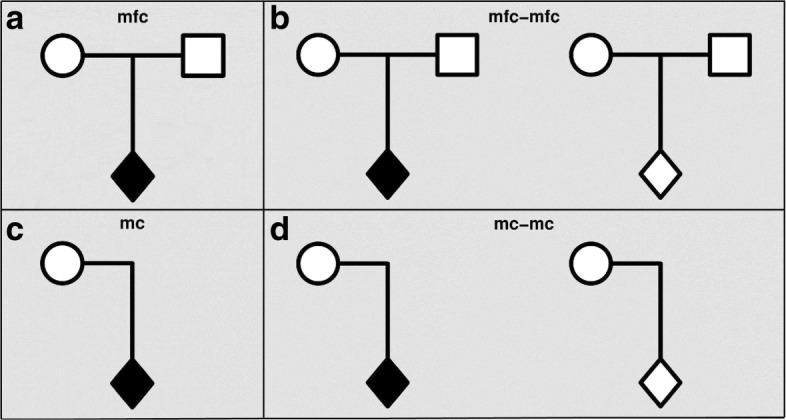
Log-linear and multinomial modeling offer a flexible framework for genetic association analyses of offspring (child), parent-of-origin and maternal effects, based on genotype data from a variety of child-parent configurations. Although the calculation of statistical power or sample size is an important first step in the planning of any scientific study, there is currently a lack of software for genetic power calculations in family-based study designs. Here, we address this shortcoming through new implementations of power calculations in the R package Haplin, which is a flexible and robust software for genetic epidemiological analyses. Power calculations in Haplin can be performed analytically using the asymptotic variance-covariance structure of the parameter estimator, or else by a straightforward simulation approach. Haplin performs power calculations for child, parent-of-origin and maternal effects, as well as for gene-environment interactions. The power can be calculated for both single SNPs and haplotypes, either autosomal or X-linked. Moreover, Haplin enables power calculations for different child-parent configurations, including (but not limited to) case-parent triads, case-mother dyads, and case-parent triads in combination with unrelated control-parent triads.
RESULTS
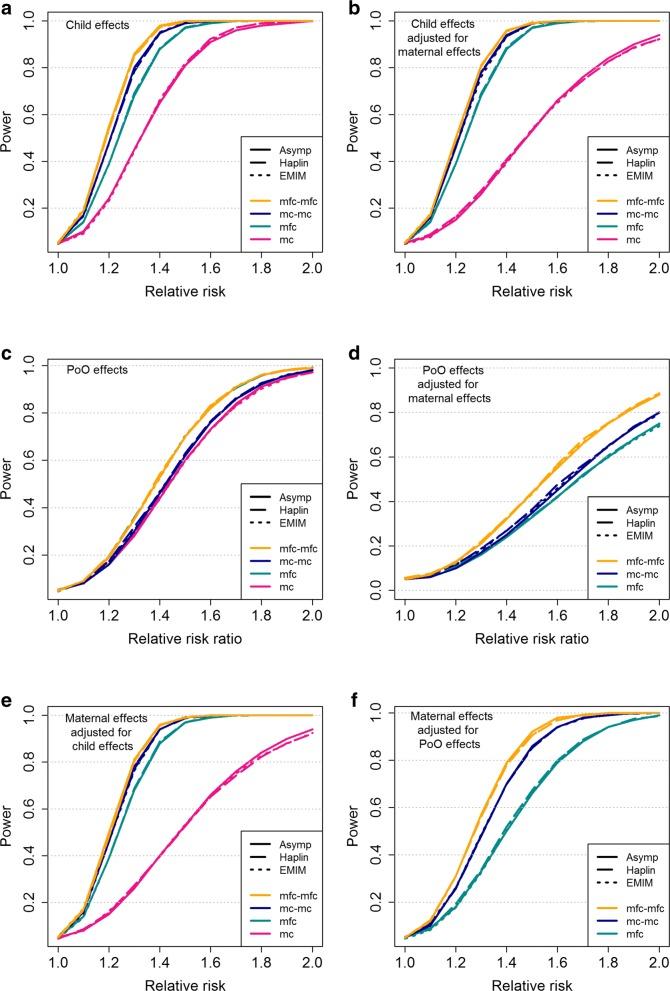
We compared the asymptotic power approximations to the power of analysis attained with Haplin. For external validation, the results were further compared to the power of analysis attained by the EMIM software using data simulations from Haplin. Consistency observed between Haplin and EMIM across various genetic scenarios confirms the computational accuracy of the inference methods used in both programs. The results also demonstrate that power calculations in Haplin are applicable to genetic association studies using either log-linear or multinomial modeling approaches.
CONCLUSIONS
Haplin provides a robust and reliable framework for power calculations in genetic association analyses for a wide range of genetic effects and etiologic scenarios, based on genotype data from a variety of child-parent configurations.
背景
基于各种亲子配置的基因型数据,对数线性和多项建模为后代(子女)、亲源和母性效应的遗传关联分析提供了一个灵活的框架。虽然统计功效或样本量的计算是任何科学研究计划的重要第一步,但目前缺乏基于家系设计的遗传功效计算软件。在这里,我们通过在灵活且强大的遗传流行病学分析软件 Haplin 中进行新的功效计算实现来解决这一不足。Haplin 中的功效计算可以使用参数估计量的渐近方差-协方差结构进行分析,也可以通过直接模拟方法进行。Haplin 可以针对子女、亲源和母性效应以及基因-环境相互作用进行功效计算。可以针对常染色体或 X 连锁的单核苷酸多态性 (SNP) 或单倍型进行功效计算。此外,Haplin 还可以针对不同的亲子配置进行功效计算,包括(但不限于)病例-父母三体型、病例-母亲二体型以及病例-父母三体型与无关对照-父母三体型的组合。
结果
我们比较了渐近功效逼近值与 Haplin 分析获得的功效。为了外部验证,还使用 Haplin 数据模拟的结果将结果与 EMIM 软件的分析功效进行了比较。在各种遗传情况下,Haplin 和 EMIM 之间观察到的一致性证实了两个程序中使用的推断方法的计算准确性。结果还表明,Haplin 中的功效计算适用于基于对数线性或多项建模方法的遗传关联研究。
结论
Haplin 为基于各种亲子配置的基因型数据的广泛遗传效应和病因学情况的遗传关联分析提供了一个强大而可靠的功效计算框架。
 Zotero 插件