
一项关于及时自适应干预(JITAIs)以促进身体活动的系统评价。
A systematic review of just-in-time adaptive interventions (JITAIs) to promote physical activity.
机构信息
School of Health Sciences, University of East Anglia, Norwich Research Park, Norwich, NR4 7TJ, UK.
Norwich Medical School, University of East Anglia, Norwich Research Park, Norwich, NR4 7TJ, UK.
出版信息
Int J Behav Nutr Phys Act. 2019 Apr 3;16(1):31. doi: 10.1186/s12966-019-0792-7.
BACKGROUND
Progress in mobile health (mHealth) technology has enabled the design of just-in-time adaptive interventions (JITAIs). We define JITAIs as having three features: behavioural support that directly corresponds to a need in real-time; content or timing of support is adapted or tailored according to input collected by the system since support was initiated; support is system-triggered. We conducted a systematic review of JITAIs for physical activity to identify their features, feasibility, acceptability and effectiveness.
METHODS
We searched Scopus, Medline, Embase, PsycINFO, Web of Science, DBLP, ACM Digital Library, Cochrane Central Register of Controlled Trials, ClinicalTrials.gov and the ISRCTN register using terms related to physical activity, mHealth interventions and JITAIs. We included primary studies of any design reporting data about JITAIs, irrespective of population, age and setting. Outcomes included physical activity, engagement, uptake, feasibility and acceptability. Paper screening and data extraction were independently validated. Synthesis was narrative. We used the mHealth Evidence Reporting and Assessment checklist to assess quality of intervention descriptions.
RESULTS
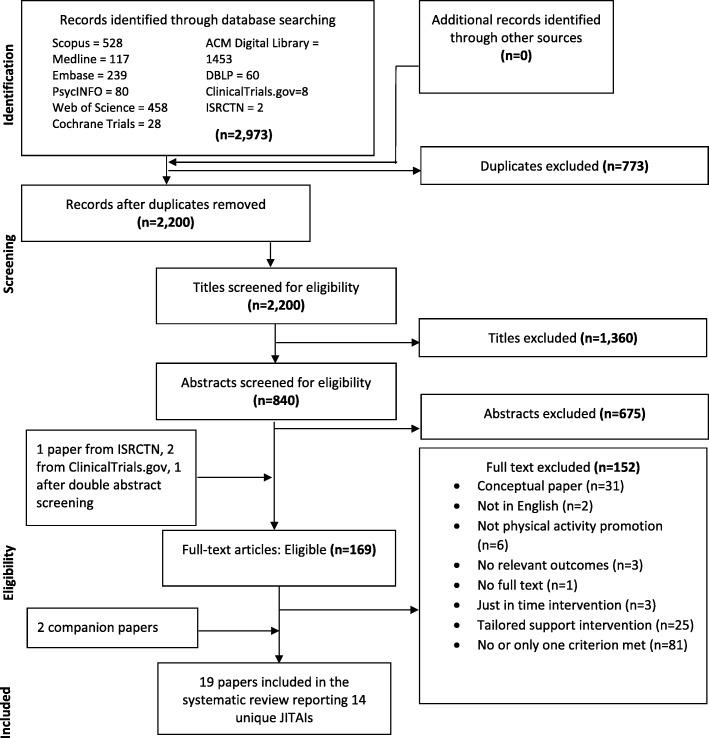
We screened 2200 titles, 840 abstracts, 169 full-text papers, and included 19 papers reporting 14 unique JITAIs, including six randomised studies. Five JITAIs targeted both physical activity and sedentary behaviour, five sedentary behaviour only, and four physical activity only. JITAIs prompted breaks following sedentary periods and/or suggested physical activities during opportunistic moments, typically over three to four weeks. Feasibility challenges related to the technology, sensor reliability and timeliness of just-in-time messages. Overall, participants found JITAIs acceptable. We found mixed evidence for intervention effects on behaviour, but no study was sufficiently powered to detect any effects. Common behaviour change techniques were goal setting (behaviour), prompts/cues, feedback on behaviour and action planning. Five studies reported a theory-base. We found lack of evidence about cost-effectiveness, uptake, reach, impact on health inequalities, and sustained engagement.
CONCLUSIONS
Research into JITAIs to increase physical activity and reduce sedentary behaviour is in its early stages. Consistent use and a shared definition of the term 'JITAI' will aid evidence synthesis. We recommend robust evaluation of theory and evidence-based JITAIs in representative populations. Decision makers and health professionals need to be cautious in signposting patients to JITAIs until such evidence is available, although they are unlikely to cause health-related harm.
REFERENCE
PROSPERO 2017 CRD42017070849.
背景
移动健康 (mHealth) 技术的进步使得即时自适应干预 (JITAI) 的设计成为可能。我们将 JITAI 定义为具有三个特征:实时对应需求的行为支持;根据系统启动支持以来收集的输入,调整或定制支持的内容或时间;支持是系统触发的。我们对用于体育活动的 JITAI 进行了系统评价,以确定其特征、可行性、可接受性和有效性。
方法
我们使用与体育活动、mHealth 干预和 JITAI 相关的术语,在 Scopus、Medline、Embase、PsycINFO、Web of Science、DBLP、ACM 数字图书馆、Cochrane 中央对照试验注册中心、ClinicalTrials.gov 和 ISRCTN 注册中心进行了系统检索。我们纳入了报告 JITAI 数据的任何设计的原始研究,无论人群、年龄和环境如何。结果包括体育活动、参与度、吸收率、可行性和可接受性。论文筛选和数据提取均经过独立验证。综合是叙述性的。我们使用 mHealth 证据报告和评估清单来评估干预描述的质量。
结果
我们筛选了 2200 篇标题、840 篇摘要和 169 篇全文论文,并纳入了 19 篇报告 14 种独特 JITAI 的论文,其中包括 6 项随机研究。5 项 JITAI 既针对体育活动又针对久坐行为,5 项仅针对久坐行为,4 项仅针对体育活动。JITAI 在久坐期间之后提示休息,并/或在机会时刻建议进行体育活动,通常持续三到四周。可行性挑战与技术、传感器可靠性和即时消息的及时性有关。总体而言,参与者认为 JITAI 是可以接受的。我们发现干预对行为的影响证据不一致,但没有研究有足够的能力来检测任何影响。常见的行为改变技术包括目标设定(行为)、提示/线索、行为反馈和行动计划。五项研究报告了理论基础。我们发现缺乏关于成本效益、吸收率、覆盖面、对健康不平等的影响以及持续参与度的证据。
结论
旨在提高体育活动和减少久坐行为的 JITAI 研究仍处于早期阶段。一致使用和共享“JITAI”一词的定义将有助于综合证据。我们建议在代表性人群中对基于理论和循证的 JITAI 进行严格评估。在获得此类证据之前,决策者和卫生专业人员在向 JITAI 患者提供建议时需要谨慎,但它们不太可能造成与健康相关的伤害。
参考文献
PROSPERO 2017 CRD42017070849.
 Zotero 插件