
基于一例病例的尿调节蛋白相关常染色体显性遗传性肾小管间质性肾病的发病机制见解
Uromodulin-related autosomal-dominant tubulointerstitial kidney disease-pathogenetic insights based on a case.
作者信息
Reindl Johanna, Gröne Hermann-Josef, Wolf Gunter, Busch Martin
机构信息
Department of Internal Medicine III, University Hospital Jena, Friedrich-Schiller-University, Jena, Germany.
Department of Cellular and Molecular Pathology, German Cancer Research Center (DKFZ), Heidelberg, Germany.
出版信息
Clin Kidney J. 2018 Nov 12;12(2):172-179. doi: 10.1093/ckj/sfy094. eCollection 2019 Apr.
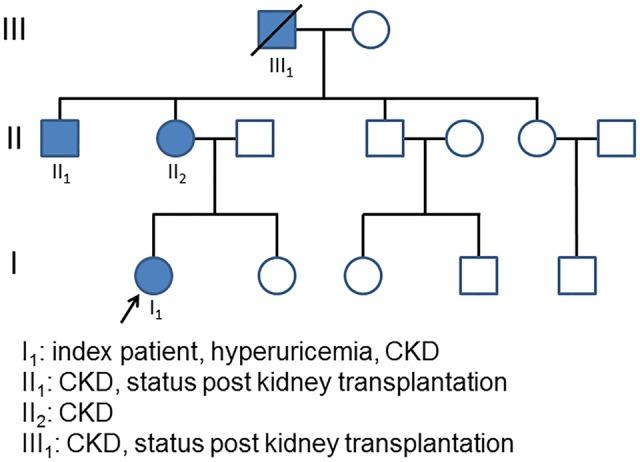
Uromodulin-related autosomal-dominant tubulointerstitial kidney disease (ADTKD-UMOD) is a rare monogenic disorder that is characterized by tubulointerstitial fibrosis and progression of kidney function loss, and may progress to end-stage renal disease. It is usually accompanied by hyperuricaemia and gout. Mutations in the uromodulin gene () resulting in malfunctioning of UMOD are known to be the cause of ADTKD-UMOD, which is assumed to be an endoplasmatic reticulum (ER) storage disease. As a case vignette, we report a 29-year-old female with a suspicious family history of chronic kidney disease presenting with progressive loss of renal function, hyperuricaemia and frequent urinary tract infections. Urinary tract infections and pyelonephritides may represent a clinical feature of uromodulin malfunction as it plays a protective role against urinary tract infections despite only sporadic data on this topic. ADTKD-UMOD was diagnosed after genetic testing revealing a missense mutation in the gene. Light microscopy showed excessive tubular interstitial fibrosis and tubular atrophy together with signs of glomerular sclerosis. Electron microscopic findings could identify electron dense storage deposits in the ER of tubular epithelial cells of the thick ascending loop. Immunohistological staining with KDEL (lysine, aspartic acid, glutamic acid, leucine) showed positivity in the tubular cells, which likely represents ER expansion upon accumulation of misfolded UMOD which could trigger the unfolded protein response and ER stress. This review highlights pathophysiological mechanisms that are subject to ADTKD-UMOD.
尿调节蛋白相关常染色体显性遗传性肾小管间质性肾病(ADTKD-UMOD)是一种罕见的单基因疾病,其特征为肾小管间质纤维化和肾功能丧失进展,最终可能发展为终末期肾病。该病通常伴有高尿酸血症和痛风。已知尿调节蛋白基因()突变导致尿调节蛋白功能异常是ADTKD-UMOD的病因,该病被认为是一种内质网(ER)贮积病。作为一个病例介绍,我们报告一名29岁女性,有慢性肾病可疑家族史,表现为进行性肾功能丧失、高尿酸血症和频繁尿路感染。尿路感染和肾盂肾炎可能是尿调节蛋白功能异常的临床特征,因为尽管关于该主题的零星数据较少,但尿调节蛋白对尿路感染起保护作用。基因检测发现基因错义突变后,确诊为ADTKD-UMOD。光镜检查显示肾小管间质纤维化和肾小管萎缩过度,伴有肾小球硬化迹象。电镜检查结果可在髓袢升支粗段肾小管上皮细胞的内质网中识别电子致密贮积物。用KDEL(赖氨酸、天冬氨酸、谷氨酸、亮氨酸)进行免疫组织化学染色显示肾小管细胞呈阳性,这可能代表错误折叠的尿调节蛋白积累后内质网扩张,进而引发未折叠蛋白反应和内质网应激。本综述强调了ADTKD-UMOD所涉及的病理生理机制。

 Zotero 插件