
美国农村和城市人口急诊就诊趋势。
Trends in Emergency Department Use by Rural and Urban Populations in the United States.
机构信息
Department of Emergency Medicine, University of New Mexico, Albuquerque.
Department of Emergency Medicine, University of Michigan, Ann Arbor.
出版信息
JAMA Netw Open. 2019 Apr 5;2(4):e191919. doi: 10.1001/jamanetworkopen.2019.1919.
IMPORTANCE
Patterns in emergency department (ED) use by rural populations may be an important indicator of the health care needs of individuals in the rural United States and may critically affect rural hospital finances.
OBJECTIVE
To describe urban and rural differences in ED use over a 12-year period by demographic characteristics, payers, and characteristics of care, including trends in ambulatory care-sensitive conditions and ED safety-net status.
DESIGN, SETTING, AND PARTICIPANTS: This cross-sectional study of ED visit data from the nationally representative National Hospital Ambulatory Medical Care Survey examined ED visit rates from January 2005 to December 2016. Visits were divided by urban and rural classification and stratified by age, sex, race/ethnicity, and payer. Emergency departments were categorized as urban or rural in accordance with the US Office of Management and Budget classification. Codes from the International Classification of Diseases, Ninth Revision (ICD-9), were used to extract visits related to ambulatory care-sensitive conditions. Safety-net status was determined by the Centers for Disease Control and Prevention definition. Visit rates were calculated using annual US Census Bureau estimates. National Hospital Ambulatory Medical Care Survey estimates were generated using provided survey weights and served as the numerator, yielding an annual, population-adjusted rate. Data were analyzed from June 2017 to November 2018.
MAIN OUTCOMES AND MEASURES
Emergency department visit rates for 2005 and 2016 with 95% confidence intervals, accompanying rate differences (RDs) comparing the 2 years, and annual rate change (RC) with accompanying trend tests using weighted linear regression models.
RESULTS
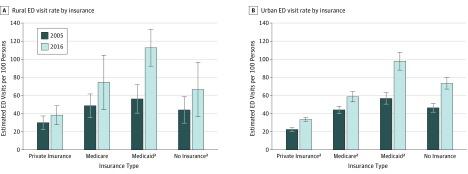
During the period examined, rural ED visit estimates increased from 16.7 million to 28.4 million, and urban visits increased from 98.6 million to 117.2 million. Rural ED visits increased for non-Hispanic white patients (13.5 million to 22.5 million), Medicaid beneficiaries (4.4 million to 9.7 million), those aged 18 to 64 years (9.6 million to 16.7 million), and patients without insurance (2.7 million to 3.4 million). Rural ED visit rates increased by more than 50%, from 36.5 to 64.5 visits per 100 persons (RD, 28.9; RC, 2.2; 95% CI, 1.2 to 3.3), outpacing urban ED visit rates, which increased from 40.2 to 42.8 visits per 100 persons (RD, 2.6; RC, 0.2; 95% CI, -0.1 to 0.6). By 2016, nearly one-fifth of all ED visits occurred in the rural setting. From 2005 to 2016, rural ED utilization rates increased for non-Hispanic white patients (RD, 26.1; RC, 1.6; 95% CI, 0.4 to 2.8), Medicaid beneficiaries (RD, 56.4; RC, 4.1; 95% CI, 2.1 to 6.1), those aged 18 to 44 years (46.9 to 81.6 visits per 100 persons; RD, 34.7; RC, 2.3; 95% CI, 1.1 to 3.5) as well as those aged 45 to 64 years (27.5 to 53.9 visits per 100 persons; RD, 26.5; RC, 1.6; 95% CI, 0.7 to 2.5), and patients without insurance (44.0 to 66.6 visits per 100 persons per year; RD, 22.6; RC, 2.7; 95% CI, 0.2 to 5.2), with a larger proportion of rural EDs categorized as safety-net status.
CONCLUSIONS AND RELEVANCE
Rural EDs are experiencing important changes in utilization rates, increasingly serving a larger proportion of traditionally disadvantaged groups and with greater pressure as safety-net hospitals.
重要性
农村地区急诊科(ED)的使用模式可能是美国农村地区个人医疗保健需求的一个重要指标,并可能对农村医院的财务状况产生重大影响。
目的
描述 12 年来城乡 ED 使用的差异,包括人口统计学特征、支付者和护理特征,包括对门诊护理敏感条件和 ED 安全网状况的趋势。
设计、地点和参与者:本研究使用国家代表性的国家医院门诊医疗调查的 ED 就诊数据,对 2005 年 1 月至 2016 年 12 月期间的 ED 就诊率进行了横断面研究。根据城乡分类和年龄、性别、种族/族裔和支付者对就诊进行分层。根据美国管理和预算局的分类,急诊科被归类为城市或农村。使用国际疾病分类第 9 版(ICD-9)的代码提取与门诊护理敏感条件相关的就诊。安全网状况由疾病控制和预防中心的定义确定。就诊率使用每年美国人口普查局的估计数计算。使用提供的调查权重生成国家医院门诊医疗调查估计数,并用作分子,产生每年、人口调整后的就诊率。数据于 2017 年 6 月至 2018 年 11 月进行分析。
主要结果和措施
2005 年和 2016 年的 ED 就诊率,置信区间为 95%,比较这两年的就诊率差异(RD),以及使用加权线性回归模型进行的年度就诊率变化(RC)和伴随的趋势检验。
结果
在所研究的期间内,农村 ED 就诊估计数从 1670 万增加到 2840 万,城市就诊数从 9860 万增加到 11720 万。农村 ED 就诊增加的人群包括非西班牙裔白人患者(从 1350 万增加到 2250 万)、医疗补助受益人(从 440 万增加到 970 万)、18 至 64 岁的人群(从 960 万增加到 1670 万)和没有保险的患者(从 270 万增加到 340 万)。农村 ED 就诊率增加了 50%以上,从每 100 人 36.5 次增加到 64.5 次(RD,28.9;RC,2.2;95%CI,1.2 至 3.3),超过了城市 ED 就诊率,城市 ED 就诊率从每 100 人 40.2 次增加到 42.8 次(RD,2.6;RC,0.2;95%CI,-0.1 至 0.6)。到 2016 年,近五分之一的 ED 就诊发生在农村地区。从 2005 年到 2016 年,非西班牙裔白人患者(RD,26.1;RC,1.6;95%CI,0.4 至 2.8)、医疗补助受益人(RD,56.4;RC,4.1;95%CI,2.1 至 6.1)、18 至 44 岁人群(每 100 人 46.9 至 81.6 次就诊;RD,34.7;RC,2.3;95%CI,1.1 至 3.5)以及 45 至 64 岁人群(每 100 人 27.5 至 53.9 次就诊;RD,26.5;RC,1.6;95%CI,0.7 至 2.5)以及没有保险的患者(每 100 人每年 44.0 至 66.6 次就诊;RD,22.6;RC,2.7;95%CI,0.2 至 5.2)就诊率增加,更多的农村 ED 被归类为安全网状态。
结论和相关性
农村 ED 的利用率正在发生重要变化,越来越多地为传统弱势群体服务,并且作为安全网医院的压力也越来越大。

 Zotero 插件