
抗病毒机制:干扰素基因刺激蛋白与溶瘤病毒限制
The Antiviral Apparatus: STING and Oncolytic Virus Restriction.
作者信息
Lee Joel, Ghonime Mohammed G, Wang Ruoning, Cassady Kevin A
机构信息
The Ohio State University College of Medicine, Biomedical Sciences Graduate Program, Columbus, OH 43210, USA.
The Research Institute at Nationwide Children's Hospital Center for Childhood Cancer and Blood Disorders, The Ohio State University, Columbus, OH, USA.
出版信息
Mol Ther Oncolytics. 2019 Mar 20;13:7-13. doi: 10.1016/j.omto.2019.02.002. eCollection 2019 Jun 28.
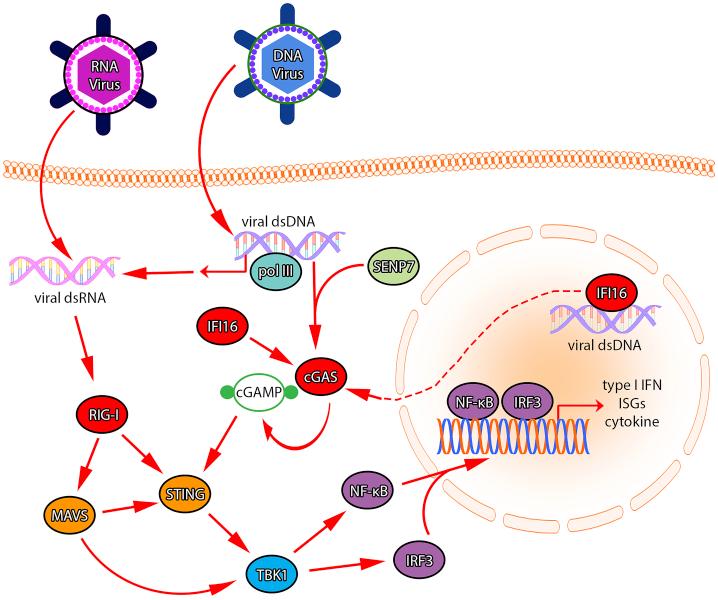
A network of pattern recognition receptors (PRRs) is responsible for the detection of invading viruses and acts as the trigger for the host antiviral response. Central to this apparatus is stimulator of interferon genes (STING), which functions as a node and integrator of detection signals. Owing to its role in both intrinsic and adaptive immunity, STING has become a focus for researchers in the field of oncolytic virotherapy. In this review, we consider the function of the cGAS-STING axis and its regulation, both by cellular mechanisms and as a result of viral interference.
模式识别受体(PRR)网络负责检测入侵的病毒,并作为宿主抗病毒反应的触发因素。该机制的核心是干扰素基因刺激因子(STING),它作为检测信号的节点和整合器发挥作用。由于其在固有免疫和适应性免疫中的作用,STING已成为溶瘤病毒疗法领域研究人员的焦点。在这篇综述中,我们探讨了cGAS-STING轴的功能及其调控,包括细胞机制以及病毒干扰导致的调控。
 Zotero 插件