
度洛西汀对中国骨关节炎疼痛患者疗效的维持:13周开放标签扩展数据
Maintenance of effect of duloxetine in Chinese patients with pain due to osteoarthritis: 13-week open-label extension data.
作者信息
Wang Guochun, Bi Liqi, Li Xiangpei, Li Zhijun, Zhao Dongbao, Chen Jinwei, He Dongyi, Wang Chia-Ning, Wu Tao, Dueñas Héctor, Skljarevski Vladimir, Yue Li
机构信息
Rheumatology Department, China-Japan Friendship Hospital, Beijing, China.
Rheumatology Department, China-Japan Union Hospital of Jilin University, Changchun, Jilin, China.
出版信息
BMC Musculoskelet Disord. 2019 Apr 22;20(1):174. doi: 10.1186/s12891-019-2527-y.
BACKGROUND
The objectives of this study were to assess the maintenance of effect of duloxetine 60 mg once-daily (QD) in Chinese patients with chronic pain due to osteoarthritis (OA) of the knee or hip and to provide additional long-term safety data.
METHODS
This was an open-label, extension phase of a randomized, double-blind, placebo-controlled clinical trial. Eligible patients were outpatients who met the American College of Rheumatology clinical and radiographic criteria for OA with a rating ≥4 on Brief Pain Inventory (BPI) 24-h average pain. After completing the 13-week placebo-controlled phase, patients originally assigned to placebo were titrated to duloxetine 60 mg QD (PLA_DLX), whereas patients originally assigned to duloxetine 60 mg QD remained on the same dose of duloxetine (DLX_DLX) for another 13 weeks. The maintenance effect of duloxetine 60 mg QD during the extension phase was evaluated by a 1-sided 97.5% confidence interval (CI) of the baseline-to-endpoint change in the extension phase for patients who took duloxetine and reported ≥30% reduction in BPI average pain at the end of placebo-controlled phase (placebo-controlled phase duloxetine responders). Other BPI severity and interference items, as well as safety and tolerability, were assessed.
RESULTS
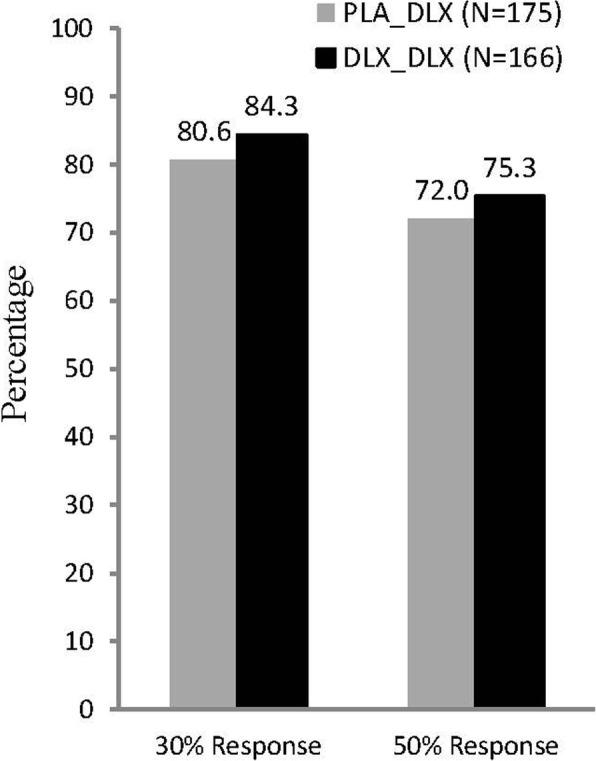
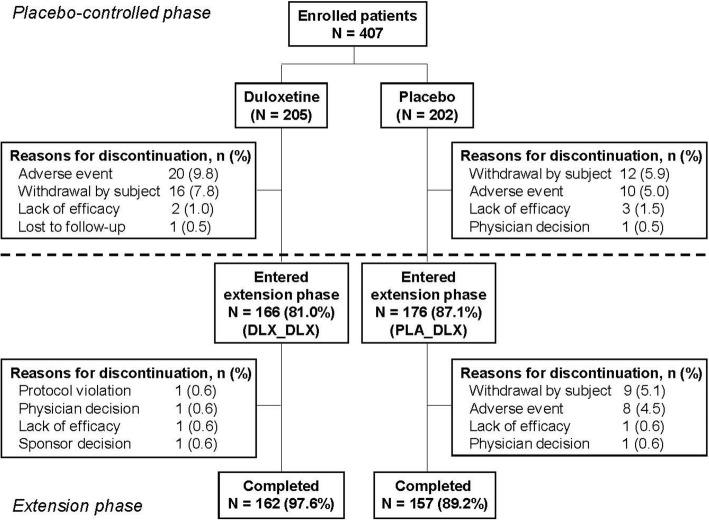
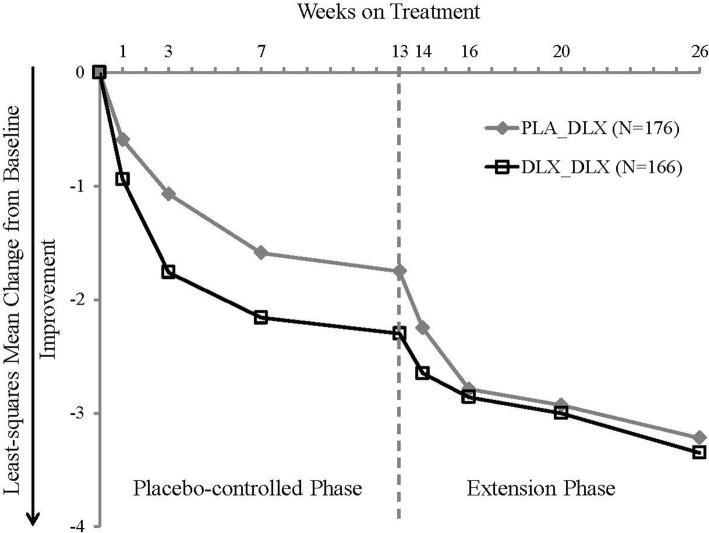
Of 342 patients entering the extension phase, 162 (97.6%) DLX_DLX-treated patients and 157 (89.2%) PLA_DLX-treated patients completed this phase. Most patients (76.0%) were female. Mean age was 60.6 years. Mean BPI average pain was 5.5 at baseline of the placebo-controlled phase. Among 113 placebo-controlled phase duloxetine responders, mean change in BPI average pain during the extension phase was - 0.59 (from 2.47 to 1.88); the upper bound of the 1-sided 97.5% CI was - 0.31 and less than the pre-specified non-inferiority margin of a 1.5-point increase (p < 0.001). Significant within-group improvements in all BPI items were observed for both PLA_DLX and DLX_DLX groups during the extension phase (all p < 0.01). No deaths or suicide-related events occurred. Seven (4.0%) PLA_DLX-treated patients and no DLX_DLX-treated patients discontinued due to an adverse event.
CONCLUSION
The analgesic effect of duloxetine 60 mg QD among treatment responders was maintained for the entire duration of the extension phase. Duloxetine 60 mg QD was well tolerated during the extension phase.
TRIAL REGISTRATION
ClinicalTrials.gov identification number NCT01931475 . Registered 29 August 2013.
背景
本研究的目的是评估每日一次口服60毫克度洛西汀对中国膝关节或髋关节骨关节炎(OA)慢性疼痛患者的疗效维持情况,并提供更多长期安全性数据。
方法
这是一项随机、双盲、安慰剂对照临床试验的开放标签延长期。符合条件的患者为门诊患者,他们符合美国风湿病学会关于OA的临床和影像学标准,且在简明疼痛量表(BPI)24小时平均疼痛评分≥4分。在完成13周的安慰剂对照期后,原分配接受安慰剂治疗的患者逐渐增加剂量至每日一次口服60毫克度洛西汀(PLA_DLX),而原分配接受每日一次口服60毫克度洛西汀治疗的患者继续服用相同剂量的度洛西汀(DLX_DLX),持续13周。对于在安慰剂对照期结束时报告BPI平均疼痛降低≥30%的度洛西汀治疗患者(安慰剂对照期度洛西汀反应者),通过延长期基线至终点变化的单侧97.5%置信区间(CI)评估每日一次口服60毫克度洛西汀在延长期的维持疗效。还评估了其他BPI严重程度和干扰项目以及安全性和耐受性。
结果
进入延长期的342例患者中,162例(97.6%)接受DLX_DLX治疗的患者和157例(89.2%)接受PLA_DLX治疗的患者完成了此阶段。大多数患者(76.0%)为女性。平均年龄为60.6岁。安慰剂对照期基线时的平均BPI平均疼痛为5.5。在113例安慰剂对照期度洛西汀反应者中,延长期BPI平均疼痛的平均变化为-0.59(从2.47降至1.88);单侧97.5%CI的上限为-0.31,低于预先设定的非劣效性界值1.5分的增加(p<0.001)。在延长期,PLA_DLX组和DLX_DLX组的所有BPI项目在组内均有显著改善(所有p<0.01)。未发生死亡或自杀相关事件。7例(4.0%)接受PLA_DLX治疗的患者因不良事件停药,接受DLX_DLX治疗者无停药。
结论
每日一次口服60毫克度洛西汀对治疗反应者的镇痛作用在延长期全程得以维持。每日一次口服60毫克度洛西汀在延长期耐受性良好。
试验注册
ClinicalTrials.gov标识符NCT01931475。2013年8月29日注册。
 Zotero 插件