
伽马射线辐照影响生菜上耐抗生素细菌及抗生素抗性基因的存活与再生长。
Gamma Irradiation Influences the Survival and Regrowth of Antibiotic-Resistant Bacteria and Antibiotic-Resistance Genes on Romaine Lettuce.
作者信息
Dharmarha Vaishali, Guron Giselle, Boyer Renee R, Niemira Brendan A, Pruden Amy, Strawn Laura K, Ponder Monica A
机构信息
Department of Food Science and Technology, Virginia Tech, Blacksburg, VA, United States.
Department of Civil and Environmental Engineering, Virginia Tech, Blacksburg, VA, United States.
出版信息
Front Microbiol. 2019 Apr 9;10:710. doi: 10.3389/fmicb.2019.00710. eCollection 2019.
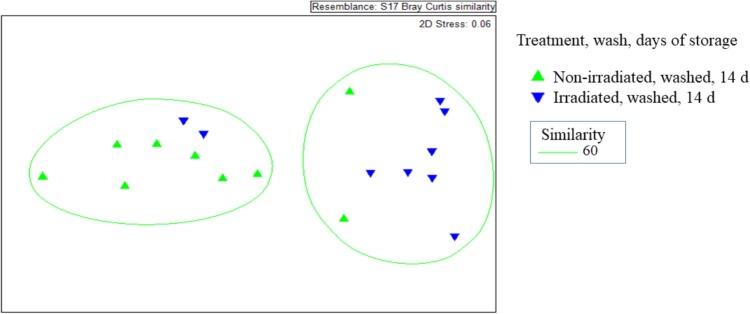
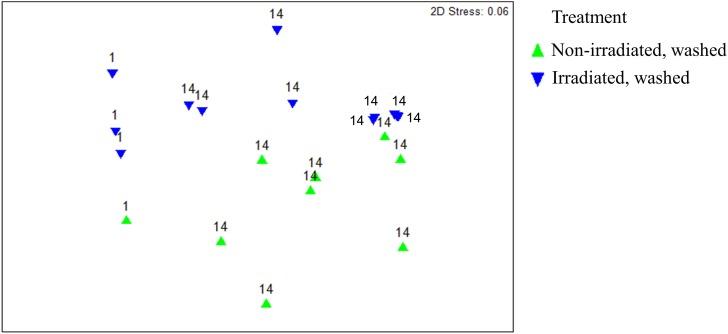
Contamination of romaine lettuce with human pathogens, antibiotic-resistant bacteria (ARB), and antibiotic resistance genes (ARGs) occurs during production. Post-harvest interventions are emplaced to mitigate pathogens, but could also mitigate ARB and ARGs on vegetables. The objective of this research was to determine changes to lettuce phyllosphere microbiota, inoculated ARB, and the resistome (profile of ARGs) following washing with a sanitizer, gamma irradiation, and cold storage. To simulate potential sources of pre-harvest contamination, romaine lettuce leaves were inoculated with compost slurry containing antibiotic-resistant strains of pathogenic ( O157:H7) and representative of spoilage bacteria (). Various combinations of washing with sodium hypochlorite (50 ppm free chlorine), packaging under modified atmosphere (98% nitrogen), irradiating (1.0 kGy) and storing at 4°C for 1 day versus 14 days were compared. Effects of post-harvest treatments on the resistome were profiled by shotgun metagenomic sequencing. Bacterial 16S rRNA gene amplicon sequencing was performed to determine changes to the phyllosphere microbiota. Survival and regrowth of inoculated ARB were evaluated by enumeration on selective media. Washing lettuce in water containing sanitizer was associated with reduced abundance of ARG classes that confer resistance to glycopeptides, β-lactams, phenicols, and sulfonamides (Wilcoxon, < 0.05). Washing followed by irradiation resulted in a different resistome chiefly due to reductions in multidrug, triclosan, polymyxin, β-lactam, and quinolone ARG classes (Wilcoxon, < 0.05). Irradiation followed by storage at 4°C for 14 days led to distinct changes to the β-diversity of the host bacteria of ARGs compared to 1 day after treatment (ANOSIM, = 0.331; = 0.003). Storage of washed and irradiated lettuce at 4°C for 14 days increased the relative abundance of and (Wilcoxon, < 0.05), two groups whose presence correlated with detection of 10 ARG classes on the lettuce phyllosphere ( < 0.05). Irradiation resulted in a significant reduction (∼3.5 log CFU/g) of inoculated strains of O157:H7 and (ANOVA, < 0.05). Results indicate that washing, irradiation and storage of modified atmosphere packaged lettuce at 4°C are effective strategies to reduce antibiotic-resistant O157:H7 and and relative abundance of various ARG classes.
在生菜生产过程中,其可能会受到人类病原体、抗生素抗性细菌(ARB)和抗生素抗性基因(ARG)的污染。收获后采取干预措施以减轻病原体污染,但这些措施也可能减轻蔬菜上的ARB和ARG。本研究的目的是确定用消毒剂清洗、伽马射线辐照和冷藏后生菜叶际微生物群、接种的ARB以及抗性组(ARG谱)的变化。为模拟收获前潜在的污染源,将含有致病性(O157:H7)抗生素抗性菌株和腐败菌代表性菌株的堆肥泥浆接种到生菜叶上。比较了用次氯酸钠(50 ppm游离氯)清洗、在改良气氛(98%氮气)下包装、辐照(1.0 kGy)以及在4°C下储存1天与14天的各种组合。通过鸟枪法宏基因组测序分析收获后处理对抗性组的影响。进行细菌16S rRNA基因扩增子测序以确定叶际微生物群的变化。通过在选择性培养基上计数来评估接种的ARB的存活和再生长情况。在含有消毒剂的水中清洗生菜与赋予对糖肽、β-内酰胺、酚类和磺胺类抗性的ARG类丰度降低有关(Wilcoxon检验,P<0.05)。先清洗后辐照导致产生不同的抗性组,主要是由于多药、三氯生、多粘菌素、β-内酰胺和喹诺酮类ARG类减少(Wilcoxon检验,P<0.05)。辐照后在4°C下储存14天与处理后1天相比,ARG宿主细菌的β-多样性发生了明显变化(ANOSIM检验,R=0.331;P=0.003)。将清洗和辐照后的生菜在4°C下储存14天增加了某两组细菌的相对丰度(Wilcoxon检验,P<0.05),这两组细菌的存在与生菜叶际10种ARG类的检测相关(P<0.05)。辐照使接种的O157:H7和某菌株显著减少(约3.5 log CFU/g)(方差分析,P<0.05)。结果表明,对改良气氛包装生菜在4°C下进行清洗、辐照和储存是减少抗生素抗性O157:H7和某菌株以及各种ARG类相对丰度的有效策略。
 Zotero 插件