
神经传递延迟的预测编码:实时时间对齐假说。
Predictive Coding with Neural Transmission Delays: A Real-Time Temporal Alignment Hypothesis.
机构信息
Melbourne School of Psychological Sciences, University of Melbourne, Melbourne, Victoria 3010, Australia
Helmholtz Institute, Department of Experimental Psychology, Utrecht University, 3512 JE, Utrecht, The Netherlands.
出版信息
eNeuro. 2019 May 7;6(2). doi: 10.1523/ENEURO.0412-18.2019. Print 2019 Mar/Apr.
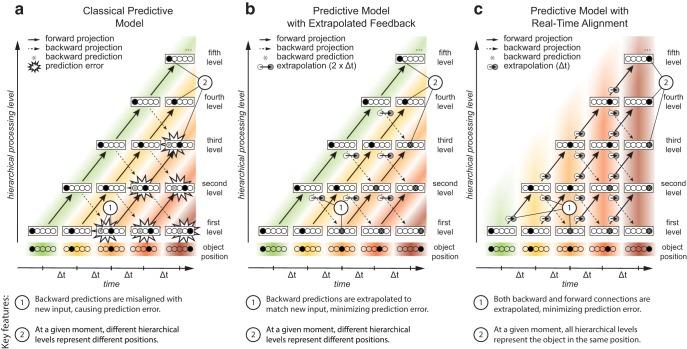
Hierarchical predictive coding is an influential model of cortical organization, in which sequential hierarchical levels are connected by backward connections carrying predictions, as well as forward connections carrying prediction errors. To date, however, predictive coding models have largely neglected to take into account that neural transmission itself takes time. For a time-varying stimulus, such as a moving object, this means that backward predictions become misaligned with new sensory input. We present an extended model implementing both forward and backward extrapolation mechanisms that realigns backward predictions to minimize prediction error. This realignment has the consequence that neural representations across all hierarchical levels become aligned in real time. Using visual motion as an example, we show that the model is neurally plausible, that it is consistent with evidence of extrapolation mechanisms throughout the visual hierarchy, that it predicts several known motion-position illusions in human observers, and that it provides a solution to the temporal binding problem.
分层预测编码是一种有影响力的皮质组织模型,其中顺序分层通过携带预测的反向连接以及携带预测误差的前向连接连接在一起。然而,到目前为止,预测编码模型在很大程度上忽略了考虑到神经传递本身需要时间。对于时变刺激,例如移动的物体,这意味着反向预测与新的感官输入不同步。我们提出了一个扩展模型,实现了前向和反向外推机制,使反向预测重新对齐以最小化预测误差。这种重新对齐的结果是,所有层次的神经表示都实时对齐。以视觉运动为例,我们表明该模型具有神经合理性,与视觉层次结构中存在外推机制的证据一致,预测了人类观察者的几种已知运动-位置错觉,并为时间绑定问题提供了解决方案。


 Zotero 插件