
克氏锥虫 EIF4E5 翻译因子同源物与 mRNA 帽-4 复合物的晶体结构
Crystal structure of the Trypanosoma cruzi EIF4E5 translation factor homologue in complex with mRNA cap-4.
机构信息
Carlos Chagas Institute, Oswaldo Cruz Foundation, FIOCRUZ-PR, Curitiba, Paraná 81350-010, Brazil.
Biochemistry Postgraduate Program, Federal University of Parana, Curitiba, Paraná 81530-000, Brazil.
出版信息
Nucleic Acids Res. 2019 Jun 20;47(11):5973-5987. doi: 10.1093/nar/gkz339.
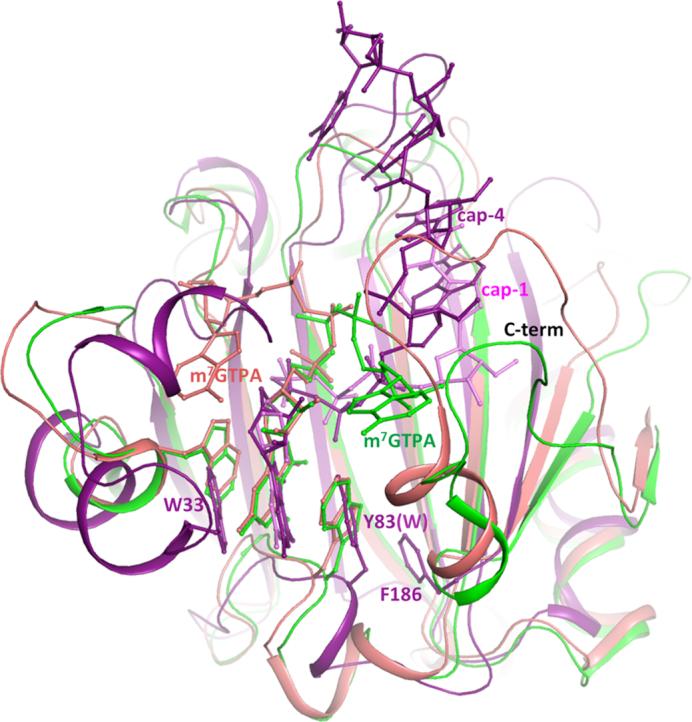
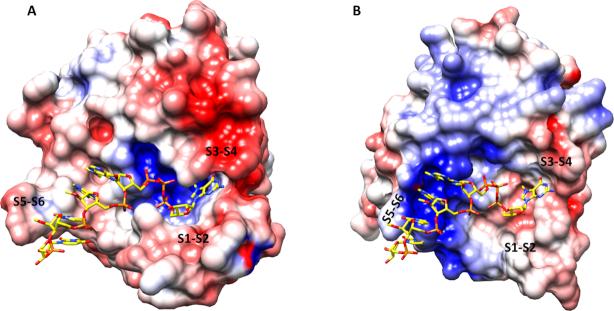
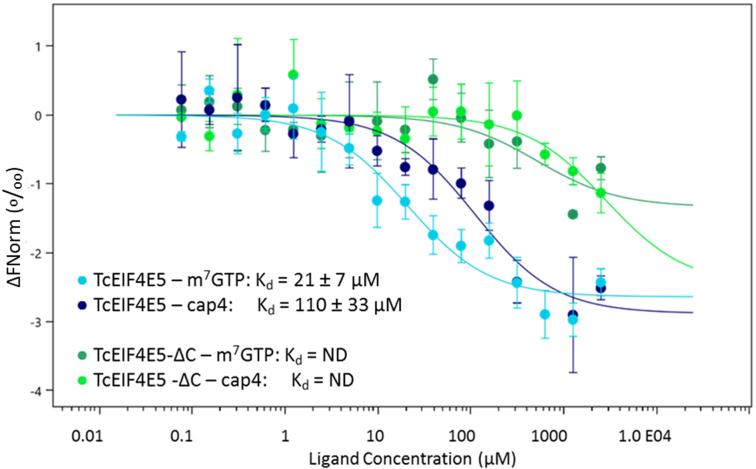
Association of the initiation factor eIF4E with the mRNA cap structure is a key step for translation. Trypanosomatids present six eIF4E homologues, showing a low conservation and also differing significantly from the IF4Es of multicellular eukaryotes. On the mRNA side, while in most eukaryotes the mRNA contains cap-0 (7-methyl-GTP), the trypanosomatid mRNA features a cap-4, which is formed by a cap-0, followed by the AACU sequence containing 2'-O-ribose methylations and base methylations on nucleotides 1 and 4. The studies on eIF4E-cap-4 interaction have been hindered by the difficulty to synthesize this rather elaborated cap-4 sequence. To overcome this problem, we applied a liquid-phase oligonucleotide synthesis strategy and describe for the first time the crystal structure of a trypanosomatid eIF4E (T. cruzi EIF4E5) in complex with cap-4. The TcEIF4E5-cap-4 structure allowed a detailed description of the binding mechanism, revealing the interaction mode for the AACU sequence, with the bases packed in a parallel stacking conformation and involved, together with the methyl groups, in hydrophobic contacts with the protein. This binding mechanism evidences a distinct cap interaction mode in comparison with previously described eIF4E structures and may account for the difference of TcEIF4E5-cap-4 dissociation constant in comparison with other eIF4E homologues.
起始因子 eIF4E 与 mRNA 帽结构的结合是翻译的关键步骤。动基体生物具有 6 种 eIF4E 同源物,其保守性较低,与多细胞真核生物的 IF4Es 也有很大的不同。在 mRNA 方面,虽然大多数真核生物的 mRNA 含有帽 0(7-甲基-GTP),但动基体生物的 mRNA 具有帽 4,它由帽 0 形成,后面跟着一个 AACU 序列,其中包含 2'-O-核糖甲基化和核苷酸 1 和 4 上的碱基甲基化。由于难以合成这种相当复杂的帽 4 序列,因此 eIF4E-cap-4 相互作用的研究受到了阻碍。为了克服这个问题,我们应用了液相寡核苷酸合成策略,并首次描述了一种动基体生物(T. cruzi EIF4E5)的 eIF4E 与帽 4 的复合物的晶体结构。TcEIF4E5-cap-4 结构允许对结合机制进行详细描述,揭示了 AACU 序列的相互作用模式,碱基以平行堆积构象排列,并与甲基一起与蛋白质形成疏水接触。与以前描述的 eIF4E 结构相比,这种结合机制表明了一种独特的帽相互作用模式,这可能解释了 TcEIF4E5-cap-4 解离常数与其他 eIF4E 同源物的差异。


 Zotero 插件