
一项 ASP8273 与厄洛替尼或吉非替尼治疗晚期 IIIB/IV 期非小细胞肺癌患者的 III 期、随机、开放标签研究。
A phase III, randomized, open-label study of ASP8273 versus erlotinib or gefitinib in patients with advanced stage IIIB/IV non-small-cell lung cancer.
机构信息
The Sidney Kimmel Comprehensive Cancer Center, Johns Hopkins University, Baltimore and The Charles A. Sammons Cancer Center at Baylor University Medical Center, Dallas, USA.
Department of Medical Oncology and Hematology, Princess Margaret Cancer Centre, Toronto, Canada.
出版信息
Ann Oncol. 2019 Jul 1;30(7):1127-1133. doi: 10.1093/annonc/mdz128.
BACKGROUND
ASP8273, a novel, small molecule, irreversible tyrosine kinase inhibitor (TKI) specifically inhibits the epidermal growth factor receptor (EGFR) in patients with activating mutations or EGFR T790M resistance mutations. The current study examines the efficacy, safety, and tolerability of ASP8273 versus erlotinib or gefitinib in patients with non-small-cell lung cancer (NSCLC) with activating EGFR mutations not previously treated with an EGFR inhibitor.
PATIENTS AND METHODS
This global, phase III, open-label, randomized study evaluated ASP8273 versus erlotinib/gefitinib in patients with locally advanced, metastatic, or unresectable stage IIIB/IV NSCLC with activating EGFR mutations. They were ineligible if they received prior chemotherapy for metastatic disease. The primary end point was progression-free survival (PFS), and secondary end points included overall survival, investigator-assessed PFS, best overall response rate (ORR), disease control rate, duration of response (DoR), and the safety/tolerability profile.
RESULTS
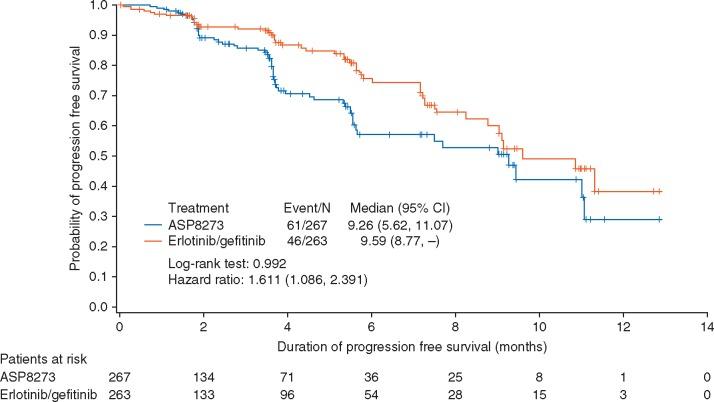
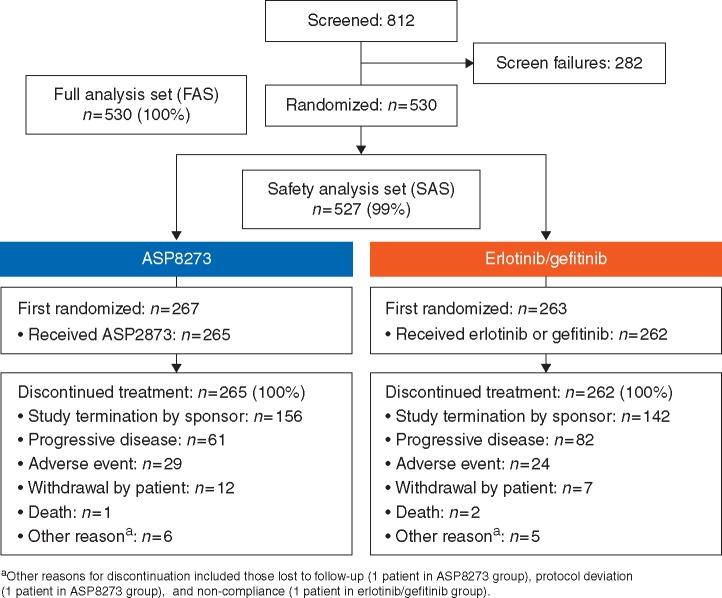
Patients (n = 530) were randomized 1 : 1 to receive ASP8273 (n = 267) or erlotinib/gefitinib (n = 263). Patient demographics between both treatment groups were generally balanced. Median PFS was 9.3 months (95% CI 5.6-11.1 months) for patients receiving ASP8273 and 9.6 months (95% CI 8.8-NE) for the erlotinib/gefitinib group, with a hazard ratio of 1.611 (P = 0.992). The ORR in the ASP8273 group was 33% (95% CI 27.4-39.0) versus 47.9% (95% CI 41.7-54.1) in the erlotinib/gefitinib group. Median DoR was similar for both groups (9.2 months for ASP8273 versus 9.0 months for erlotinib/gefitinib). More grade ≥3 treatment-emergent adverse events (TEAEs) occurred in patients receiving ASP8273 than in those receiving erlotinib/gefitinib (54.7% versus 43.5%). An independent data monitoring committee carried out an interim safety analysis and recommended discontinuing the study due to toxicity and limited predicted efficacy of ASP8273 relative to erlotinib/gefitinib.
CONCLUSIONS
First-line ASP8273 did not show improved PFS or equivalent toxicities versus erlotinib/gefitinib.
CLINICALTRIAL.GOV NUMBER: NCT02588261.
背景
ASP8273 是一种新型的小分子、不可逆的酪氨酸激酶抑制剂(TKI),专门针对具有激活突变或 EGFR T790M 耐药突变的表皮生长因子受体(EGFR)的患者。本研究评估了 ASP8273 与厄洛替尼或吉非替尼在未接受过 EGFR 抑制剂治疗的具有激活 EGFR 突变的非小细胞肺癌(NSCLC)患者中的疗效、安全性和耐受性。
方法
这是一项全球性的、三期、开放标签、随机研究,评估了 ASP8273 与厄洛替尼/吉非替尼在具有激活 EGFR 突变的局部晚期、转移性或不可切除的 IIIB/IV 期 NSCLC 患者中的疗效。既往接受转移性疾病化疗的患者不符合入组条件。主要终点是无进展生存期(PFS),次要终点包括总生存期、研究者评估的 PFS、最佳总缓解率(ORR)、疾病控制率、缓解持续时间(DoR)和安全性/耐受性特征。
结果
530 名患者(n=530)按 1:1 随机接受 ASP8273(n=267)或厄洛替尼/吉非替尼(n=263)治疗。两组患者的人口统计学特征基本平衡。接受 ASP8273 治疗的患者中位 PFS 为 9.3 个月(95%CI 5.6-11.1 个月),接受厄洛替尼/吉非替尼治疗的患者中位 PFS 为 9.6 个月(95%CI 8.8-NE),风险比为 1.611(P=0.992)。ASP8273 组的 ORR 为 33%(95%CI 27.4-39.0),厄洛替尼/吉非替尼组为 47.9%(95%CI 41.7-54.1)。两组的中位 DoR 相似(ASP8273 为 9.2 个月,厄洛替尼/吉非替尼为 9.0 个月)。接受 ASP8273 治疗的患者发生≥3 级治疗相关不良事件(TEAE)的比例高于接受厄洛替尼/吉非替尼治疗的患者(54.7% vs. 43.5%)。一个独立的数据监测委员会进行了中期安全性分析,并建议停止该研究,因为 ASP8273 的毒性和预测疗效相对于厄洛替尼/吉非替尼有限。
结论
一线 ASP8273 与厄洛替尼/吉非替尼相比,未显示出改善的 PFS 或等效的毒性。
临床试验编号
NCT02588261。
 Zotero 插件