
8周吸气肌训练对健康老年人平衡能力的影响:一项随机、双盲、安慰剂对照研究。
The effects of 8 weeks of inspiratory muscle training on the balance of healthy older adults: a randomized, double-blind, placebo-controlled study.
作者信息
Ferraro Francesco V, Gavin James P, Wainwright Tom, McConnell Alison
机构信息
Department of Human Sciences and Public Health, Bournemouth University, Bournemouth, United Kingdom.
School of Health Sciences, University of Southampton, Southampton, United Kingdom.
出版信息
Physiol Rep. 2019 May;7(9):e14076. doi: 10.14814/phy2.14076.
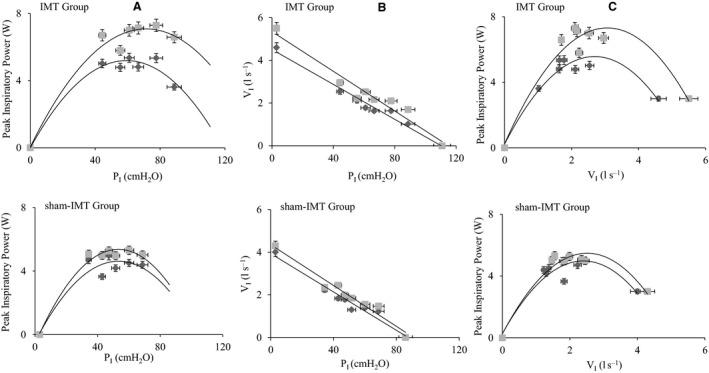
To examine the effects of 8-week unsupervised, home-based inspiratory muscle training (IMT) on the balance and physical performance of healthy older adults. Fifty-nine participants (74 ± 6 years) were assigned randomly in a double-blinded fashion to either IMT or sham-IMT, using a pressure threshold loading device. The IMT group performed 30-breath twice daily at ~50% of maximal inspiratory pressure (MIP). The sham-IMT group performed 60-breaths once daily at ~15% MIP; training was home-based and unsupervised, with adherence self-reported through training diaries. Respiratory outcomes were assessed pre- and postintervention, including forced vital capacity, forced expiratory volume, peak inspiratory flow rate (PIFR), MIP, and inspiratory peak power. Balance and physical performance outcomes were measured using the shortened version of the Balance Evaluation System test (mini-BEST), Biodex postural stability test, timed up and go, five sit-to-stand, isometric "sit-up" and Biering-Sørensen tests. Between-group effects were examined using two-way repeated measures ANOVA, with Bonferroni correction. After 8-week, the IMT group demonstrated greater improvements (P ≤ 0.05) in: PIFR (IMT = 0.9 ± 0.3 L sec ; sham-IMT = 0.3 L sec ); mini-BEST (IMT = 3.7 ± 1.3; sham-IMT = 0.5 ± 0.9) and Biering-Sørensen (IMT = 62.9 ± 6.4 sec; sham-IMT = 24.3 ± 1.4 sec) tests. The authors concluded that twice daily unsupervised, home-based IMT is feasible and enhances inspiratory muscle function and balance for community-dwelling older adults.
为研究为期8周的无监督家庭式吸气肌训练(IMT)对健康老年人平衡能力和身体机能的影响。59名参与者(74±6岁)采用双盲法,使用压力阈值负荷装置随机分为IMT组或假IMT组。IMT组每天进行两次30次呼吸,吸气压力约为最大吸气压力(MIP)的50%。假IMT组每天进行一次60次呼吸,吸气压力约为MIP的15%;训练在家中进行且无监督,通过训练日记自我报告依从情况。在干预前后评估呼吸指标,包括用力肺活量、用力呼气量、吸气峰值流速(PIFR)、MIP和吸气峰值功率。使用简化版平衡评估系统测试(mini-BEST)、Biodex姿势稳定性测试、计时起立行走测试、五次坐立测试、等长“仰卧起坐”测试和比林-索伦森测试来测量平衡和身体机能指标。采用双向重复测量方差分析及Bonferroni校正来检验组间效应。8周后,IMT组在以下方面表现出更大改善(P≤0.05):PIFR(IMT组=0.9±0.3升/秒;假IMT组=0.3升/秒)、mini-BEST(IMT组=3.7±1.3;假IMT组=0.5±0.9)和比林-索伦森测试(IMT组=62.9±6.4秒;假IMT组=24.3±1.4秒)。作者得出结论,对于社区居住的老年人,每天两次无监督的家庭式IMT是可行的,且能增强吸气肌功能和平衡能力。

 Zotero 插件