
通过微阵列和生物信息学分析鉴定人类结直肠癌的新型生物标志物和小分子药物。
Identification of novel biomarkers and small molecule drugs in human colorectal cancer by microarray and bioinformatics analysis.
机构信息
Laboratory Medicine Center, People's Hospital of Hai'an County, Nantong, P. R. China.
Department of Clinical Biobank, Nantong University Affiliated Hospital, Nantong, P. R. China.
出版信息
Mol Genet Genomic Med. 2019 Jul;7(7):e00713. doi: 10.1002/mgg3.713. Epub 2019 May 13.
BACKGROUND
Colorectal cancer (CRC) is one of the most common malignant tumors. In the present study, the expression profile of human multistage colorectal mucosa tissues, including healthy, adenoma, and adenocarcinoma samples was downloaded to identify critical genes and potential drugs in CRC.
METHODS
Expression profiles, GSE33113 and GSE44076, were integrated using bioinformatics methods. Differentially expressed genes (DEGs) were analyzed by R language. Functional enrichment analyses of the DEGs were performed using the Database for Annotation, visualization, and integrated discovery (DAVID) database. Then, the search tool for the retrieval of interacting genes (STRING) database and Cytoscape were used to construct a protein-protein interaction (PPI) network and identify hub genes. Subsequently, survival analysis was performed among the key genes using Gene Expression Profiling Interactive Analysis (GEPIA). Connectivity Map (CMap) was used to query potential drugs for CRC.
RESULTS
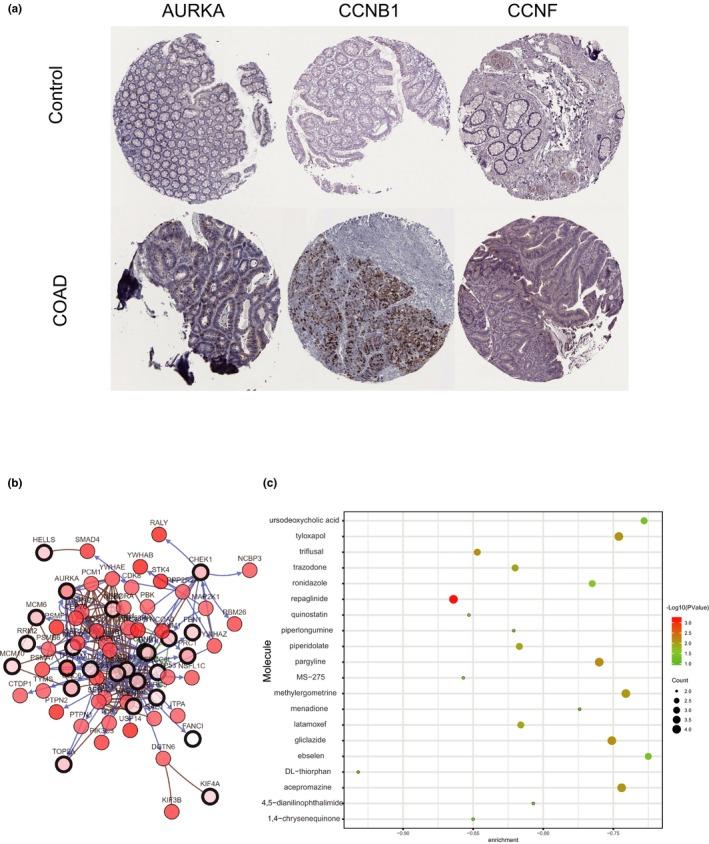
A total of 428 upregulated genes and 751 downregulated genes in CRC were identified. The functional changes of these DEGs were mainly associated with cell cycle, oocyte meiosis, DNA replication, p53 signaling pathway, and progesterone-mediated oocyte maturation. A PPI network was identified by STRING with 482 nodes and 2,368 edges. Survival analysis revealed that high mRNA expression of AURKA, CCNB1, CCNF, and EXO1 was significantly associated with longer overall survival. Moreover, CMap predicted a panel of small molecules as possible adjuvant drugs to treat CRC.
CONCLUSION
Our study found key dysregulated genes involved in CRC and potential drugs to combat it, which may provide novel insights and potential biomarkers for prognosis, as well as providing new CRC treatments.
背景
结直肠癌(CRC)是最常见的恶性肿瘤之一。在本研究中,下载了人类多阶段结直肠黏膜组织(包括健康、腺瘤和腺癌样本)的表达谱,以鉴定 CRC 中的关键基因和潜在药物。
方法
使用生物信息学方法整合表达谱 GSE33113 和 GSE44076。使用 R 语言分析差异表达基因(DEGs)。使用数据库 for Annotation, visualization, and integrated discovery (DAVID) 数据库对 DEGs 进行功能富集分析。然后,使用 search tool for the retrieval of interacting genes (STRING) 数据库和 Cytoscape 构建蛋白质-蛋白质相互作用(PPI)网络并鉴定枢纽基因。随后,使用 Gene Expression Profiling Interactive Analysis(GEPIA)对关键基因进行生存分析。使用 Connectivity Map(CMap)查询 CRC 的潜在药物。
结果
共鉴定出 CRC 中 428 个上调基因和 751 个下调基因。这些 DEGs 的功能变化主要与细胞周期、卵母细胞减数分裂、DNA 复制、p53 信号通路和孕激素介导的卵母细胞成熟有关。通过 STRING 构建了一个包含 482 个节点和 2368 个边的 PPI 网络。生存分析显示,AURKA、CCNB1、CCNF 和 EXO1 的高 mRNA 表达与总生存期延长显著相关。此外,CMap 预测了一组小分子可能作为治疗 CRC 的辅助药物。
结论
本研究发现了参与 CRC 的关键失调基因和潜在药物,这可能为预后提供新的见解和潜在的生物标志物,并为 CRC 的治疗提供新的方法。


 Zotero 插件