
细胞减灭术 (CRS) 和腹腔热灌注化疗 (HIPEC) 后辅助树突状细胞免疫治疗 (DCBI) 治疗腹膜间皮瘤的 II 期单中心开放标签临床试验:MESOPEC 试验的原理和设计。
Adjuvant dendritic cell based immunotherapy (DCBI) after cytoreductive surgery (CRS) and hyperthermic intraperitoneal chemotherapy (HIPEC) for peritoneal mesothelioma, a phase II single centre open-label clinical trial: rationale and design of the MESOPEC trial.
机构信息
Surgical Oncology, Erasmus MC, Rotterdam, Zuid-Holland, The Netherlands.
Pulmonary Medicine, Erasmus MC, Rotterdam, Zuid-Holland, The Netherlands.
出版信息
BMJ Open. 2019 May 14;9(5):e026779. doi: 10.1136/bmjopen-2018-026779.
INTRODUCTION
Malignant peritoneal mesothelioma (MPM) is an uncommon but aggressive neoplasm and has a strong association with asbestos exposure. MPM has low survival rates of approximately 1 year even after (palliative) surgery and/or systemic chemotherapy. Recent advances in treatment strategies focusing on cytoreductive surgery (CRS) and hyperthermic intraperitoneal chemotherapy (HIPEC) have resulted in improved median survival of 53 months and a 5 year survival of 47%. However, recurrence rates are high. Current systemic chemotherapy in the adjuvant setting is of limited efficacy, while immunotherapy with dendritic cell based immunotherapy (DCBI) has yielded promising results in murine models with peritoneal mesothelioma and in patients with pleural mesothelioma.
METHODS AND ANALYSIS
The MESOPEC trial is an open-label single centre phase II study. The study population are adult patients with histological/cytological confirmed diagnosis of epithelioid malignant peritoneal mesothelioma.
INTERVENTION
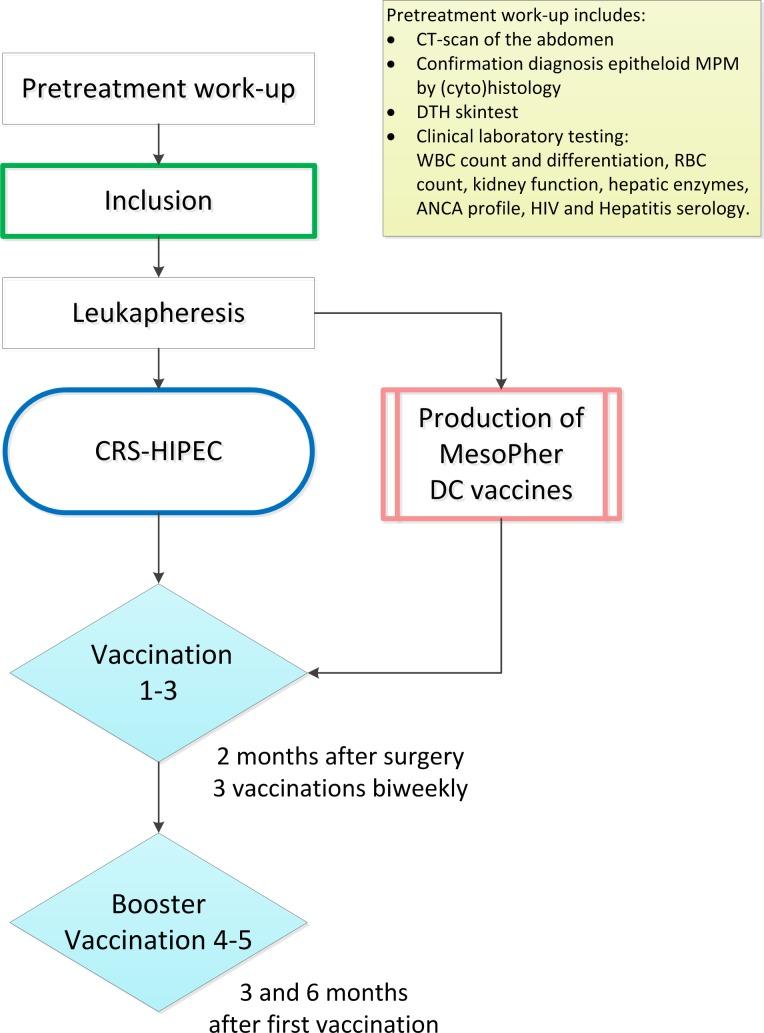
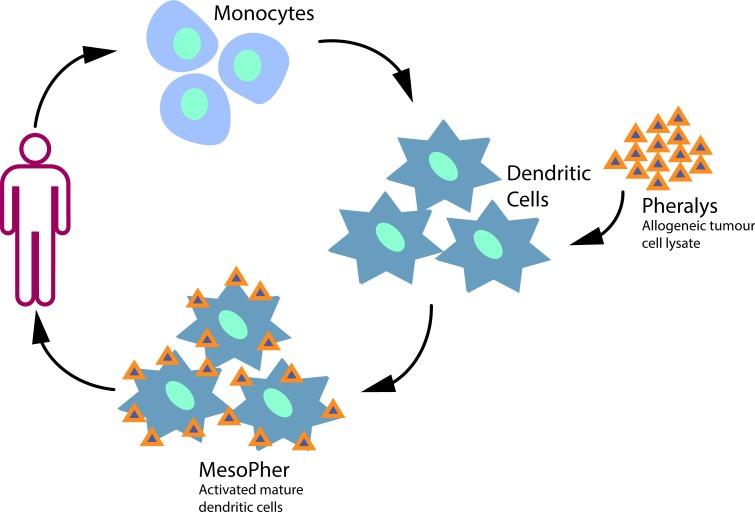
4 to 6 weeks before CRS-HIPEC a leukapheresis is performed of which the monocytes are used for differentiation to dendritic cells (DCs). Autologous DCs pulsed with allogeneic tumour associated antigens (MesoPher) are re-injected 8 to 10 weeks after surgery, three times biweekly. Additional booster vaccinations are given at 3 and 6 months.Primary objective is to determine the feasibility of administering DCBI after CRS-HIPEC in patients with malignant peritoneal mesothelioma. Secondary objectives are to assess safety of DCBI in patients with peritoneal mesothelioma and determine whether a specific immunological response against the tumour occurs as a result of this adjuvant immunotherapy.
ETHICS AND DISSEMINATION
Permission to carry out this study protocol has been granted by the Central Committee on Research Involving Human Subjects (CCMO in Dutch) and the Research Ethics Committee (METC in Dutch). The results of this trial will be submitted for publication in a peer-reviewed journal.
TRIAL REGISTRATION NUMBER
NTR7060. EudraCT: 2017-000897-12; Pre-Results.
介绍
恶性腹膜间皮瘤(MPM)是一种罕见但侵袭性的肿瘤,与石棉暴露有很强的关联。即使在(姑息性)手术后和/或全身化疗后,MPM 的生存率也很低,约为 1 年。最近,以细胞减灭术(CRS)和腹腔热灌注化疗(HIPEC)为重点的治疗策略的进展,使中位生存期延长至 53 个月,5 年生存率提高至 47%。然而,复发率仍然很高。目前辅助治疗中的全身化疗疗效有限,而基于树突状细胞的免疫疗法(DCBI)在腹膜间皮瘤的小鼠模型和胸膜间皮瘤患者中取得了有希望的结果。
方法和分析
MESOPEC 试验是一项开放标签的单中心 II 期研究。研究人群为组织学/细胞学证实为上皮样恶性腹膜间皮瘤的成年患者。
干预措施
在 CRS-HIPEC 前 4 至 6 周进行白细胞分离术,从中分离出单核细胞用于分化为树突状细胞(DC)。用同种异体肿瘤相关抗原(MesoPher)对自体 DC 进行脉冲处理,在手术后 8 至 10 周进行 3 次每 2 周一次的再注射。在 3 个月和 6 个月时进行额外的加强疫苗接种。主要目标是确定在恶性腹膜间皮瘤患者中在 CRS-HIPEC 后给予 DCBI 的可行性。次要目标是评估腹膜间皮瘤患者中 DCBI 的安全性,并确定是否由于这种辅助免疫疗法而发生针对肿瘤的特异性免疫反应。
伦理和传播
中央人体研究伦理委员会(CCMO)和研究伦理委员会(METC)已批准进行这项研究方案。这项试验的结果将提交给同行评议的期刊发表。
试验注册号
NTR7060。EudraCT:2017-000897-12;预结果。

 Zotero 插件