
神经激肽-1受体拮抗剂马罗匹坦对接受卵巢子宫切除术的猫的镇痛效果评估。
Evaluation of the Antinociceptive Effect of Maropitant, a Neurokinin-1 Receptor Antagonist, in Cats Undergoing Ovariohysterectomy.
作者信息
Corrêa Janaina M X, Soares Priscila C L R, Niella Raquel V, Costa Brenda A, Ferreira Maxuel S, Junior Alex C Silva, Sena Aline S, Sampaio Kátia M O R, Silva Elisângela B, Silva Fabiana L, Lavor Mário S L
机构信息
Postgraduate Program in Animal Science, State University of Santa Cruz (UESC), Ilhéus, Bahia, Brazil.
Department of Agricultural and Environmental Sciences, State University of Santa Cruz (UESC), Ilhéus, Bahia, Brazil.
出版信息
Vet Med Int. 2019 Apr 8;2019:9352528. doi: 10.1155/2019/9352528. eCollection 2019.
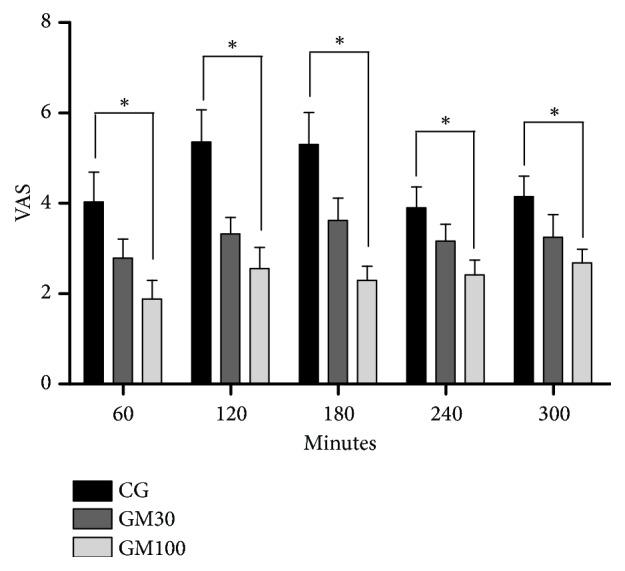
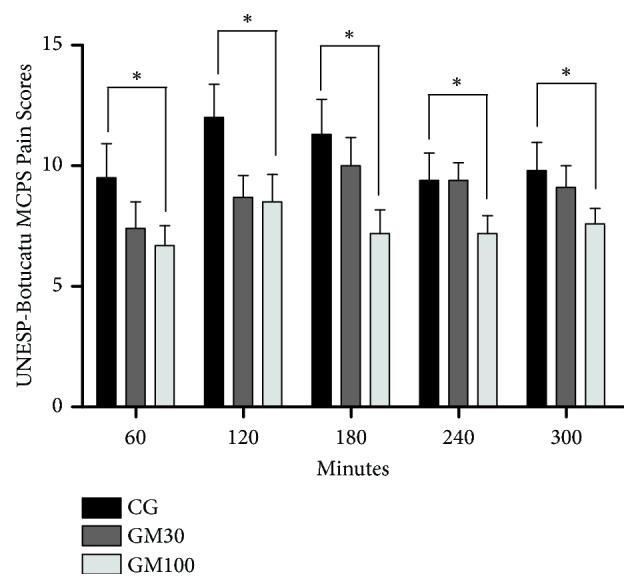
Maropitant is a neurokinin-1 (NK1) receptor antagonist that can be used for pain management. The objective of this study was to evaluate the effect of continuous infusion of two doses of maropitant on cardiorespiratory parameters and its postoperative analgesic effect in cats undergoing ovariohysterectomy. Thirty cats were randomly assigned to one of three groups (10 cats each group): the control group (CG) received a continuous infusion of 10 ml/kg/h Ringer's lactate; GM30 and GM100 first received an intravenous (IV) bolus of 1 mg/kg maropitant; GM30 then received continuous infusion of 30 g/kg/h maropitant; and GM100 then received continuous infusion of 100 g/kg/h maropitant. The maropitant was diluted into Ringer's lactate and the GM30 and GM100 also received fluids intraoperatively. In all groups, premedication included intramuscular injections of morphine and acepromazine, followed by induction with propofol and maintenance with isoflurane. Temperature, heart rate (HR), Doppler blood pressure (DBP), respiratory rate, oxygen saturation, and measuring the end-tidal carbon dioxide and isoflurane were monitored. Postoperative pain was evaluated using a visual analog scale and the UNESP-Botucatu multidimensional composite pain scale in cats; morphine was used for analgesic rescue. During the surgical procedure, cats in GM100 demonstrated lower HR and DBP than those in CG. With regard to the evaluation of postoperative pain, GM100 required the least frequent morphine rescue and less rescue analgesia compared with CG. In conclusion, cats in GM100 maintained lower DBP and HR and required lower analgesic rescue during the postoperative period. The results suggested that animals receiving maropitant bolus (1 mg/kg) plus (100 g/kg/h) experienced greater postoperative comfort, reflected by the lesser need for analgesic rescue. The use of maropitant in surgical procedures in cats contributes to postoperative comfort.
马罗匹坦是一种神经激肽-1(NK1)受体拮抗剂,可用于疼痛管理。本研究的目的是评估连续输注两种剂量的马罗匹坦对接受卵巢子宫切除术的猫的心肺参数的影响及其术后镇痛效果。30只猫被随机分为三组之一(每组10只猫):对照组(CG)接受10毫升/千克/小时的乳酸林格氏液连续输注;GM30和GM100首先接受1毫克/千克马罗匹坦的静脉推注;GM30随后接受30微克/千克/小时马罗匹坦的连续输注;GM100随后接受100微克/千克/小时马罗匹坦的连续输注。将马罗匹坦稀释到乳酸林格氏液中,GM30和GM100在术中也接受补液。在所有组中,术前用药包括肌肉注射吗啡和乙酰丙嗪,随后用丙泊酚诱导并用异氟烷维持。监测体温、心率(HR)、多普勒血压(DBP)、呼吸频率、血氧饱和度,并测量呼气末二氧化碳和异氟烷。使用视觉模拟量表和UNESP-博图卡图多维复合疼痛量表对猫的术后疼痛进行评估;吗啡用于镇痛解救。在手术过程中,GM100组的猫的HR和DBP低于CG组。关于术后疼痛评估,与CG组相比,GM100组所需的吗啡解救频率最低,解救镇痛量也较少。总之,GM100组的猫在术后维持较低的DBP和HR,且所需的镇痛解救较少。结果表明,接受马罗匹坦推注(1毫克/千克)加(100微克/千克/小时)的动物术后舒适度更高,这体现在对镇痛解救的需求较少。在猫的外科手术中使用马罗匹坦有助于提高术后舒适度。
 Zotero 插件