
CRISPR/Cas 在体内基因组编辑中的传递方面。
Delivery Aspects of CRISPR/Cas for in Vivo Genome Editing.
机构信息
Department of Pharmaceutics, Utrecht Institute of Pharmaceutical Sciences (UIPS) , Utrecht University , Universiteitsweg 99 , 3584 CG Utrecht , The Netherlands.
出版信息
Acc Chem Res. 2019 Jun 18;52(6):1555-1564. doi: 10.1021/acs.accounts.9b00106. Epub 2019 May 17.
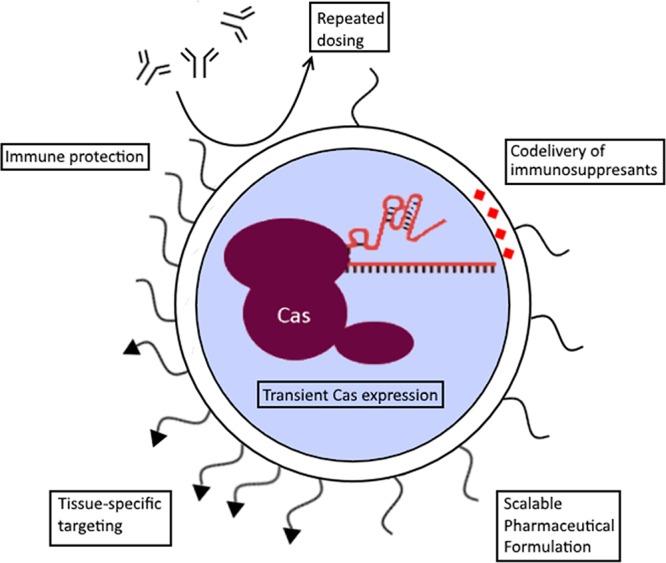
The discovery of CRISPR/Cas has revolutionized the field of genome editing. CRIPSR/Cas components are part of the bacterial immune system and are able to induce double-strand DNA breaks in the genome, which are resolved by endogenous DNA repair mechanisms. The most relevant of these are the error-prone nonhomologous end joining and homology directed repair pathways. The former can lead to gene knockout by introduction of insertions and deletions at the cut site, while the latter can be used for gene correction based on a provided repair template. In this Account, we focus on the delivery aspects of CRISPR/Cas for therapeutic applications in vivo. Safe and effective delivery of the CRISPR/Cas components into the nucleus of affected cells is essential for therapeutic gene editing. These components can be delivered in several formats, such as pDNA, viral vectors, or ribonuclear complexes. In the ideal case, the delivery system should address the current limitations of CRISPR gene editing, which are (1) lack of targeting specific tissues or cells, (2) the inability to enter cells, (3) activation of the immune system, and (4) off-target events. To circumvent most of these problems, initial therapeutic applications of CRISPR/Cas were performed on cells ex vivo via classical methods (e.g., microinjection or electroporation) and novel methods (e.g., TRIAMF and iTOP). Ideal candidates for such methods are, for example, hematopoietic cells, but not all tissue types are suited for ex vivo manipulation. For direct in vivo application, however, delivery systems are needed that can target the CRISPR/Cas components to specific tissues or cells in the human body, without causing immune activation or causing high frequencies of off-target effects. Viral systems have been used as a first resort to transduce cells in vivo. These systems suffer from problems related to packaging constraints, immunogenicity, and longevity of Cas expression, which favors off-target events. Viral vectors are as such not the best choice for direct in vivo delivery of CRISPR/Cas. Synthetic vectors can deliver nucleic acids as well, without the innate disadvantages of viral vectors. They can be classed into lipid, polymeric, and inorganic particles, all of which have been reported in the literature. The advantage of synthetic systems is that they can deliver the CRISPR/Cas system also as a preformed ribonucleoprotein complex. The transient nature of this approach favors low frequencies of off-target events and minimizes the window of immune activation. Moreover, from a pharmaceutical perspective, synthetic delivery systems are much easier to scale up for clinical use compared to viral vectors and can be chemically functionalized with ligands to obtain target cell specificity. The first preclinical results with lipid nanoparticles delivering CRISPR/Cas either as mRNA or ribonucleoproteins are very promising. The goal is translating these CRISPR/Cas therapeutics to a clinical setting as well. Taken together, these current trends seem to favor the use of sgRNA/Cas ribonucleoprotein complexes delivered in vivo by synthetic particles.
CRISPR/Cas 的发现彻底改变了基因组编辑领域。CRISPR/Cas 元件是细菌免疫系统的一部分,能够在基因组中诱导双链 DNA 断裂,这些断裂通过内源性 DNA 修复机制来解决。其中最重要的是易错的非同源末端连接和同源定向修复途径。前者可以通过在切割位点引入插入和缺失来导致基因敲除,而后者可以基于提供的修复模板用于基因校正。在本报告中,我们专注于 CRISPR/Cas 用于体内治疗应用的递药方面。将 CRISPR/Cas 组件安全有效地递送至受影响细胞的细胞核对于治疗性基因编辑至关重要。这些组件可以以多种形式递送至细胞,例如 pDNA、病毒载体或核糖核复合物。在理想情况下,递药系统应解决 CRISPR 基因编辑当前的局限性,这些局限性包括(1)缺乏靶向特定组织或细胞的能力,(2)无法进入细胞,(3)激活免疫系统,以及(4)脱靶事件。为了规避大多数这些问题,CRISPR/Cas 的最初治疗应用是通过经典方法(例如微注射或电穿孔)和新型方法(例如 TRIAMF 和 iTOP)在体外对细胞进行的。此类方法的理想候选物例如是造血细胞,但并非所有组织类型都适合体外操作。然而,对于直接体内应用,需要能够将 CRISPR/Cas 组件靶向递送至人体特定组织或细胞而不引起免疫激活或导致高频率的脱靶效应的递药系统。病毒系统已被用作体内转导细胞的首选方法。这些系统存在与包装限制、免疫原性和 Cas 表达的持久性相关的问题,这有利于脱靶事件。因此,病毒载体并不是直接体内递送 CRISPR/Cas 的最佳选择。合成载体也可以输送核酸,而没有病毒载体的内在缺点。它们可以分为脂质、聚合物和无机颗粒,这些都在文献中有报道。合成系统的优势在于,它们还可以将 CRISPR/Cas 系统作为预先形成的核糖核蛋白复合物进行递药。这种方法的瞬时性有利于降低脱靶事件的频率,并将免疫激活窗口最小化。此外,从药物学的角度来看,与病毒载体相比,合成递药系统更易于进行临床应用的放大,并可以通过配体进行化学功能化以获得靶细胞特异性。使用脂质纳米颗粒递送至体内的 CRISPR/Cas 作为 mRNA 或核糖核蛋白的初步临床前结果非常有前景。目标是将这些 CRISPR/Cas 治疗方法转化为临床应用。综上所述,这些当前趋势似乎有利于使用合成颗粒体内递药的 sgRNA/Cas 核糖核蛋白复合物。


 Zotero 插件