
对口腔白斑和口腔鳞状细胞癌中血小板内皮细胞黏附分子-1表达进行免疫组织化学评估,以探讨其作为恶性转化预测指标的潜力。
An immunohistochemical evaluation of podoplanin expression in oral leukoplakia and oral squamous cell carcinoma to explore its potential to be used as a predictor for malignant transformation.
作者信息
Aiswarya A, Suresh Rakesh, Janardhanan Mahija, Savithri Vindhya, Aravind Thara, Mathew Lisha
机构信息
Department of Oral Pathology and Microbiology, Amrita School of Dentistry, Amrita Vishwa Vidyapeetham, AIMS Campus, Kochi, Kerala, India.
出版信息
J Oral Maxillofac Pathol. 2019 Jan-Apr;23(1):159. doi: 10.4103/jomfp.JOMFP_272_17.
BACKGROUND
Oral leukoplakia (OL) is a potentially malignant disorder with increased risk for the development of oral squamous cell carcinoma (OSCC). Many cases of OSCC arise from the malignant transformation of preexisting OL. However, the risk of progression into OSCC and the possible prediction of malignant potential of OL remain inconclusive. Recent studies have shown that podoplanin, a mucin-like transmembrane glycoprotein specifically expressed in lymphatic endothelial cells, is expressed in various neoplasms including OSCC, indicating its possible biologic role in tumor cells. In this study, an evaluation of podoplanin expression in OL and OSCC has been carried out to assess its potential role as a biomarker to predict the possibility of malignant transformation in OL cases.
AIMS AND OBJECTIVES
To assess the usefulness of podoplanin as a potential biomarker for predicting the risk of malignant transformation in OL, by comparing its immunohistochemical expression in OL and OSCC.
MATERIALS AND METHODS
Archival paraffin-embedded blocks of 25 OL cases with varying grades of dysplasia and 30 OSCC cases showing its varying grades were selected. Sections were subjected to immunohistochemical staining for podoplanin and compared with the control group for evaluation of results in the three groups.
RESULTS
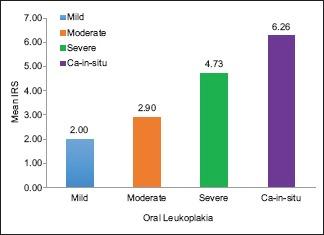
A statistically significant increase in podoplanin expression was observed from normal mucosa through OL to OSCC. In the OL cases, the podoplanin staining score progressively increased from mild dysplasia to carcinoma , whereas in OSCC, well-differentiated group showed the maximum expression of podoplanin.
CONCLUSION
The progressive increase in podoplanin expression through the increasing grades of dysplasia in OL is suggestive of an increased risk for malignant transformation with increased expression of podoplanin in OL cases. A high podoplanin expression in the well-differentiated OSCC may indicate a vital role for podoplanin in the early stages of tumorigenesis.
背景
口腔白斑(OL)是一种具有潜在恶性的疾病,发生口腔鳞状细胞癌(OSCC)的风险增加。许多OSCC病例源于先前存在的OL的恶性转化。然而,OL进展为OSCC的风险以及OL恶性潜能的可能预测仍无定论。最近的研究表明,血小板内皮细胞黏附分子(podoplanin)是一种在淋巴管内皮细胞中特异性表达的黏蛋白样跨膜糖蛋白,在包括OSCC在内的各种肿瘤中均有表达,表明其在肿瘤细胞中可能具有生物学作用。在本研究中,对OL和OSCC中血小板内皮细胞黏附分子的表达进行了评估,以评估其作为生物标志物预测OL病例恶性转化可能性的潜在作用。
目的
通过比较血小板内皮细胞黏附分子在OL和OSCC中的免疫组化表达,评估其作为预测OL恶性转化风险的潜在生物标志物的实用性。
材料与方法
选取25例不同发育异常等级的OL病例和30例不同等级的OSCC病例的存档石蜡包埋块。对切片进行血小板内皮细胞黏附分子的免疫组化染色,并与对照组比较,以评估三组的结果。
结果
从正常黏膜经OL到OSCC,观察到血小板内皮细胞黏附分子表达有统计学意义的增加。在OL病例中,血小板内皮细胞黏附分子染色评分从轻度发育异常到癌逐渐增加,而在OSCC中,高分化组血小板内皮细胞黏附分子表达最高。
结论
随着OL发育异常等级的增加,血小板内皮细胞黏附分子表达逐渐增加,提示OL病例中随着血小板内皮细胞黏附分子表达增加,恶性转化风险增加。高分化OSCC中血小板内皮细胞黏附分子的高表达可能表明血小板内皮细胞黏附分子在肿瘤发生早期起着重要作用。




 Zotero 插件