
基于生物材料的肿瘤特异性 T 细胞激活和扩增。
Biomaterial-Based Activation and Expansion of Tumor-Specific T Cells.
机构信息
Department of Tumor Immunology, Radboud Institute for Molecular Life Sciences, Radboud University Medical Center, Nijmegen, Netherlands.
Division of Immunotherapy, Oncode Institute, Radboud University Medical Center, Nijmegen, Netherlands.
出版信息
Front Immunol. 2019 May 3;10:931. doi: 10.3389/fimmu.2019.00931. eCollection 2019.
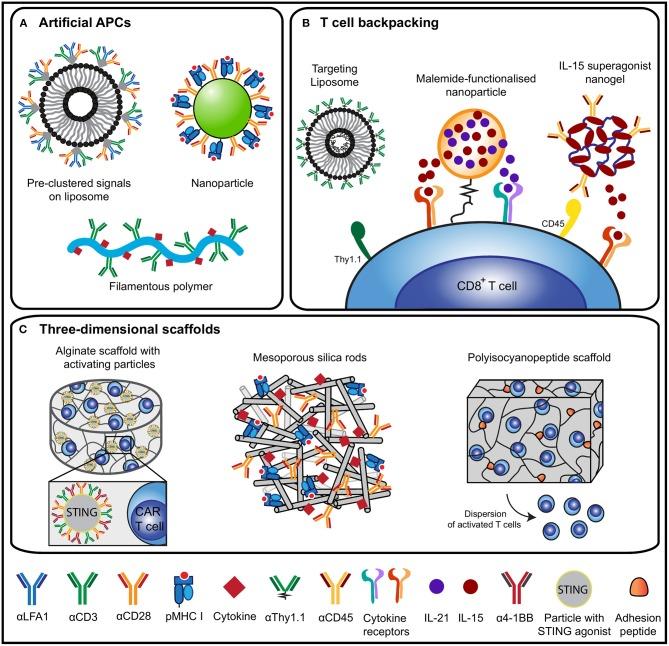
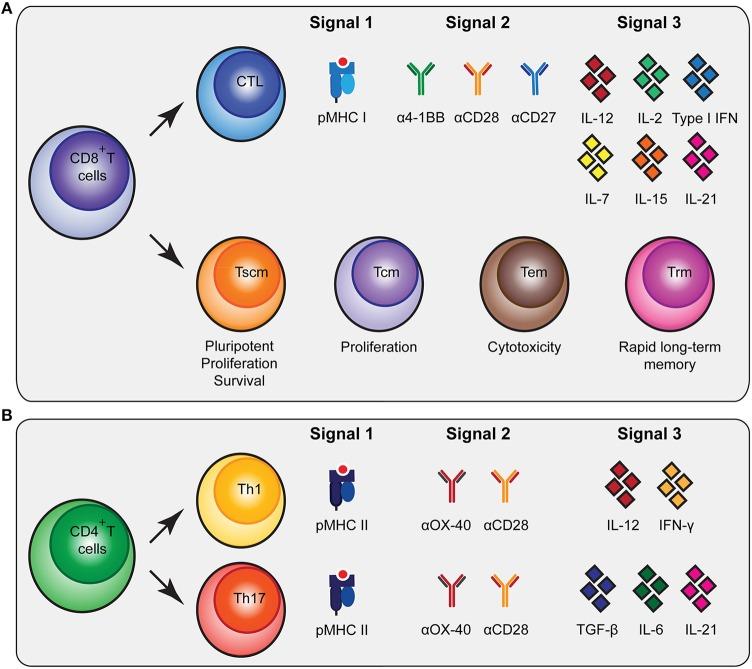
Traditional tumor vaccination approaches mostly focus on activating dendritic cells (DCs) by providing them with a source of tumor antigens and/or adjuvants, which in turn activate tumor-reactive T cells. Novel biomaterial-based cancer immunotherapeutic strategies focus on directly activating and stimulating T cells through molecular cues presented on synthetic constructs with the aim of improving T cell survival, more precisely steer T cell activation and direct T cell differentiation. Synthetic artificial antigen presenting cells (aAPCs) decorated with T cell-activating ligands are being developed to induce robust tumor-specific T cell responses, essentially bypassing DCs. In this perspective, we approach these promising new technologies from an immunological angle, first by identifying the CD4 and CD8 T cell subtypes that are imperative for robust anti-cancer immunity and subsequently discussing the molecular cues needed to induce these cells types. We will elaborate on how biomaterials can be applied to stimulate T cells and to improve their survival, activation and function. Scaffold-based methods can also be used as delivery vehicles for adoptive transfer of T cells, including tumor-infiltrating lymphocytes (TILs) and chimeric antigen receptor expressing (CAR) T cells, while simultaneously stimulating these cells. Finally, we provide suggestions on how these insights could advance the field of biomaterial-based activation and expansion of tumor-specific T cells in the future.
传统的肿瘤疫苗接种方法主要集中在通过提供肿瘤抗原和/或佐剂的来源来激活树突状细胞 (DCs), 从而激活肿瘤反应性 T 细胞。新型基于生物材料的癌症免疫治疗策略侧重于通过合成构建体上呈现的分子信号直接激活和刺激 T 细胞,旨在提高 T 细胞的存活率,更精确地控制 T 细胞的激活并直接指导 T 细胞分化。用 T 细胞激活配体修饰的合成人工抗原呈递细胞 (aAPC) 被开发用于诱导强大的肿瘤特异性 T 细胞反应,基本上绕过了 DCs。从免疫学角度来看,我们首先从识别对强大的抗癌免疫至关重要的 CD4 和 CD8 T 细胞亚群入手,然后讨论诱导这些细胞类型所需的分子信号。我们将详细阐述生物材料如何用于刺激 T 细胞并提高其存活率、激活和功能。基于支架的方法也可用于作为过继转移 T 细胞(包括肿瘤浸润淋巴细胞 (TIL) 和嵌合抗原受体表达 (CAR) T 细胞)的载体,同时刺激这些细胞。最后,我们就如何利用这些见解来推动未来基于生物材料的肿瘤特异性 T 细胞激活和扩增领域提出了建议。
 Zotero 插件