
认知衰老轨迹中皮质白质的活化小胶质细胞
Activated Microglia in Cortical White Matter Across Cognitive Aging Trajectories.
作者信息
Gefen Tamar, Kim Garam, Bolbolan Kabriya, Geoly Andrew, Ohm Daniel, Oboudiyat Carly, Shahidehpour Ryan, Rademaker Alfred, Weintraub Sandra, Bigio Eileen H, Mesulam M-Marsel, Rogalski Emily, Geula Changiz
机构信息
Mesulam Center for Cognitive Neurology and Alzheimer's Disease, Feinberg School of Medicine, Northwestern University, Chicago, IL, United States.
Department of Psychiatry and Behavioral Sciences, Feinberg School of Medicine, Northwestern University, Chicago, IL, United States.
出版信息
Front Aging Neurosci. 2019 May 14;11:94. doi: 10.3389/fnagi.2019.00094. eCollection 2019.
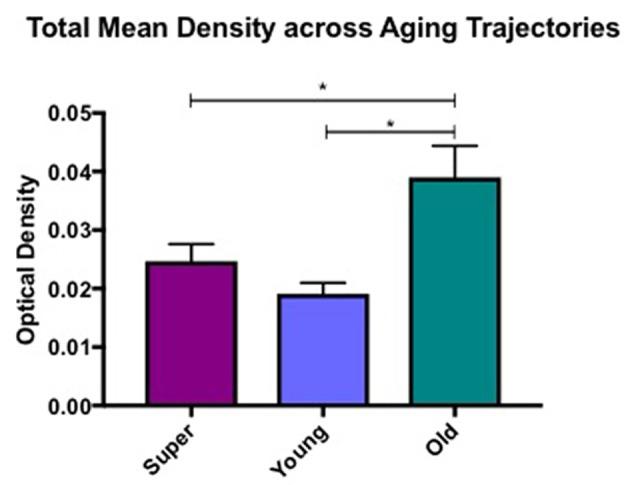
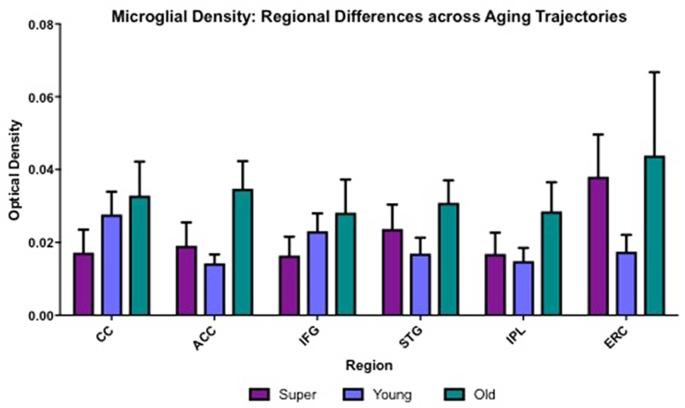
Activation of microglia, the primary mediators of inflammation in the brain, is a major component of gliosis and neuronal loss in a number of age-related neurodegenerative disorders, such as Alzheimer's disease (AD). The role of activated microglia in white matter, and its relationship with cognitive decline during aging are unknown. The current study evaluated microglia densities in the white matter of postmortem specimens from cognitively normal young adults, cognitively normal older adults, and cognitive "SuperAgers," a unique group of individuals over age 80 whose memory test scores are at a level equal to or better than scores of 50-to-65-year-olds. Whole hemisphere sections from cognitively normal old, young, and "SuperAgers" were used to quantify densities of human leukocyte antigen-D related (HLA-DR)-positive activated microglia underlying five cortical regions. Statistical findings showed a significant main effect of group on differences in microglia density where cognitively normal old showed highest densities. No difference between SuperAgers and young specimens were detected. In two autopsied SuperAgers with MRI FLAIR scans available, prominent hyperintensities in periventricular regions were observed, and interestingly, examination of corresponding postmortem sections showed only sparse microglia densities. In conclusion, activated microglia appear to respond to age-related pathologic changes in cortical white matter, and this phenomenon is largely spared in SuperAgers. Findings offer insights into the relationship between white matter neuroinflammatory changes and cognitive integrity during aging.
小胶质细胞是大脑炎症的主要介质,其激活是许多与年龄相关的神经退行性疾病(如阿尔茨海默病(AD))中胶质细胞增生和神经元丢失的主要组成部分。激活的小胶质细胞在白质中的作用及其与衰老过程中认知衰退的关系尚不清楚。本研究评估了认知正常的年轻成年人、认知正常的老年人以及认知“超级老人”(一组80岁以上的独特个体,其记忆测试分数与50至65岁人群相当或更好)死后标本白质中的小胶质细胞密度。使用认知正常的老年人、年轻人和“超级老人”的全脑半球切片来量化五个皮质区域下人类白细胞抗原-D相关(HLA-DR)阳性激活小胶质细胞的密度。统计结果显示,组间在小胶质细胞密度差异上存在显著的主效应,认知正常的老年人密度最高。未检测到超级老人和年轻标本之间的差异。在两名有MRI FLAIR扫描结果的尸检超级老人中,观察到脑室周围区域有明显的高信号,有趣的是,对相应的死后切片检查显示只有稀疏的小胶质细胞密度。总之,激活的小胶质细胞似乎对皮质白质中与年龄相关的病理变化有反应,而这种现象在超级老人中基本不存在。这些发现为衰老过程中白质神经炎症变化与认知完整性之间的关系提供了见解。


 Zotero 插件