
用于胶质瘤常规诊断的基因靶向新一代测序panel的设计与验证
Design and Validation of a Gene-Targeted, Next-Generation Sequencing Panel for Routine Diagnosis in Gliomas.
作者信息
D'Haene Nicky, Meléndez Bárbara, Blanchard Oriane, De Nève Nancy, Lebrun Laetitia, Van Campenhout Claude, Salmon Isabelle
机构信息
Department of Pathology, Erasme Hospital, Université Libre de Bruxelles, 1070 Brussels, Belgium.
出版信息
Cancers (Basel). 2019 Jun 4;11(6):773. doi: 10.3390/cancers11060773.
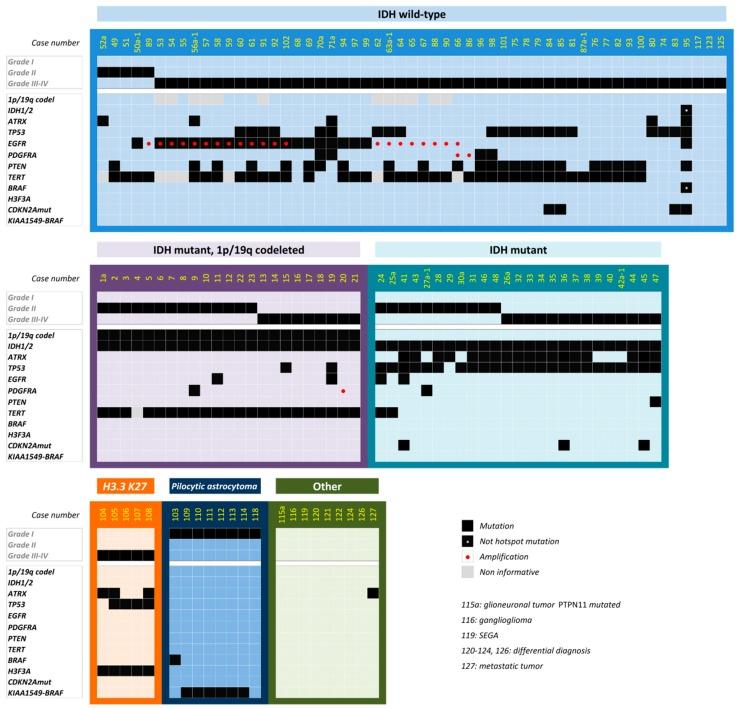
The updated 2016 World Health Organization (WHO) classification system for gliomas integrates molecular alterations and histology to provide a greater diagnostic and prognostic utility than the previous, histology-based classification. The increasing number of markers that are tested in a correct diagnostic procedure makes gene-targeted, next-generation sequencing (NGS) a powerful tool in routine pathology practice. We designed a 14-gene NGS panel specifically aimed at the diagnosis of glioma, which allows simultaneous detection of mutations and copy number variations, including the 1p/19q-codeletion and Epidermal Growth Factor Receptor () amplification. To validate this panel, we used reference mutated DNAs, nontumor and non-glioma samples, and 52 glioma samples that were previously characterized. The panel was then prospectively applied to 91 brain lesions. A specificity of 100% and sensitivity of 99.4% was achieved for mutation detection. Orthogonal methods, such as in situ hybridization and immunohistochemical techniques, were used for validation, which showed high concordance. The molecular alterations that were identified allowed diagnosis according to the updated WHO criteria, and helped in the differential diagnosis of difficult cases. This NGS panel is an accurate and sensitive method, which could replace multiple tests for the same sample. Moreover, it is a rapid and cost-effective approach that can be easily implemented in the routine diagnosis of gliomas.
2016年更新的世界卫生组织(WHO)胶质瘤分类系统整合了分子改变和组织学特征,相比之前基于组织学的分类系统,具有更高的诊断和预后价值。在正确的诊断流程中检测的标志物数量不断增加,使得基因靶向的新一代测序(NGS)成为常规病理学实践中的有力工具。我们设计了一个专门用于胶质瘤诊断的14基因NGS检测板,它能够同时检测突变和拷贝数变异,包括1p/19q共缺失和表皮生长因子受体(EGFR)扩增。为了验证该检测板,我们使用了参考突变DNA、非肿瘤和非胶质瘤样本以及52个先前已进行特征分析的胶质瘤样本。然后将该检测板前瞻性地应用于91个脑病变样本。在突变检测方面,实现了100%的特异性和99.4%的敏感性。采用原位杂交和免疫组化技术等正交方法进行验证,结果显示一致性很高。所识别的分子改变能够根据更新后的WHO标准进行诊断,并有助于对疑难病例进行鉴别诊断。这个NGS检测板是一种准确且灵敏的方法,可以替代对同一样本进行的多项检测。此外,它是一种快速且经济高效的方法,能够轻松应用于胶质瘤的常规诊断。

 Zotero 插件