
在 FRAME 关键性试验及其扩展研究的日本亚组中,与安慰剂相比,罗莫佐单抗治疗 1 年可增加骨密度,随后用地舒单抗治疗 2 年。
Increased bone mineral density for 1 year of romosozumab, vs placebo, followed by 2 years of denosumab in the Japanese subgroup of the pivotal FRAME trial and extension.
机构信息
Miyauchi Medical Center, Osaka, Japan.
Amgen Inc., Thousand Oaks, CA, USA.
出版信息
Arch Osteoporos. 2019 Jun 5;14(1):59. doi: 10.1007/s11657-019-0608-z.
UNLABELLED
Romosozumab, which binds sclerostin, rebuilds the skeletal foundation before transitioning to antiresorptive treatment. This subgroup analysis of an international, randomized, double-blind study in postmenopausal women with osteoporosis showed efficacy and safety outcomes for romosozumab followed by denosumab in Japanese women were generally consistent with those for the overall population.
PURPOSE
In the international, randomized, double-blind, phase 3 FRActure study, in postmenopausal woMen with ostEoporosis (FRAME; NCT01575834), romosozumab followed by denosumab significantly improved bone mineral density (BMD) and reduced fracture risk. This report evaluates Japanese women in FRAME.
METHODS
Postmenopausal women with osteoporosis (T-score - 3.5 to - 2.5 at total hip or femoral neck) received romosozumab 210 mg or placebo subcutaneously monthly for 12 months, then each group received denosumab 60 mg subcutaneously every 6 months for 24 months. The key endpoint for Japanese women was BMD change. Other endpoints included new vertebral, clinical, and nonvertebral fracture; the subgroup analysis did not have adequate power to demonstrate statistically significant reductions.
RESULTS
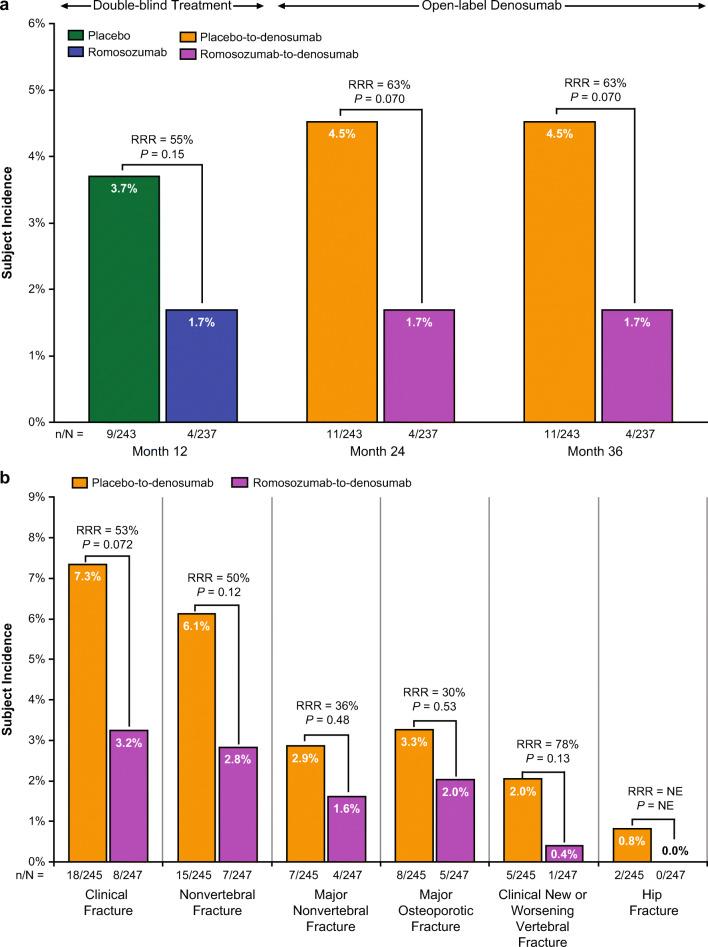
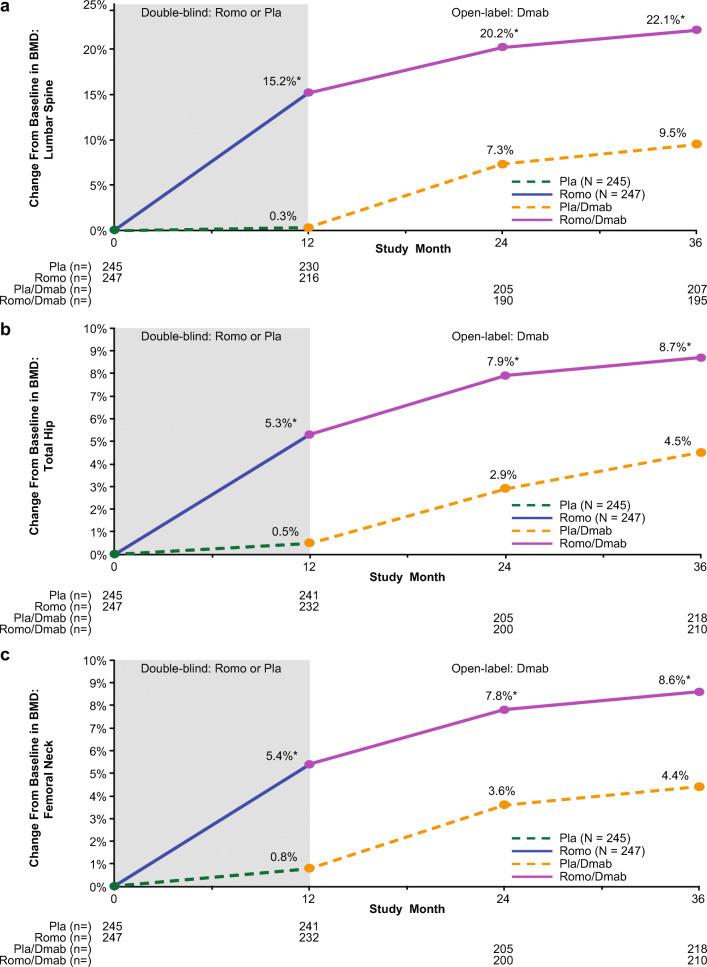
Of 7180 enrolled subjects, 492 (6.9%) were Japanese (247 romosozumab, 245 placebo). BMD increases from baseline were greater (P < 0.001) for romosozumab-to-denosumab than placebo-to-denosumab at the lumbar spine (36 months, 12.7%), total hip (4.2%), and femoral neck (4.1%). Fracture risk was lower through 36 months for romosozumab-to-denosumab vs placebo-to-denosumab for new vertebral (1.7% vs 4.5%; relative risk reduction (RRR) 63%, P = 0.070), clinical (3.2% vs 7.3%; RRR 53%, P = 0.072), nonvertebral (2.8% vs 6.1%; RRR 50%, P = 0.12), and all other fracture types evaluated. Rates of adverse events and positively adjudicated serious cardiovascular events were generally balanced between groups.
CONCLUSIONS
Efficacy and safety for romosozumab-to-denosumab were similar between Japanese women and the overall population. The sequence of romosozumab to rebuild the skeletal foundation before transitioning to antiresorptive treatment with denosumab is a promising regimen for Japanese postmenopausal women with osteoporosis at high risk of fracture.
目的
在国际、随机、双盲、3 期 FRActure 研究中,绝经后骨质疏松症妇女(FRAME;NCT01575834)中,罗莫佐单抗序贯地舒单抗显著改善了骨密度(BMD)并降低了骨折风险。本报告评估了 FRAME 中的日本女性。
方法
骨质疏松症绝经后妇女(全髋或股骨颈 T 评分-3.5 至-2.5)接受罗莫佐单抗 210mg 或安慰剂皮下每月 1 次共 12 个月,然后每组接受地舒单抗 60mg 皮下每 6 个月 1 次共 24 个月。日本女性的主要终点是 BMD 变化。其他终点包括新发椎体、临床和非椎体骨折;亚组分析没有足够的效力证明统计学意义上的降低。
结果
在 7180 名入组受试者中,492 名(6.9%)为日本女性(罗莫佐单抗 247 名,安慰剂 245 名)。与安慰剂序贯地舒单抗相比,罗莫佐单抗序贯地舒单抗在腰椎(36 个月,12.7%)、全髋(4.2%)和股骨颈(4.1%)的 BMD 增加更大(P<0.001)。与安慰剂序贯地舒单抗相比,罗莫佐单抗序贯地舒单抗在 36 个月时新发椎体(1.7% vs. 4.5%;相对风险降低(RRR)63%,P=0.070)、临床(3.2% vs. 7.3%;RRR 53%,P=0.072)、非椎体(2.8% vs. 6.1%;RRR 50%,P=0.12)和所有其他评估的骨折类型的骨折风险均较低。不良事件和阳性裁决的严重心血管事件的发生率在两组之间基本平衡。
结论
罗莫佐单抗序贯地舒单抗在日本女性和总体人群中的疗效和安全性相似。罗莫佐单抗序贯重建骨骼基础,然后序贯使用地舒单抗进行抗吸收治疗,这是一种有前途的方案,适用于日本绝经后骨质疏松症、骨折风险高的女性。

 Zotero 插件