
频繁更换医生并寻求处方类阿片类药物与高危使用的可能性增加相关。
Doctor hopping and doctor shopping for prescription opioids associated with increased odds of high-risk use.
机构信息
Department of Environmental and Occupational Health, University of Arkansas for Medical Sciences College of Public Health, Little Rock, AR, USA.
Health Services Research and Development Center for Mental Healthcare and Outcomes Research, Central Arkansas Veterans Healthcare System, Little Rock, AR, USA.
出版信息
Pharmacoepidemiol Drug Saf. 2019 Aug;28(8):1117-1124. doi: 10.1002/pds.4838. Epub 2019 Jun 5.
PURPOSE
Early detection of risky behaviors involving prescription opioids can assist prescribers in implementing safer prescribing. Patient-to-prescriber travel patterns may indicate potential opioid misuse. We introduce doctor hopping, patients bypassing nearby prescribers in favor of more distant ones, as a new spatial estimation of potentially risky behavior, and compare with traditional doctor shopping metrics.
METHODS
We examined all filled opioid prescriptions between 2015 and 2016 from the Arkansas Prescription Drug Monitoring Program. We calculated patient-to-prescriber travel times and number of prescribers bypassed for each prescription, adjusted for payment method. Opioid recipients traveling further than the nearest urban area and bypassing more prescribers than 99% of other recipients from the same zip code were identified as doctor hoppers. We calculated odds ratios to evaluate how doctor hopping and doctor shopping correspond to high-risk opioid uses.
RESULTS
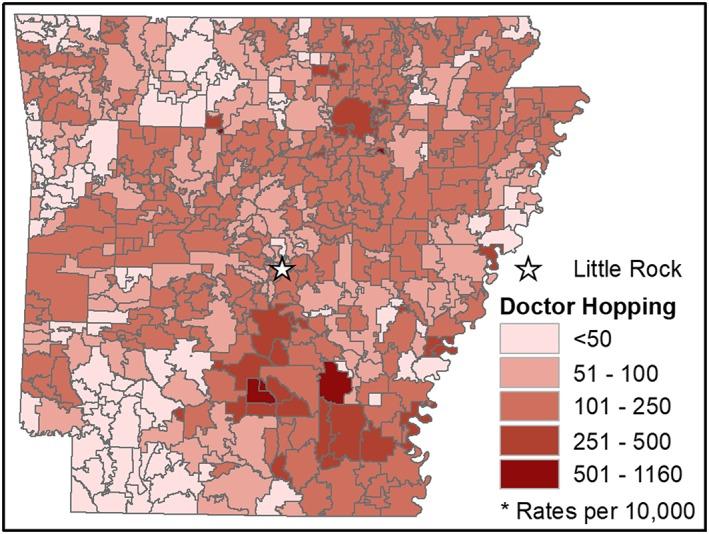
Approximately 0.72% of all opioid recipients in Arkansas engaged in doctor hopping two or more times during the study period. Rates of doctor hopping varied spatially but were more common in rural areas. Doctor shopping was more common in urban areas. Both hopping and shopping were significantly associated with higher odds of engaging in high-risk opioid use. The combination of doctor hopping and doctor shopping metrics can predict high-risk use better than either metric alone and may allow for earlier detection than doctor shopping alone.
CONCLUSIONS
Doctor hopping is positively associated with high-risk opioid use and is distinct from and complementary to doctor shopping. We recommend Prescription Drug Monitoring Program (PDMP) vendors incorporate similar spatial analyses into their systems.
目的
早期发现涉及处方类阿片的危险行为可以帮助医生更安全地进行处方。患者到医生的出行模式可能表明存在潜在的阿片类药物滥用风险。我们提出“医生跳转”(doctor hopping)这一概念,即患者绕过附近的医生,转而选择更远的医生,作为一种新的潜在危险行为的空间评估方法,并与传统的“医生购物”(doctor shopping)指标进行比较。
方法
我们研究了 2015 年至 2016 年期间阿肯色州处方药物监测计划中所有已开具的阿片类药物处方。我们计算了每个处方的患者到医生的出行时间和绕过的医生数量,并根据支付方式进行了调整。对于每个处方,我们定义那些出行距离超过最近城区的患者和那些绕过的医生数量超过同邮政编码 99%的其他患者的患者为“医生跳转”者。我们计算了比值比(odds ratios)来评估“医生跳转”和“医生购物”与高风险阿片类药物使用的对应关系。
结果
在研究期间,阿肯色州约有 0.72%的阿片类药物受者存在两次或两次以上的“医生跳转”行为。“医生跳转”的发生率存在空间差异,但在农村地区更为常见。而“医生购物”在城市地区更为常见。“医生跳转”和“医生购物”都与更高的高风险阿片类药物使用的可能性显著相关。“医生跳转”和“医生购物”指标的结合可以比单独使用任何一个指标更好地预测高风险使用,并且可能比单独使用“医生购物”更早发现。
结论
“医生跳转”与高风险阿片类药物使用呈正相关,与“医生购物”不同且互补。我们建议处方药物监测计划(PDMP)供应商在其系统中纳入类似的空间分析。

 Zotero 插件