
社区获得性临床 中 Panton-Valentine 白细胞毒素 (PVL) 和抗生素耐药性的流行情况:一项为期 11 年的城市冈比亚医院回顾性试点研究。
Prevalence of Panton-Valentine Leukocidin (PVL) and Antimicrobial Resistance in Community-Acquired Clinical in an Urban Gambian Hospital: A 11-Year Period Retrospective Pilot Study.
机构信息
Medical Research Council Unit The Gambia at London School of Hygiene & Tropical Medicine, Banjul, Gambia.
Environmental Protection Agency, Washington, DC, United States.
出版信息
Front Cell Infect Microbiol. 2019 May 22;9:170. doi: 10.3389/fcimb.2019.00170. eCollection 2019.
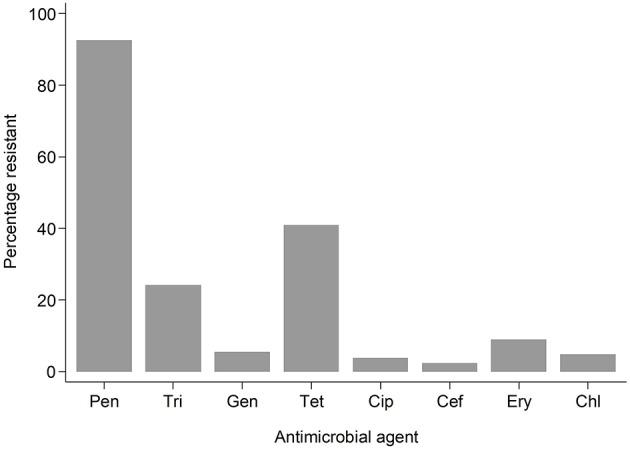
is a major human pathogen. Panton-Valentine leukocidin (PVL) is a virulence factor produced by some strains that causes leukocyte lysis and tissue necrosis. PVL-associated (PVL-SA) predominantly causes skin and soft-tissue infections (SSTIs) but can also cause invasive infections such as necrotizing pneumonia. It is carried by both community-associated methicillin susceptible (CA-MSSA) and methicillin resistant (CA-MRSA). This study aims to determine the prevalence of PVL-SA among patients seen at an urban Gambian hospital and associated antibiotic resistance. Archived clinical (70 invasive bacteraemia and 223 non-invasive SSTIs) from 293 patients were retrieved as well as relevant data from clinical records where available. Antibiotic susceptibility was assessed using disc diffusion according to Clinical Laboratory Standards Institute (CLSI) guidelines. Genomic DNA was extracted and the presence of lukF and lukS PVL genes was detected by conventional gel-based PCR. PVL-SA strains accounted for 61.4% (180/293) of isolates. PVL prevalence was high in both Gambian bacteraemia and SSTIs strains. Antimicrobial resistance was low and included chloramphenicol (4.8%), cefoxitin (2.4%), ciprofloxacin (3.8%), erythromycin (8.9%), gentamicin (5.5%) penicillin (92.5%), tetracycline (41.0%), and sulfamethoxazole-trimethoprim (24.2%). There was no association of PVL with antimicrobial resistance. PVL expression is high among clinical strains among Gambian patients. Reporting of PVL-SA clinical infections is necessary to enable the monitoring of the clinical impact of these strains in the population and guide prevention of the spread of virulent PVL-positive CA-MRSA strains. () is a major human pathogen with several virulence factors. We performed a retrospective analysis to investigate the prevalence of one such virulence factor (PVL) amongst clinical samples. We found a high prevalence in our setting but antimicrobial resistance including methicillin resistance was low.
是一种主要的人类病原体。Panton-Valentine 白细胞毒素 (PVL) 是某些菌株产生的一种毒力因子,可导致白细胞溶解和组织坏死。与 PVL 相关的金黄色葡萄球菌 (PVL-SA) 主要引起皮肤和软组织感染 (SSTIs),但也可引起侵袭性感染,如坏死性肺炎。它存在于社区相关的甲氧西林敏感金黄色葡萄球菌 (CA-MSSA) 和耐甲氧西林金黄色葡萄球菌 (CA-MRSA) 中。本研究旨在确定冈比亚一家城市医院就诊患者中 PVL-SA 的流行情况及其相关的抗生素耐药性。从 293 名患者中检索了存档的临床资料 (70 例侵袭性菌血症和 223 例非侵袭性 SSTIs),以及临床记录中可用的相关数据。根据临床实验室标准化研究所 (CLSI) 指南,使用纸片扩散法评估抗生素敏感性。提取基因组 DNA,通过常规凝胶电泳 PCR 检测 lukF 和 lukS PVL 基因的存在。PVL-SA 菌株占 293 株分离株的 61.4%(180/293)。PVL 在冈比亚菌血症和 SSTIs 菌株中的流行率都很高。抗生素耐药性低,包括氯霉素 (4.8%)、头孢西丁 (2.4%)、环丙沙星 (3.8%)、红霉素 (8.9%)、庆大霉素 (5.5%)、青霉素 (92.5%)、四环素 (41.0%)和磺胺甲噁唑-甲氧苄啶 (24.2%)。PVL 与抗生素耐药性无关。在冈比亚患者的临床分离株中,PVL 表达水平很高。报告 PVL-SA 临床感染对于监测这些菌株在人群中的临床影响并指导预防毒力较强的 PVL 阳性 CA-MRSA 菌株传播非常必要。() 是一种主要的人类病原体,具有多种毒力因子。我们进行了一项回顾性分析,以调查一种此类毒力因子 (PVL) 在临床分离株中的流行情况。我们在研究环境中发现了高流行率,但包括耐甲氧西林在内的抗生素耐药率较低。


 Zotero 插件