
表面声波泳动的频率依赖性。
Frequency dependence of surface acoustic wave swimming.
机构信息
1 College of Engineering, Mathematics and Physical Sciences, University of Exeter , Exeter EX4 4QF , UK.
2 Natural Sciences, University of Exeter , Exeter, EX4 4QF , UK.
出版信息
J R Soc Interface. 2019 Jun 28;16(155):20190113. doi: 10.1098/rsif.2019.0113. Epub 2019 Jun 19.
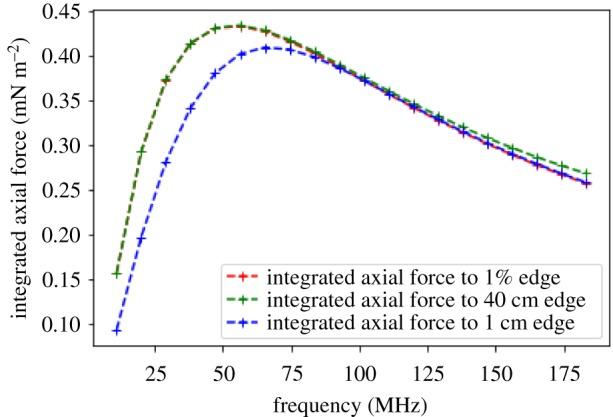
Surface acoustic waves (SAWs) are elastic waves that can be excited directly on the surface of piezoelectric crystals using a transducer, leading to their exploitation for numerous technological applications, including for example microfluidics. Recently, the concept of SAW streaming, which underpins SAW microfluidics, was extended to make the first experimental demonstration of 'SAW swimming', where instead of moving water droplets on the surface of a device, SAWs are used as a propulsion mechanism. Using theoretical analysis and experiments, we show that the SAW swimming force can be controlled directly by changing the SAW frequency, due to attenuation and changing force distributions within each SAW streaming jet. Additionally, an optimum frequency exists which generates a maximum SAW swimming force. The SAW frequency can therefore be used to control the efficiency and forward force of these SAW swimming devices. The SAW swimming propulsion mechanism also mimics that used by many microorganisms, where propulsion is produced by a cyclic distortion of the body shape. This improved understanding of SAW swimming provides a test-bed for exploring the science of microorganism swimming, and could bring new insight to the evolutionary significance for the length and beating frequency of swimming microbial flagella.
表面声波(SAWs)是弹性波,可以通过换能器直接在压电晶体表面激发,从而被广泛应用于各种技术领域,例如微流控技术。最近,表面声波流的概念得到了扩展,使其首次在实验中展示了“表面声波游动”,即用表面声波作为推进机制来移动设备表面的液滴,而不是移动水。通过理论分析和实验,我们发现,由于每个表面声波流射流内的衰减和力分布的变化,表面声波游动的力可以通过改变表面声波的频率来直接控制。此外,存在一个最佳频率,可以产生最大的表面声波游动力。因此,表面声波的频率可以用来控制这些表面声波游动器件的效率和前进力。表面声波游动的推进机制也模拟了许多微生物所使用的推进机制,即通过周期性地改变身体形状来产生推进力。对表面声波游动的这种深入了解为探索微生物游动的科学提供了一个试验台,并为微生物游动的生物进化意义,即游动微生物鞭毛的长度和拍打频率,提供了新的见解。

 Zotero 插件