
诱导多能干细胞衍生的肥厚型心肌病患者心肌细胞舒张功能障碍建模。
Modelling diastolic dysfunction in induced pluripotent stem cell-derived cardiomyocytes from hypertrophic cardiomyopathy patients.
机构信息
Stanford Cardiovascular Institute, Stanford University School of Medicine, 265 Campus Drive, Stanford, CA, USA.
Division of Cardiology, Department of Medicine, Stanford University School of Medicine, Stanford, CA, USA.
出版信息
Eur Heart J. 2019 Dec 1;40(45):3685-3695. doi: 10.1093/eurheartj/ehz326.
AIMS
Diastolic dysfunction (DD) is common among hypertrophic cardiomyopathy (HCM) patients, causing major morbidity and mortality. However, its cellular mechanisms are not fully understood, and presently there is no effective treatment. Patient-specific induced pluripotent stem cell-derived cardiomyocytes (iPSC-CMs) hold great potential for investigating the mechanisms underlying DD in HCM and as a platform for drug discovery.
METHODS AND RESULTS
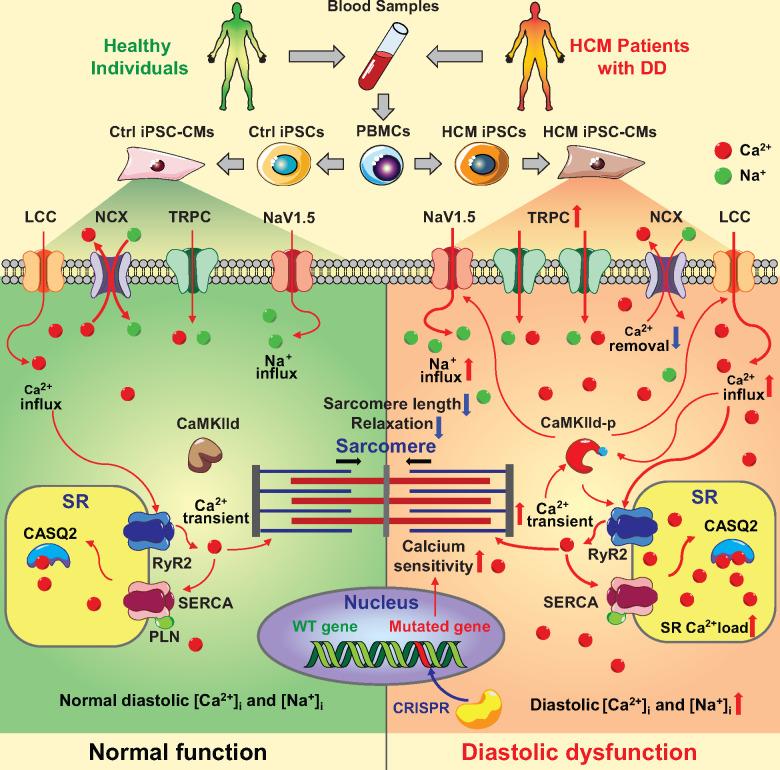
In the present study, beating iPSC-CMs were generated from healthy controls and HCM patients with DD. Micropatterned iPSC-CMs from HCM patients showed impaired diastolic function, as evidenced by prolonged relaxation time, decreased relaxation rate, and shortened diastolic sarcomere length. Ratiometric Ca2+ imaging indicated elevated diastolic [Ca2+]i and abnormal Ca2+ handling in HCM iPSC-CMs, which were exacerbated by β-adrenergic challenge. Combining Ca2+ imaging and traction force microscopy, we observed enhanced myofilament Ca2+ sensitivity (measured as dF/Δ[Ca2+]i) in HCM iPSC-CMs. These results were confirmed with genome-edited isogenic iPSC lines that carry HCM mutations, indicating that cytosolic diastolic Ca2+ overload, slowed [Ca2+]i recycling, and increased myofilament Ca2+ sensitivity, collectively impairing the relaxation of HCM iPSC-CMs. Treatment with partial blockade of Ca2+ or late Na+ current reset diastolic Ca2+ homeostasis, restored diastolic function, and improved long-term survival, suggesting that disturbed Ca2+ signalling is an important cellular pathological mechanism of DD. Further investigation showed increased expression of L-type Ca2+channel (LTCC) and transient receptor potential cation channels (TRPC) in HCM iPSC-CMs compared with control iPSC-CMs, which likely contributed to diastolic [Ca2+]i overload.
CONCLUSION
In summary, this study recapitulated DD in HCM at the single-cell level, and revealed novel cellular mechanisms and potential therapeutic targets of DD using iPSC-CMs.
目的
舒张功能障碍(DD)在肥厚型心肌病(HCM)患者中很常见,导致了较高的发病率和死亡率。然而,其细胞机制尚未完全阐明,目前也没有有效的治疗方法。患者特异性诱导多能干细胞衍生的心肌细胞(iPSC-CMs)在研究 HCM 中 DD 的发病机制以及作为药物发现平台方面具有巨大潜力。
方法和结果
本研究中,从健康对照者和伴有 DD 的 HCM 患者中生成了搏动的 iPSC-CMs。HCM 患者的微图案化 iPSC-CMs 表现出舒张功能障碍,表现在舒张时间延长、舒张速率降低和舒张时的肌节长度缩短。比率钙成像表明 HCM iPSC-CMs 中的舒张 [Ca2+]i 升高和 Ca2+ 处理异常,β-肾上腺素能刺激可使这些异常进一步加重。结合钙成像和牵引力显微镜,我们观察到 HCM iPSC-CMs 中的肌球蛋白丝 Ca2+ 敏感性增强(以 dF/Δ[Ca2+]i 衡量)。这些结果通过携带 HCM 突变的基因组编辑同基因 iPSC 系得到了证实,表明细胞质舒张 Ca2+ 过载、[Ca2+]i 再循环减慢以及肌球蛋白丝 Ca2+ 敏感性增加,共同损害了 HCM iPSC-CMs 的舒张功能。用 Ca2+ 部分阻断或晚期 Na+ 电流阻滞治疗可重置舒张 Ca2+ 稳态,恢复舒张功能并提高长期存活率,这表明紊乱的 Ca2+ 信号是 DD 的一个重要细胞病理机制。进一步的研究表明,与对照 iPSC-CMs 相比,HCM iPSC-CMs 中 L 型 Ca2+通道(LTCC)和瞬时受体电位阳离子通道(TRPC)的表达增加,这可能导致舒张 [Ca2+]i 过载。
结论
综上所述,本研究在单细胞水平再现了 HCM 中的 DD,并通过 iPSC-CMs 揭示了 DD 的新的细胞机制和潜在治疗靶点。
 Zotero 插件