
体力活动轨迹与死亡率:基于人群的队列研究。
Physical activity trajectories and mortality: population based cohort study.
机构信息
MRC Epidemiology Unit, University of Cambridge, School of Clinical Medicine, Box 285 Institute of Metabolic Science, Cambridge Biomedical Campus, Cambridge CB2 0QQ, UK.
Department of Public Health and Primary Care, University of Cambridge, School of Clinical Medicine, Cambridge Biomedical Campus, Cambridge, UK.
出版信息
BMJ. 2019 Jun 26;365:l2323. doi: 10.1136/bmj.l2323.
OBJECTIVE
To assess the prospective associations of baseline and long term trajectories of physical activity on mortality from all causes, cardiovascular disease, and cancer.
DESIGN
Population based cohort study.
SETTING
Adults from the general population in the UK.
PARTICIPANTS
14 599 men and women (aged 40 to 79) from the European Prospective Investigation into Cancer and Nutrition-Norfolk cohort, assessed at baseline (1993 to 1997) up to 2004 for lifestyle and other risk factors; then followed to 2016 for mortality (median of 12.5 years of follow-up, after the last exposure assessment).
MAIN EXPOSURE
Physical activity energy expenditure (PAEE) derived from questionnaires, calibrated against combined movement and heart rate monitoring.
MAIN OUTCOME MEASURES
Mortality from all causes, cardiovascular disease, and cancer. Multivariable proportional hazards regression models were adjusted for age, sex, sociodemographics, and changes in medical history, overall diet quality, body mass index, blood pressure, triglycerides, and cholesterol levels.
RESULTS
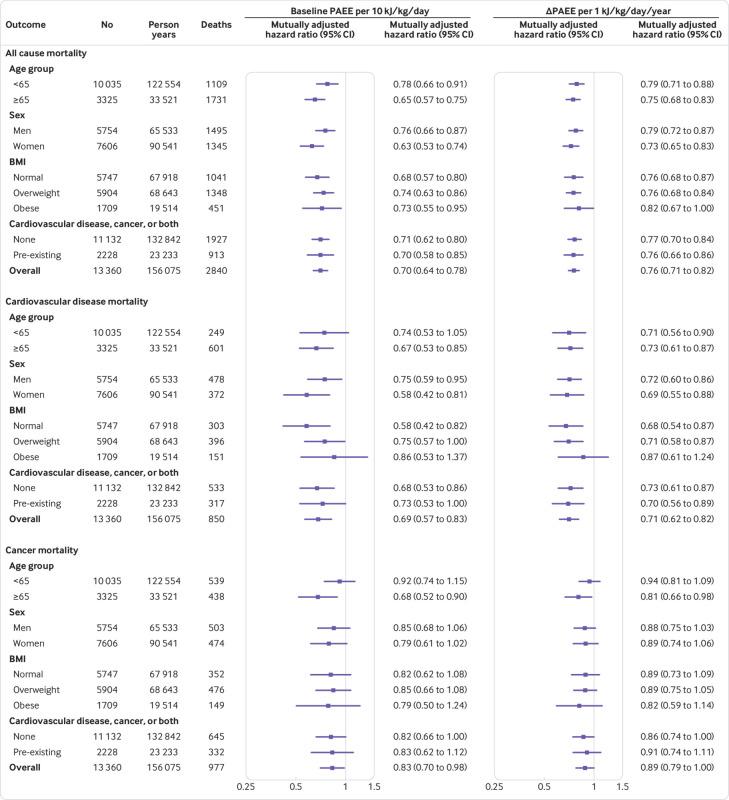
During 171 277 person years of follow-up, 3148 deaths occurred. Long term increases in PAEE were inversely associated with mortality, independent of baseline PAEE. For each 1 kJ/kg/day per year increase in PAEE (equivalent to a trajectory of being inactive at baseline and gradually, over five years, meeting the World Health Organization minimum physical activity guidelines of 150 minutes/week of moderate-intensity physical activity), hazard ratios were: 0.76 (95% confidence interval 0.71 to 0.82) for all cause mortality, 0.71 (0.62 to 0.82) for cardiovascular disease mortality, and 0.89 (0.79 to 0.99) for cancer mortality, adjusted for baseline PAEE, and established risk factors. Similar results were observed when analyses were stratified by medical history of cardiovascular disease and cancer. Joint analyses with baseline and trajectories of physical activity show that, compared with consistently inactive individuals, those with increasing physical activity trajectories over time experienced lower risks of mortality from all causes, with hazard ratios of 0.76 (0.65 to 0.88), 0.62 (0.53 to 0.72), and 0.58 (0.43 to 0.78) at low, medium, and high baseline physical activity, respectively. At the population level, meeting and maintaining at least the minimum physical activity recommendations would potentially prevent 46% of deaths associated with physical inactivity.
CONCLUSIONS
Middle aged and older adults, including those with cardiovascular disease and cancer, can gain substantial longevity benefits by becoming more physically active, irrespective of past physical activity levels and established risk factors. Considerable population health impacts can be attained with consistent engagement in physical activity during mid to late life.
目的
评估基线和长期体力活动轨迹与全因、心血管疾病和癌症死亡率的前瞻性关联。
设计
基于人群的队列研究。
地点
英国的一般人群中的成年人。
参与者
来自欧洲癌症与营养前瞻性调查-诺福克队列的 14599 名男性和女性(年龄 40 至 79 岁),在基线(1993 年至 1997 年)时评估生活方式和其他危险因素;然后随访至 2016 年以了解死亡率(中位随访 12.5 年,在最后一次暴露评估后)。
主要暴露
体力活动能量消耗(PAEE)来自问卷,经联合运动和心率监测校准。
主要结局测量
全因、心血管疾病和癌症死亡率。多变量比例风险回归模型调整了年龄、性别、社会人口统计学因素以及医疗史、整体饮食质量、体重指数、血压、甘油三酯和胆固醇水平的变化。
结果
在 171277 人年的随访期间,发生了 3148 例死亡。PAEE 的长期增加与死亡率呈负相关,独立于基线 PAEE。对于 PAEE 每年每公斤体重增加 1 kJ/kg/天(相当于基线时不活动,然后在五年内逐渐达到世界卫生组织每周 150 分钟中等强度体力活动的最低体力活动指南),风险比为:全因死亡率为 0.76(95%置信区间 0.71 至 0.82),心血管疾病死亡率为 0.71(0.62 至 0.82),癌症死亡率为 0.89(0.79 至 0.99),调整了基线 PAEE 和已确立的风险因素。当按心血管疾病和癌症的医疗史进行分层分析时,也观察到了类似的结果。与基线和体力活动轨迹的联合分析表明,与持续不活动的个体相比,随着时间的推移体力活动轨迹增加的个体全因死亡率风险较低,风险比分别为 0.76(0.65 至 0.88)、0.62(0.53 至 0.72)和 0.58(0.43 至 0.78),基线体力活动水平分别为低、中、高。在人群层面上,达到并维持至少最低体力活动建议可能会预防 46%与体力活动不足相关的死亡。
结论
中年和老年人,包括患有心血管疾病和癌症的人,通过增加身体活动可以获得显著的长寿益处,而与过去的身体活动水平和已确立的风险因素无关。在中年至晚年持续参与身体活动可以实现相当大的人群健康影响。


 Zotero 插件