
感染中的疾病耐受。
Disease Tolerance in Infection.
机构信息
Department of Microbiology, Immunology and Cancer Biology and the Carter Immunology Center, University of Virginia School of Medicine, Charlottesville, VA, United States.
出版信息
Front Cell Infect Microbiol. 2019 Jun 6;9:185. doi: 10.3389/fcimb.2019.00185. eCollection 2019.
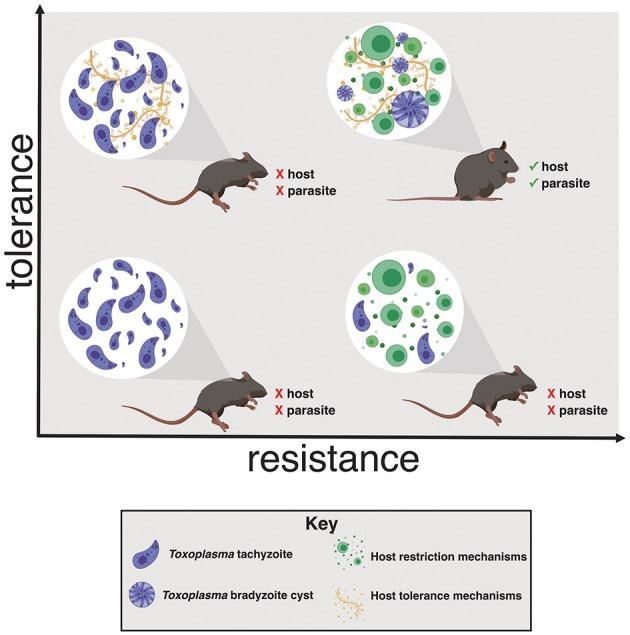
is a successful protozoan parasite that cycles between definitive felid hosts and a broad range of intermediate hosts, including rodents and humans. Within intermediate hosts, this obligate intracellular parasite invades the small intestine, inducing an inflammatory response. infects infiltrating immune cells, using them to spread systemically and reach tissues amenable to chronic infection. An intact immune system is necessary to control life-long chronic infection. Chronic infection is characterized by formation of parasite cysts, which are necessary for survival through the gastrointestinal tract of the next host. Thus, must evade sterilizing immunity, but still rely on the host's immune response for survival and transmission. To do this, exploits a central cost-benefit tradeoff in immunity: the need to escalate inflammation for pathogen clearance vs. the need to limit inflammation-induced bystander damage. What are the consequences of sustained inflammation on host biology? Many studies have focused on aspects of the immune response that directly target growth and survival, commonly referred to as "resistance mechanisms." However, it is becoming clear that a parallel arm of the immune response has evolved to mitigate damage caused by the parasite directly (for example, egress-induced cell death) or bystander damage due to the inflammatory response (for example, reactive nitrogen species, degranulation). These so-called "disease tolerance" mechanisms promote tissue function and host survival without directly targeting the pathogen. Here we review changes to host metabolism, tissue structure, and immune function that point to disease tolerance mechanisms during infection. We explore the impact tolerance programs have on the health of the host and parasite biology.
是一种成功的原生动物寄生虫,它在终末猫科宿主和广泛的中间宿主之间循环,包括啮齿动物和人类。在中间宿主中,这种专性细胞内寄生虫侵袭小肠,诱导炎症反应。 感染浸润的免疫细胞,利用它们在体内传播并到达适合慢性感染的组织。完整的免疫系统是控制终身慢性感染所必需的。慢性感染的特征是形成寄生虫包囊,这是通过下一个宿主的胃肠道存活所必需的。因此, 必须逃避杀菌性免疫,但仍依赖宿主的免疫反应来生存和传播。为此, 利用了免疫中的一个核心成本效益权衡:需要为清除病原体而加剧炎症与需要限制由炎症引起的旁观者损伤之间的平衡。持续的炎症对宿主生物学有什么影响?许多研究都集中在直接针对 生长和存活的免疫反应的各个方面,通常被称为“抵抗机制”。然而,现在越来越清楚的是,免疫反应的另一个平行分支已经进化,以减轻寄生虫直接引起的损伤(例如,出芽诱导的细胞死亡)或由炎症反应引起的旁观者损伤(例如,活性氮物种,脱粒)。这些所谓的“疾病耐受”机制在不直接针对病原体的情况下促进组织功能和宿主存活。在这里,我们回顾了宿主代谢、组织结构和免疫功能的变化,这些变化表明了 在感染过程中的疾病耐受机制。我们探讨了耐受方案对宿主健康和寄生虫生物学的影响。
 Zotero 插件