
血流感染患者的医院感染:毒力因子与临床特征。
Bloodstream Infections in Patients at a University Hospital: Virulence Factors and Clinical Characteristics.
机构信息
Laboratory of Clinical Microbiology, Department of Pathology, Clinical and Toxicological Analysis, Health Sciences Center, State University of Londrina, Londrina, Brazil.
Laboratory of Microbiology, Department of Microbiology, State University of Londrina, Londrina, Brazil.
出版信息
Front Cell Infect Microbiol. 2019 Jun 6;9:191. doi: 10.3389/fcimb.2019.00191. eCollection 2019.
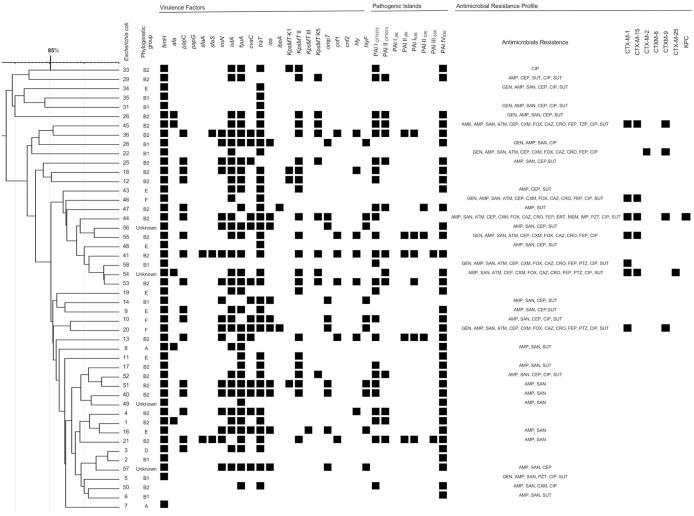
Extraintestinal pathogenic (ExPEC) isolates are responsible for many bloodstream infections. The aim of this study was to characterize isolated from the bloodstreams of patients ( = 48) at the University Hospital in Brazil. Epidemiological data were obtained through the analysis of medical records and laboratory tests. By PCR analysis, we investigated the presence of virulence factors (VFs), pathogenicity islands (PAIs), extended-spectrum β-lactamase (ESBL), phylogenetic classifications (A, B1, B2, C, D, E, and F) and molecular genotype by enterobacterial repetitive intergenic consensus-polymerase chain reaction (ERIC-PCR). The mortality analysis showed that 33.3% of the deaths were associated with bacteraemia due to infections; in addition, an age between 60 and 75 years ( < 0.001; OR = 6.3[2.1-18.9]) and bacteraemia with an abdominal origin ( = 0.02; OR = 5[1.2-20.5]) were risk factors for the severity of the infection. Additionally, the presence of the gene was associated with mortality due to bacteraemia ( = 0.027; OR = 11.4[1.5-85.7]). Immunosuppression (27.1%), intestinal diseases (25.0%) and diabetes (18.8%), were prevalent among patients, and most of the bacteraemia cases were secondary to urinary tract infections (50.0%). The serum resistance gene T was present in 77.1% of isolates, group capsular 2 ( II) was present in 45.8% and the K5 capsule was present in 20.8% of isolates. The isolates also showed a high prevalence for the siderophore yersiniabactina (A) (70.8%) and PAI IV (77.1%). Phylogenetic analysis showed that group B2 (45.8%) was the most prevalent, and was the phylogroup that had a higher prevalence of VFs and PAIs. However, in this study, a considerable number of isolated bacteria were classified as group B1 (18.8%) and as group E (14.6%). Eight (16.7%) isolates were resistant to third and fourth generation cephalosporin and group CTX-M-1 (CTX-M-15) was the most prevalent ESBL type. The molecular genotyping showed two clonal lineages and several isolates that were not related to each other. This study provides additional information on the epidemiological and molecular characteristics of bloodstream infections in Brazil.
肠外致病性(ExPEC)分离株是许多血流感染的原因。本研究的目的是描述巴西大学医院血流感染患者(n=48)中分离的 。通过分析病历和实验室检查获取流行病学数据。通过 PCR 分析,我们调查了毒力因子(VF)、致病性岛(PAI)、超广谱β-内酰胺酶(ESBL)、系统进化分类(A、B1、B2、C、D、E 和 F)和肠杆菌基因间重复一致性-聚合酶链反应(ERIC-PCR)的分子基因型的存在情况。死亡率分析显示,33.3%的死亡与 感染引起的菌血症有关;此外,年龄在 60 至 75 岁之间(<0.001;OR=6.3[2.1-18.9])和腹部来源的菌血症(=0.02;OR=5[1.2-20.5])是感染严重程度的危险因素。此外, 基因的存在与 菌血症引起的死亡率相关(=0.027;OR=11.4[1.5-85.7])。免疫抑制(27.1%)、肠道疾病(25.0%)和糖尿病(18.8%)在患者中较为常见,大多数菌血症病例继发于尿路感染(50.0%)。血清抗性基因 T 存在于 77.1%的分离株中,组 capsular 2(II)存在于 45.8%的分离株中,K5 荚膜存在于 20.8%的分离株中。分离株还表现出高铁载体耶尔森菌素 A(A)(70.8%)和 PAI IV(77.1%)的流行。系统发育分析显示,B2 组(45.8%)最为流行,是具有较高 VF 和 PAI 流行率的 phylogroup。然而,在这项研究中,相当数量的分离菌被归类为 B1 组(18.8%)和 E 组(14.6%)。8 株(16.7%)分离株对第三代和第四代头孢菌素耐药,CTX-M-1(CTX-M-15)是最流行的 ESBL 型。分子基因分型显示了两个克隆谱系和一些彼此之间没有关系的分离株。本研究提供了巴西血流感染的流行病学和分子特征的附加信息。
 Zotero 插件