
日粮中高浓度维生素 D3 对从出雏日至 68 周龄 W36 产蛋鸡生产性能、骨骼健康、蛋壳质量和蛋黄维生素 D3 含量的影响。
Effect of high concentrations of dietary vitamin D3 on pullet and laying hen performance, skeleton health, eggshell quality, and yolk vitamin D3 content when fed to W36 laying hens from day of hatch until 68 wk of age.
机构信息
Department of Animal and Poultry Science, Virginia Tech, Blacksburg, VA 24061, USA.
Prestage Department of Poultry Science, North Carolina State University, Raleigh, NC 27695, USA.
出版信息
Poult Sci. 2019 Dec 1;98(12):6713-6720. doi: 10.3382/ps/pez386.
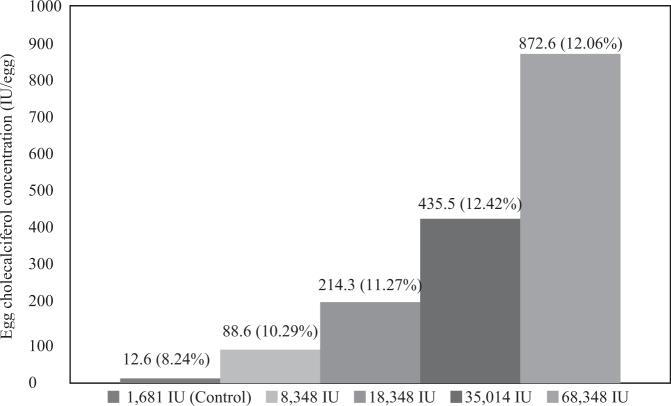
The objective of this experiment was to investigate the effects of various dietary concentrations of vitamin D3 (D3) on pullet and laying hen performance, eggshell quality, bone health, and yolk D3 content from day of hatch until 68 wk of age. Initially, 440 Hy-line W36-day-old chicks were randomly assigned to 5 dietary treatments: 1,681 (control); 8,348; 18,348; 35,014; 68,348 IU D3/kg. At 17 wk of age, pullets were assigned to experimental diets with 12 replicate groups of 6 birds. At 17 wk of age, pullets fed diets containing 8,348 and 35,014 IU D3/kg had an increased bone mineral density in comparison to the control fed birds (P ≤ 0.01). Body weights of pullets fed the diet with 68,348 IU D3/kg were lower than other treatments (P ≤ 0.01). Hen-housed egg production (HHEP) of hens fed the 35,014 IU D3/kg diet was increased in comparison to control-fed hens (P ≤ 0.01), whereas HHEP of those fed 68,348 IU D3/kg diet was reduced in comparison to all other treatments (P ≤ 0.01). Shell breaking strength of eggs from hens fed 8,348, 35,014 and 68,348 IU D3/kg was increased in comparison to eggs from control-fed birds (P ≤ 0.01). Fat-free tibia ash content of hens fed any of the diets supplemented with D3 (8,348 to 68,348 IU D3/kg) was increased in comparison to control-fed hens (P ≤ 0.05). Yolk D3 content increased linearly with dietary D3 and the D3 transfer efficiency for the control, 8,348 IU, 18,348 IU, 35,014 IU, and 68,348 IU D3 treatments were 8.24, 10.29, 11.27, 12.42, and 12.06%, respectively. These data suggest that supplementation of dietary D3 up to 35,014 IU D3/kg feed maintained if not increased laying hen performance and enhanced pullet and laying hen skeletal quality as well as yolk D3 content and eggshell quality. Feeding pullets at a higher level 68,348 IU of D3 resulted in reduced growth and ultimately decreased performance of laying hens.
本实验旨在研究不同维生素 D3(D3)日粮浓度对雏鸡和产蛋鸡生产性能、蛋壳质量、骨骼健康以及蛋黄 D3 含量的影响。研究选取 440 只海兰 36 日龄小鸡,随机分为 5 个日粮处理组:1681(对照组)、8348、18348、35014、68348IU D3/kg。17 周龄时,母鸡被分配到含有 12 个重复组每组 6 只鸡的实验组日粮中。17 周龄时,与对照组相比,饲喂 8348 和 35014IU D3/kg 日粮的母鸡骨矿物质密度增加(P≤0.01)。饲喂 68348IU D3/kg 日粮的母鸡体重低于其他处理组(P≤0.01)。饲喂 35014IU D3/kg 日粮母鸡的产蛋鸡产蛋率(HHEP)高于对照组母鸡(P≤0.01),而饲喂 68348IU D3/kg 日粮母鸡的产蛋率低于其他所有处理组(P≤0.01)。与对照组相比,饲喂 8348、35014 和 68348IU D3/kg 日粮母鸡的鸡蛋蛋壳破裂强度增加(P≤0.01)。与对照组相比,饲喂任何添加 D3(8348 至 68348IU D3/kg)日粮的母鸡的无脂胫骨灰分含量增加(P≤0.05)。母鸡蛋黄 D3 含量随日粮 D3 呈线性增加,对照组、8348IU、18348IU、35014IU 和 68348IU D3 处理组的 D3 转移效率分别为 8.24%、10.29%、11.27%、12.42%和 12.06%。这些数据表明,日粮中添加高达 35014IU D3/kg 的 D3 可以维持产蛋鸡的生产性能,如果不能提高,也可以提高母鸡和育成母鸡的骨骼质量,以及蛋黄 D3 含量和蛋壳质量。饲喂育成母鸡更高水平的 68348IU D3 会导致生长减少,最终导致产蛋母鸡的生产性能下降。
 Zotero 插件