
基于 16S rRNA 基因测序的益生菌和益生元对急性结肠炎小鼠肠道微生物群的影响。
Effects of probiotics and prebiotics on intestinal microbiota in mice with acute colitis based on 16S rRNA gene sequencing.
机构信息
Department of Gastroenterology, Peking Union Medical College Hospital, Peking Union Medical College, Chinese Academy of Medical Sciences, Beijing 100730, China.
National Cancer Center/Cancer Hospital, Peking Union Medical College, Chinese Academy of Medical Sciences, Beijing 100021, China.
出版信息
Chin Med J (Engl). 2019 Aug 5;132(15):1833-1842. doi: 10.1097/CM9.0000000000000308.
BACKGROUND
Imbalance of intestinal microbiota was closely related to colitis. Under these circumstances, regulation of enteric flora may be beneficial to the repair of inflammation. We aimed to investigate the effects of probiotics (Bifidobacterium and Lactobacillus), prebiotics and their combination on inflammation, and microflora in mice of acute colitis.
METHODS
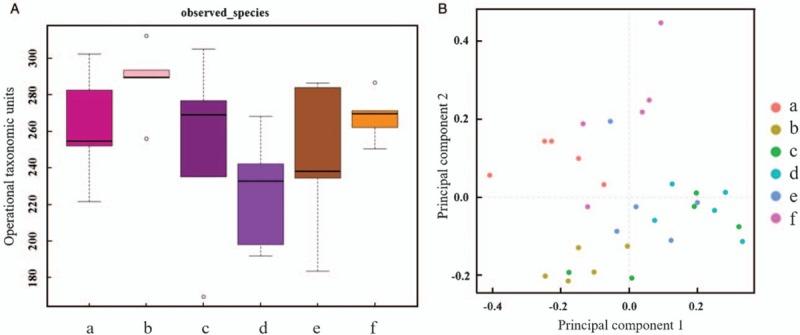
C57BL/6J mice were divided into six groups randomly (blank control group, model control group, probiotics group, synbiotics group, lactitol group and probiotics + lactitol group). Each group was given 2.5% dextran sulfate sodium drinking water for 5 days other than the blank control group. Except for the model control group, the other four groups were intervened with probiotics, synbiotics (probiotics and inulin), lactitol, and probiotics + lactitol. Mice were sacrificed after 1 week of gavage, and pathologic scores were calculated. The feces of different periods and intestinal mucosa samples were collected to analyze the differences of intestinal microbiota by 16S rRNA sequencing. Differences of two groups or multiple groups were statistically examined through unpaired Student t test and analysis of variance (ANOVA), respectively. ANOVA, Tukey, Anosim, and metastats analysis were used to compare differences of microbiota among different groups.
RESULTS
After gavage for 1 week, the pathologic scores of groups with the intervention were significantly lower than those in the model control group, and the difference was statistically significant (P < 0.05). The model control group was higher in the genus of Bacteroides (relative abundance: 0.3679 vs. 0.0099, P = 0.0016) and lower in Lactobacillus (relative abundance: 0.0020 vs. 0.0122, P = 0.0188), Roseburia (relative abundance: 0.0004 vs. 0.0109, P = 0.0157), compared with the blank control group. However, the same phenomenon was not found in groups gavaged with probiotics and lactitol. Compared with model control group, mice with intervention were increased with Bifidobacterium (relative abundance: 0.0172 vs. 0.0039, P = 0.0139), Lachnospiraceae_NK4A136_group (relative abundance: 0.1139 vs. 0.0320, P = 0.0344), Lachnospiraceae_UCG-006 (relative abundance: 0.0432 vs. 0.0054, P = 0.0454), and decreased with Alistipes (relative abundance: 0.0036 vs. 0.0105, P = 0.0207) in varying degrees. The mucosal flora was more abundant than the fecal flora, and genus of Mucispirillum (relative abundance: 0.0207 vs. 0.0001, P = 0.0034) was more common in the mucosa. Lactitol group showed higher level of Akkermansia than model control group (relative abundance: 0.0138 vs. 0.0055, P = 0.0415), probiotics group (relative abundance: 0.0138 vs. 0.0022, P = 0.0041), and synbiotics group (relative abundance: 0.0138 vs. 0.0011, P = 0.0034), while probiotics + lactitol group had more abundant Akkermansia than synbiotics group (relative abundance: 0.0215 vs. 0.0013, P = 0.0315).
CONCLUSIONS
Probiotics and prebiotics reduce the degree of inflammation in acute colitis mice obviously. Mice with acute colitis show reduced beneficial genera and increased harmful genera. Supplementation of probiotics and prebiotics display the advantage of increasing the proportion of helpful bacteria and regulating the balance of intestinal microbiota. Lactitol might promote the proliferation of Akkermansia.
背景
肠道微生物群失衡与结肠炎密切相关。在这种情况下,调节肠内菌群可能有利于炎症的修复。本研究旨在探讨益生菌(双歧杆菌和乳杆菌)、益生元和它们的组合对急性结肠炎小鼠炎症和微生物群的影响。
方法
将 C57BL/6J 小鼠随机分为六组(空白对照组、模型对照组、益生菌组、合生菌组、乳果糖组和益生菌+乳果糖组)。除空白对照组外,其余五组均给予 2.5%葡聚糖硫酸钠饮用水连续 5 天。除模型对照组外,其余四组分别用益生菌、合生菌(益生菌和菊粉)、乳果糖、益生菌+乳果糖进行干预。灌胃 1 周后处死小鼠,计算病理评分。收集不同时期的粪便和肠黏膜样本,通过 16S rRNA 测序分析肠道微生物群的差异。通过非配对学生 t 检验和方差分析(ANOVA)分别对两组或多组间的差异进行统计学检验。采用 ANOVA、Tukey、Anosim 和 metastats 分析比较不同组间微生物群的差异。
结果
灌胃 1 周后,干预组的病理评分明显低于模型对照组,差异有统计学意义(P<0.05)。模型对照组的拟杆菌属(相对丰度:0.3679 比 0.0099,P=0.0016)和乳杆菌属(相对丰度:0.0020 比 0.0122,P=0.0188)较高,罗斯伯里氏菌属(相对丰度:0.0004 比 0.0109,P=0.0157)较低,与空白对照组相比。然而,在给予益生菌和乳果糖的组中没有发现相同的现象。与模型对照组相比,干预组的双歧杆菌属(相对丰度:0.0172 比 0.0039,P=0.0139)、毛螺旋菌科 NK4A136 属(相对丰度:0.1139 比 0.0320,P=0.0344)、毛螺旋菌科 UCG-006(相对丰度:0.0432 比 0.0054,P=0.0454)增加,而 Alistipes 减少(相对丰度:0.0036 比 0.0105,P=0.0207)。黏膜菌群比粪便菌群更为丰富,黏膜中常见的微生物属为 Mucispirillum(相对丰度:0.0207 比 0.0001,P=0.0034)。乳果糖组的 Akkermansia 丰度高于模型对照组(相对丰度:0.0138 比 0.0055,P=0.0415)、益生菌组(相对丰度:0.0138 比 0.0022,P=0.0041)和合生菌组(相对丰度:0.0138 比 0.0011,P=0.0034),而益生菌+乳果糖组的 Akkermansia 丰度高于合生菌组(相对丰度:0.0215 比 0.0013,P=0.0315)。
结论
益生菌和益生元可明显减轻急性结肠炎小鼠的炎症程度。急性结肠炎小鼠有益菌减少,有害菌增加。补充益生菌和益生元可增加有益菌的比例,调节肠道微生物群的平衡。乳果糖可能促进 Akkermansia 的增殖。


 Zotero 插件