
人体成分:澳大利亚 11-12 岁儿童及其父母的人群流行病学和一致性。
Body composition: population epidemiology and concordance in Australian children aged 11-12 years and their parents.
机构信息
Murdoch Children's Research Institute, Parkville, Victoria, Australia.
Department of Paediatrics, The University of Melbourne, Parkville, Victoria, Australia.
出版信息
BMJ Open. 2019 Jul 4;9(Suppl 3):95-105. doi: 10.1136/bmjopen-2018-023698.
OBJECTIVES
Overweight and obesity remain at historically high levels, cluster within families and are established risk factors for multiple diseases. We describe the epidemiology and cross-generational concordance of body composition among Australian children aged 11-12 years and their parents.
DESIGN
The population-based cross-sectional Child Health CheckPoint study, nested within the Longitudinal Study of Australian Children (LSAC).
SETTING
Assessment centres in seven major Australian cities and eight regional cities, or home visits; February 2015-March 2016.
PARTICIPANTS
Of all participating CheckPoint families (n=1874), body composition data were available for 1872 children (49% girls) and 1852 parents (mean age 43.7 years; 88% mothers), including 1830 biological parent-child pairs.
MEASURES
Height, weight, body mass index (BMI), waist circumference and waist-to-height ratio for all participants; body fat and fat-free mass by four-limb bioimpedence analysis (BIA) at assessment centres, or body fat percentage by two-limb BIA at home visits. parent-child concordance was assessed using (i) Pearson's correlation coefficients, and (ii) partial correlation coefficients adjusted for age, sex and socioeconomic disadvantage. Survey weights and methods accounted for LSAC's complex sample design.
RESULTS
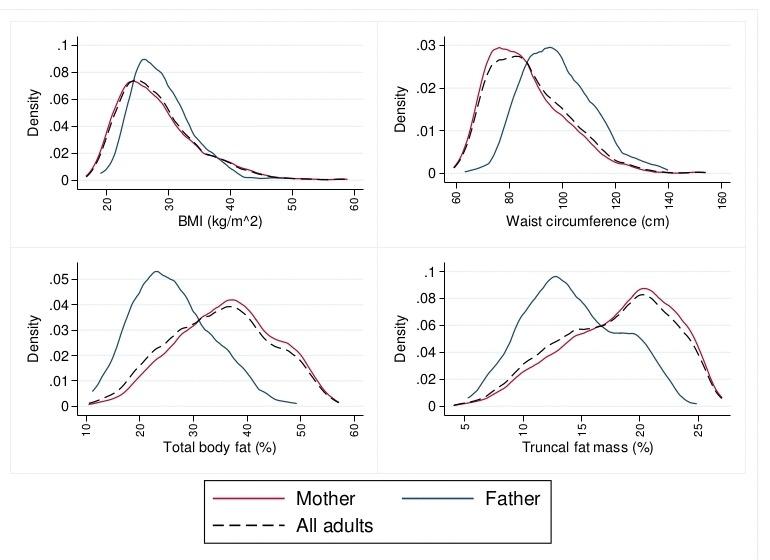
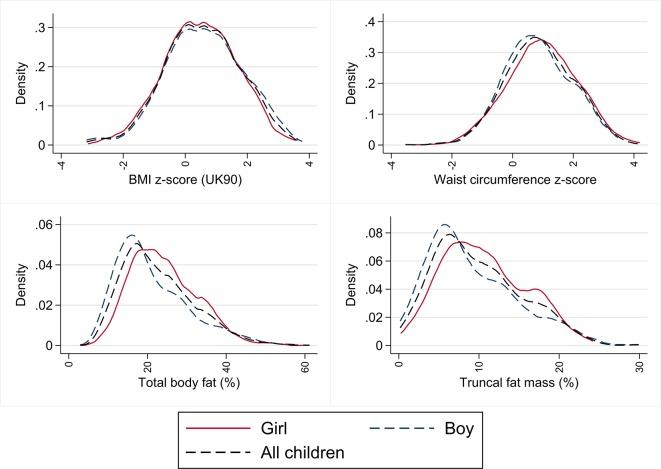
20.7% of children were overweight and 6.2% obese, as were 33.5% and 31.6% of parents. Boys and girls showed similar distributions for all body composition measures but, despite similar BMI and waist-to-height ratio, mothers had higher proportions of total and truncal fat than fathers. Parent-child partial correlations were greatest for height (0.37, 95% CI 0.33 to 0.42). Other anthropometric and fat/lean measures showed strikingly similar partial correlations, ranging from 0.25 (95% CI 0.20 to 0.29) for waist circumference to 0.30 (95% CI 0.25 to 0.34) for fat-free percentage. Whole-sample and sex-specific percentile values are provided for all measures.
CONCLUSIONS
Excess adiposity remains prevalent in Australian children and parents. Moderate cross-generational concordance across all measures of leanness and adiposity is already evident by late childhood.
目的
超重和肥胖仍处于历史高位,在家庭中聚集,并成为多种疾病的既定风险因素。我们描述了澳大利亚 11-12 岁儿童及其父母的身体成分的流行病学和跨代一致性。
设计
基于人群的横断面儿童健康检查点研究,嵌套在澳大利亚儿童纵向研究(LSAC)中。
地点
澳大利亚七个主要城市和八个区域城市的评估中心,或家庭访问;2015 年 2 月至 2016 年 3 月。
参与者
所有参与检查点的家庭(n=1874)中,有 1872 名儿童(49%为女孩)和 1852 名父母(平均年龄 43.7 岁;88%为母亲),包括 1830 对亲生父母-子女对,可获得身体成分数据。
措施
所有参与者的身高、体重、体重指数(BMI)、腰围和腰高比;评估中心的四肢生物阻抗分析(BIA)测量的体脂肪和去脂体重,或家庭访问时的 BIA 测量的体脂肪百分比。使用(i)皮尔逊相关系数和(ii)调整年龄、性别和社会经济劣势的偏相关系数评估父母-子女的一致性。调查权重和方法考虑了 LSAC 的复杂样本设计。
结果
20.7%的儿童超重,6.2%肥胖,父母中分别有 33.5%和 31.6%超重和肥胖。男孩和女孩在所有身体成分测量上都有相似的分布,但尽管 BMI 和腰高比相似,母亲的体脂和躯干脂肪比例仍高于父亲。身高的父母-子女偏相关系数最大(0.37,95%CI 0.33 至 0.42)。其他人体测量和脂肪/瘦肉测量的偏相关系数也非常相似,范围从腰围的 0.25(95%CI 0.20 至 0.29)到去脂百分比的 0.30(95%CI 0.25 至 0.34)。为所有测量指标提供了全样本和性别特异性百分位数值。
结论
超重和肥胖在澳大利亚儿童和父母中仍然很普遍。到童年后期,瘦体重和肥胖的所有指标都已经显示出适度的跨代一致性。

 Zotero 插件